

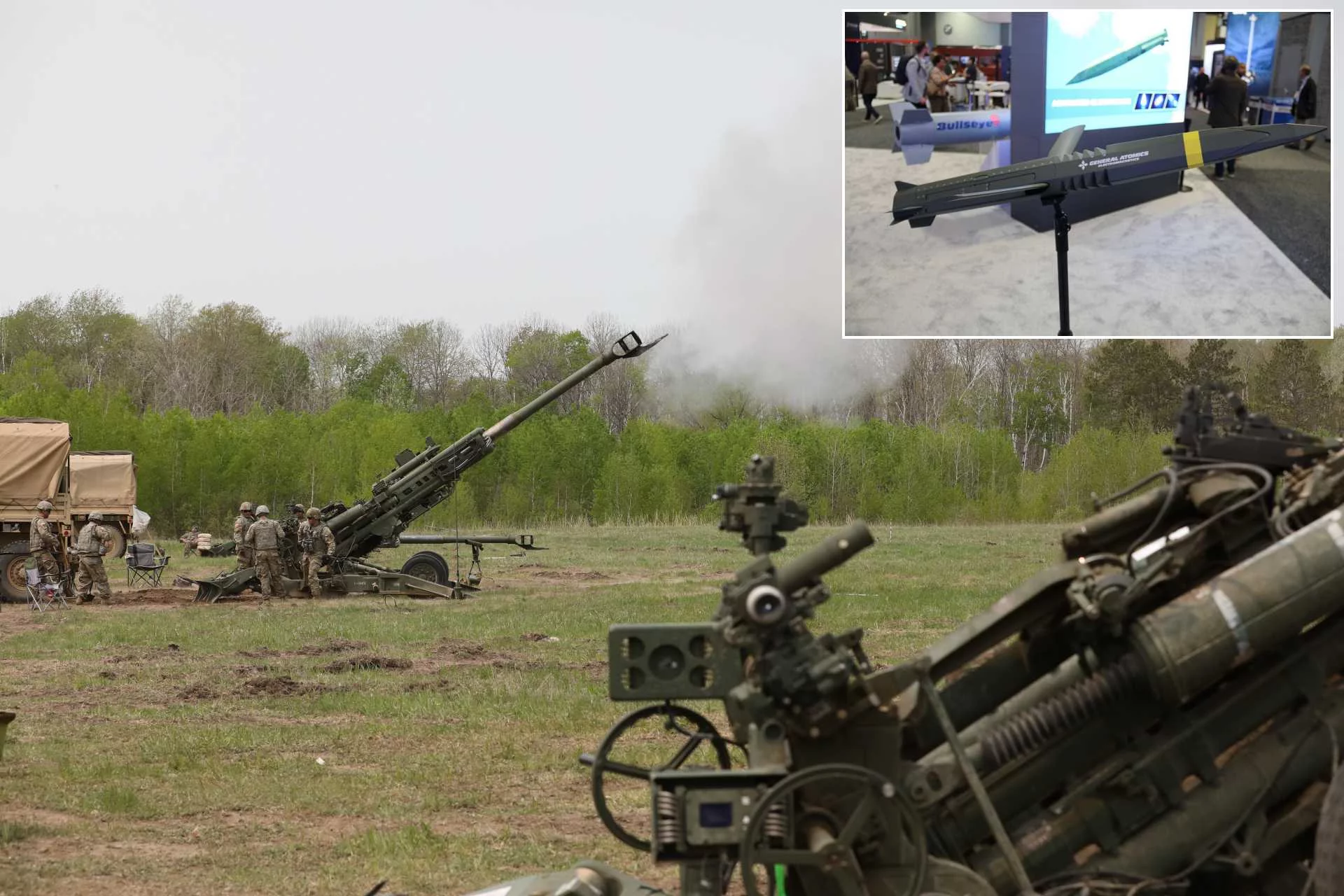
General Atomics Electromagnetic Systems (GA-EMS) has taken a major step forward in artillery precision with a successful demonstration of its Long Range Maneuvering Projectile (LRMP). In August, multiple guided rounds were fired from a U.S. Army M777 155mm towed howitzer at Yuma Proving Ground, Arizona, validating key flight phases such as sabot separation, wing deployment and in-flight maneuvering. The tests illustrate how legacy tube artillery can be evolved into long-range precision strike systems.
Unlike conventional 155mm shells that extend range via ballistic enhancements, the LRMP operates as an actively guided glide munition. It deploys wings and uses onboard guidance to steer during flight, enabling engagements well beyond standard tube artillery reach. Critically, the design reduces dependence on GPS by relying on internal navigation and inertial guidance—an advantage in contested electromagnetic environments that U.S. forces may face.
The demonstration used M231 propellant charges, commonly held in Army inventories, underscoring compatibility with existing logistics and the potential for rapid fielding. Each projectile transitioned cleanly from a spin-stabilized launch to a guided glide phase, corroborating years of aerodynamic modelling and wind-tunnel testing. Using the lightweight, widely fielded M777 platform signals GA-EMS’s intent to deliver near-term capability without wholesale platform replacement.
GA-EMS President Scott Forney framed the trial as proof that affordable, scalable precision firepower is attainable for high-end conflict scenarios. “This isn’t about exotic one-offs,” Forney said. “It’s about providing practical, producible solutions that perform under stress.”
According to company claims, LRMP can extend tube artillery reach to beyond 100 kilometers while delivering precision strikes and in-flight maneuverability—more than three times the typical range of standard 155mm rounds. The system reportedly targets CEP figures under 10 meters in contested conditions, a step-change that could allow artillery units to prosecute high-value and mobile targets previously reserved for air or missile systems.
Sources indicate the Army and Navy are evaluating LRMP derivatives for multi-domain usage; the Navy is studying ship-launched variants under its Common Round Initiative. August’s test data will feed further warfighter evaluations, with expanded range trials planned at Yuma and White Sands ahead of the end of FY2026.
LRMP’s modular architecture also enables future payload flexibility—sensor-fused warheads, EW payloads, or ISR packages—creating the potential for multi-role munitions that support deep fires, anti-armor effects, or communications disruption.
The transition from demonstrator to Program of Record will require additional testing, budget alignment, and joint-service commitment. Still, close alignment between test outcomes and predictive models increases the likelihood of operational adoption. In the broader modernization picture, LRMP signals a move away from static shell doctrines toward smart, guided munitions—capabilities that could significantly reshape artillery’s role in contested, multi-domain operations.
