

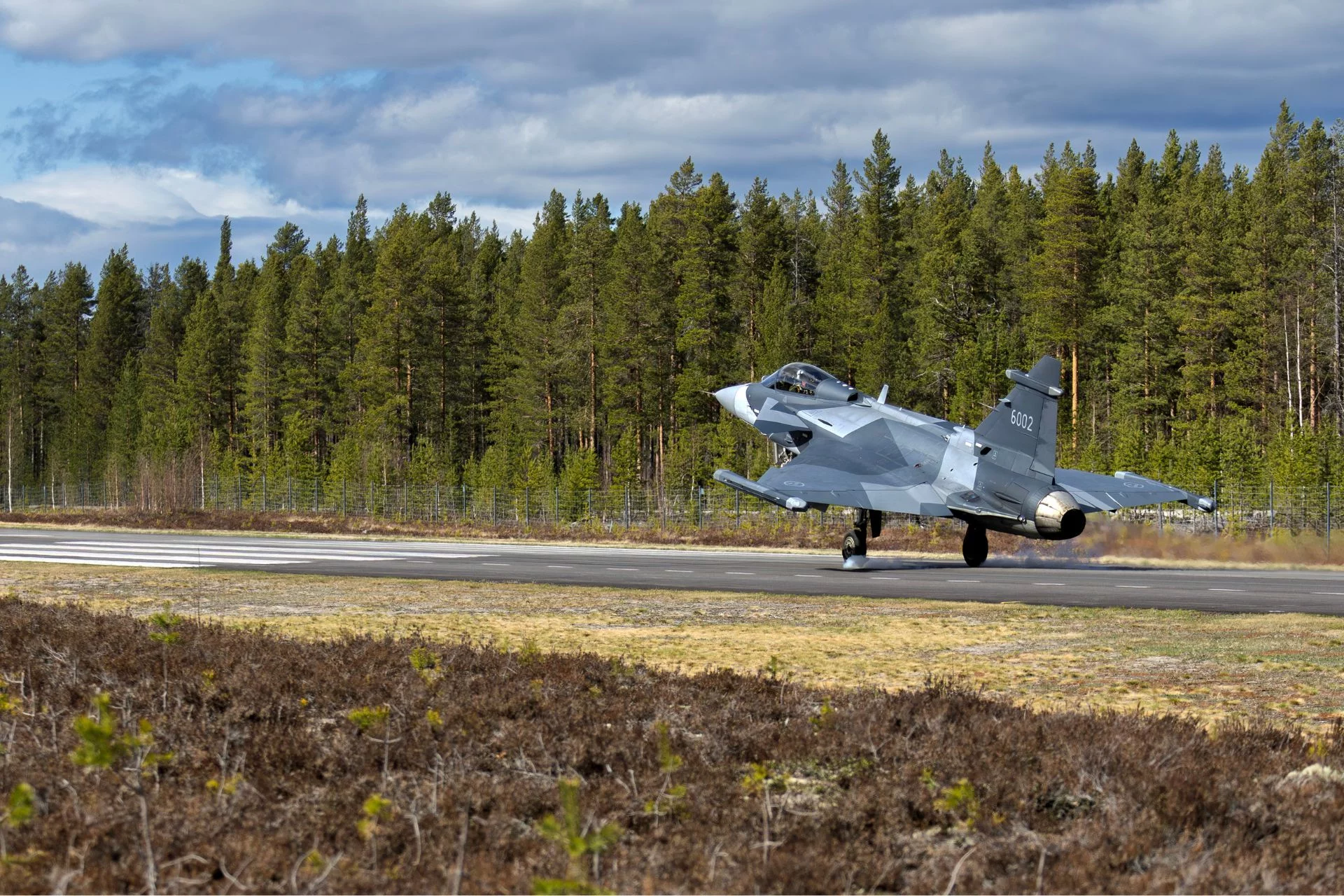
The Swedish Armed Forces have officially received their first JAS 39 Gripen E during a ceremony at Skaraborg Air Wing F 7, marking the start of operational deployment to the Flygvapnet and a major step in Sweden’s air-defense modernization. The event launches a 60-aircraft program designed to strengthen national and NATO airpower in Northern Europe.
Developed for dispersed operations — a core concept of Swedish air doctrine — the Gripen E is engineered to take off from short or improvised runways and be rearmed within 10 to 20 minutes. Powered by a 98 kN GE F414G engine, the aircraft features ten hardpoints, increased fuel capacity, and modular avionics for sustained operations under combat conditions.
Defense Minister Pål Jonson confirmed that the fleet will total 60 Gripen Es and highlighted the aircraft’s advanced electronic warfare suite, AI-enabled mission systems, and rapid software reconfiguration capability — allowing new updates to be installed within hours.
The fighter’s integrated sensor suite combines the ES-05 Raven AESA radar, Skyward-G infrared search and track (IRST), and Arexis electronic-warfare system, providing 360° situational awareness and passive detection without emissions. This enables Swedish pilots to operate effectively in radar-denied and high electronic-warfare environments, maintaining “first look, first shot” advantages against stealthy adversaries.
The Gripen E can carry up to seven Meteor beyond-visual-range missiles, two IRIS-T short-range missiles, and various air-to-ground munitions, depending on mission requirements. Its open architecture supports incremental software upgrades, ensuring compatibility with future weapons and sensors.
Tactically, the radar-IRST pairing allows flexible engagement patterns. In the Baltic and High North, four-ship formations can split roles, with two aircraft remaining passive on IRST while the others scan actively with Raven radar — a method that enables early detection and synchronized targeting. Combined with Sweden’s dispersed basing doctrine, this approach complicates enemy targeting and enhances operational survivability.
Following Sweden’s accession to NATO in March 2024, the induction of Gripen E adds a modern sensor-shooter node to the Nordic-Baltic air defense network. The aircraft strengthens regional deterrence, expands interoperability with allied forces, and enhances Sweden’s role in joint missions such as air policing, maritime interdiction, and integrated air-and-missile defense.
Beyond its operational impact, the Gripen E reinforces Sweden’s domestic defense industry and symbolizes the country’s shift toward a digitally adaptive, AI-enabled air force prepared for modern, high-threat environments.
