

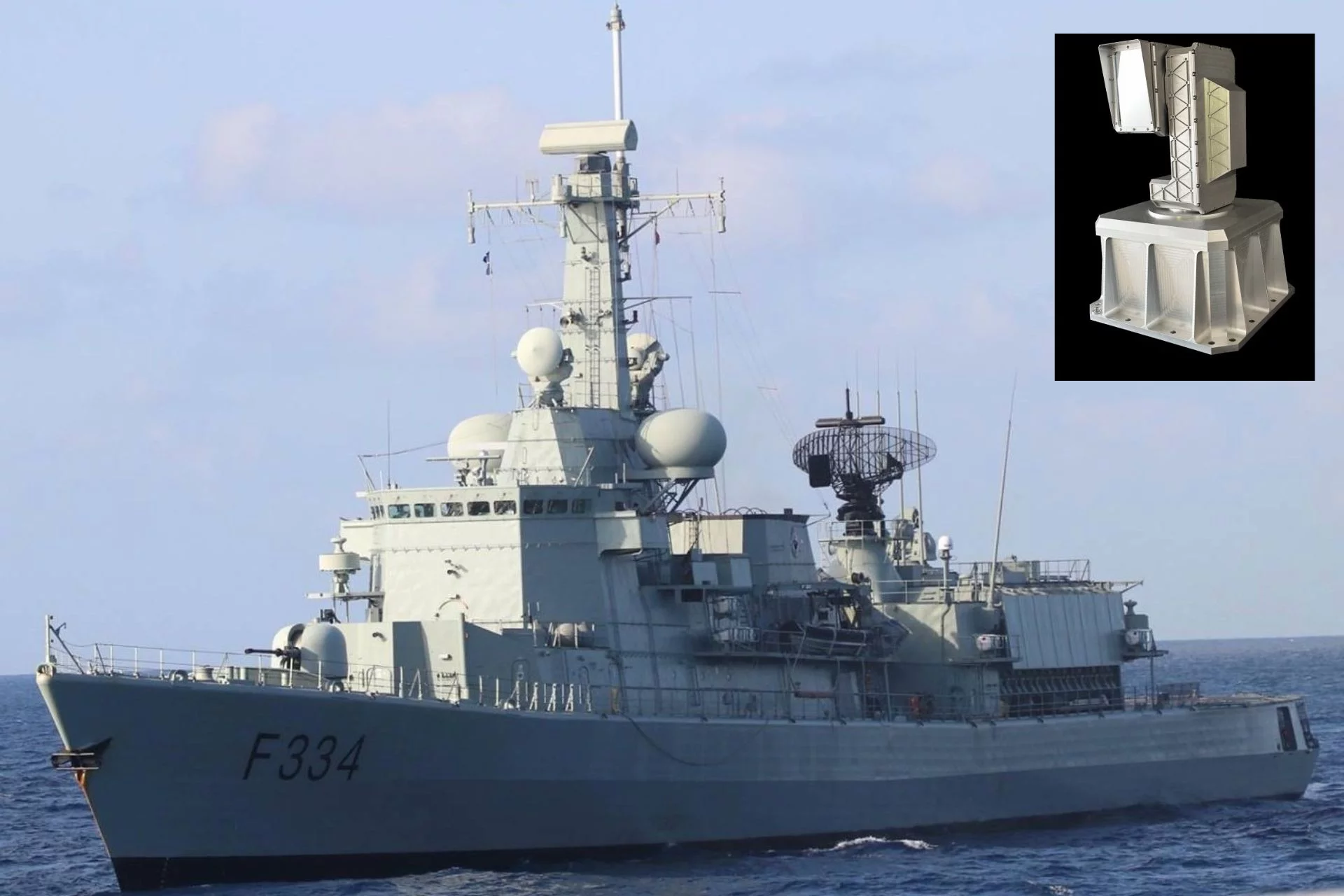
At REPMUS 2025, Astrolight’s POLARIS free‑space optical terminals established a spectrum‑silent, jam‑resistant communication channel between two Portuguese Navy ships. According to Seapower and a NATO DIANA note dated 17 October 2025, the link endured rain, fog and routine electromagnetic clutter without being detected or jammed by nearby ships, aircraft, drones or shore sensors, and it supported throughput sufficient for multiple HD video streams.
Astrolight personnel embarked with Portuguese crews on NRP Dom Francisco de Almeida and NRP Dom Carlos I to install and operate the terminals at sea. What distinguishes POLARIS is less the FSO concept itself and more its fleet-level performance and operational discreteness: the system’s very narrow 0.1° beam reduces interception probability while enabling an effective link budget that can deliver up to ~1 Gbps of usable throughput and aggregate more than ten real‑time HD video feeds.
The gimballed terminal weighs about 16 kg, draws roughly 200 W at 48 V DC, and uses Ethernet interfaces for both data and control—simplifying mast integration and naval IP network interoperability. The focused beam concentrates up to 4 W of emitted power on the intended path, lowering the chance that an adversary’s sensor falls within the useful lobe and complicating attempts at jamming or data reconstruction.
A mature ship‑to‑ship laser link yields three practical benefits: it preserves emission control for stealthy coordination during screening, deception or mine-warfare tasks; it increases command-and-control resilience when GPS and RF channels are degraded by jamming or decoys; and by limiting electromagnetic spill, it reduces targeting cues available to combined EW and passive sensor networks. Range remains limited by the horizon and mast height—though UAV or buoy relays can extend coverage—and weather attenuation is a constraint. Still, the Portuguese trials and earlier work with the Lithuanian Navy demonstrated usable throughput in rain and fog. Reliable gimballed stabilization and inertial references are essential for tracking on moving decks; POLARIS’s multi‑stream performance in rough seas is a practical indicator of that robustness.
Given persistent EW activity in theatres such as the Baltic and North Atlantic—and on routes to the Arctic and Indo‑Pacific—adding an optical layer that denies adversaries easy intelligence cues complicates the strike chain and buys more decision time. The DIANA‑backed firm’s delivery of an operational capability during a major Alliance exercise also signals a faster path to fielding niche but critical subsystems without waiting for new ship classes. If allies scale deployment, naval formations could, within a single budget cycle, field an undetectable optical backbone for local C2 and unmanned-system control—exactly the kind of capability REPMUS aimed to enable.
