

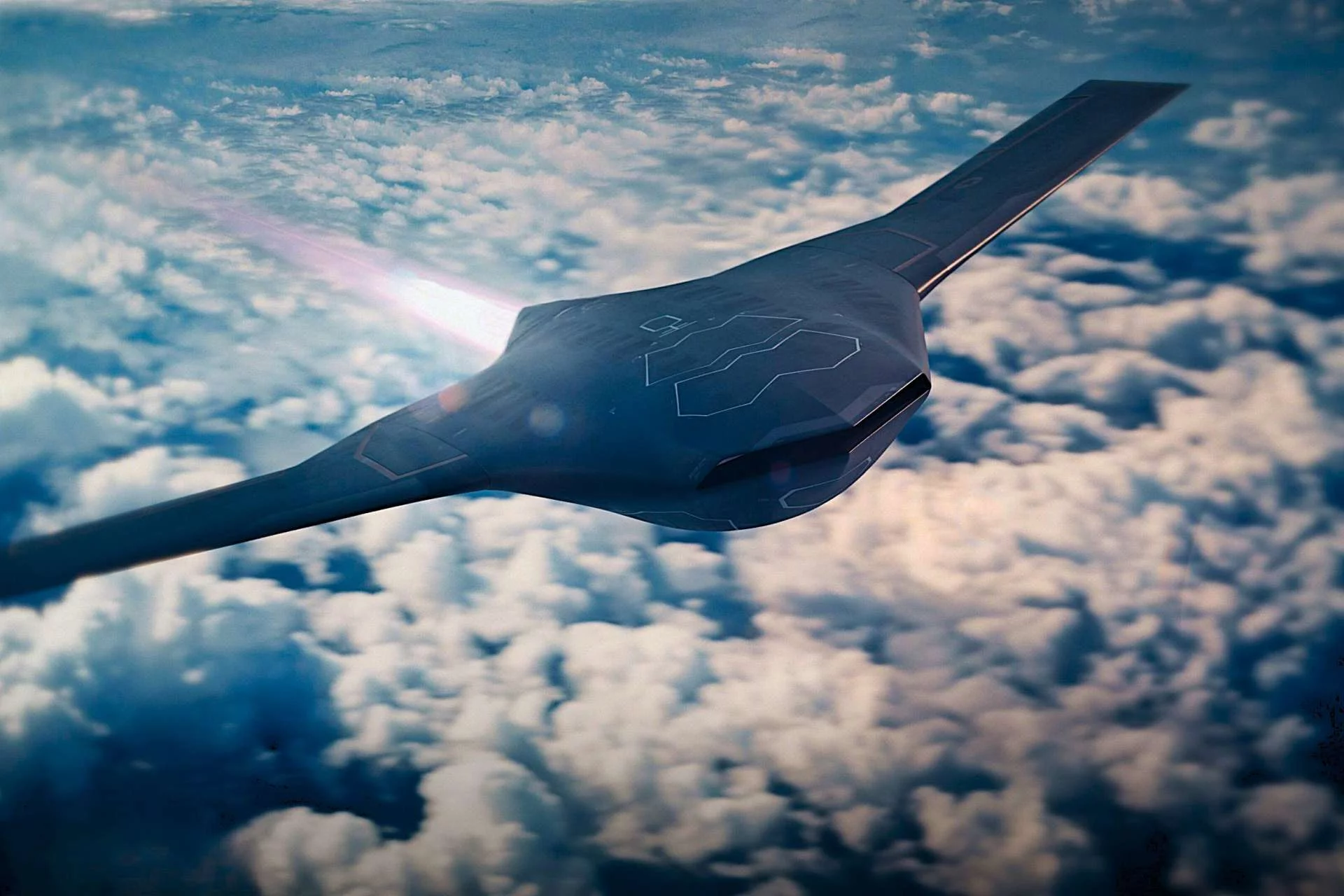
On October 21, 2025, Shield AI unveiled X-BAT in Washington: an AI-piloted, jet-powered VTOL “fighter” designed to operate without runways by launching and recovering from a trailer-like vehicle. The concept aims to combine long reach and autonomy to produce combat airpower from ships, islands, or austere pads—particularly for theatres facing anti-access challenges.
X-BAT is built around Shield AI’s Hivemind autonomy stack, intended to plan, fly, and prosecute missions with supervisory human oversight rather than continuous control. The aircraft transitions from vertical lift to wing-borne cruise: a VTOL-capable inlet, thrust vectoring and high-lift control surfaces enable the switch, while a fighter-class engine supplies the power for vertical operations and sustained dash. Published figures describe a compact footprint (roughly 26 ft long, 39 ft wingspan), growth-capable internal fuel and a modular avionics bay. Shield AI cites targets including a ceiling above 50,000 ft, >4.0 g maneuvering and a range in excess of 2,000 nm; top dash speed remains undisclosed.
Mission systems reflect a multirole profile. X-BAT is planned to field multimode radar, passive sensing, electronic warfare suites and hardened communications for contested environments. Its planned weapon mix covers air-to-air interceptors and medium-range missiles plus anti-ship and precision strike loads (examples given include LRASM and JSOW C-1), enabling counter-air, sea-denial and deep-strike tasks from nontraditional basing. Fusing autonomy with these systems is intended to compress targeting timelines and allow dispersed operations with a small logistical footprint.
Shield AI’s operational concept emphasizes “launch from anywhere.” A launch/recovery vehicle lowers blast protection, unfolds wings and raises the aircraft to a vertical posture for liftoff. Acceptable basing options range from a cleared 100×100 ft pad to improved airfields, cargo and assault ships, carriers and other surface vessels. Profiles include return-to-base round trips, one-way missions with recovery ashore or afloat, and island-hopping sequences—effectively decoupling fighter effects from fixed runways.
From a training and sustainment perspective, X-BAT represents a potential rethink of pilot pipelines and logistics. The autonomy layer is designed to handle routine airmanship—takeoff, transition, navigation and recovery—so human controllers concentrate on mission objectives and rules of engagement. The compact storage dimensions and modular avionics aim to reduce deployment cost and speed role changes between missions.
Strategically, a runway-independent autonomous fighter could alter regional balances where archipelagic or littoral geography matters, and offer expeditionary forces credible airpower without hardened bases. If the system meets its stated capabilities—high altitude, long range and high maneuverability—X-BAT could reshape how commanders generate and sustain combat aviation across land and sea from dispersed, resilient basing footprints.
