

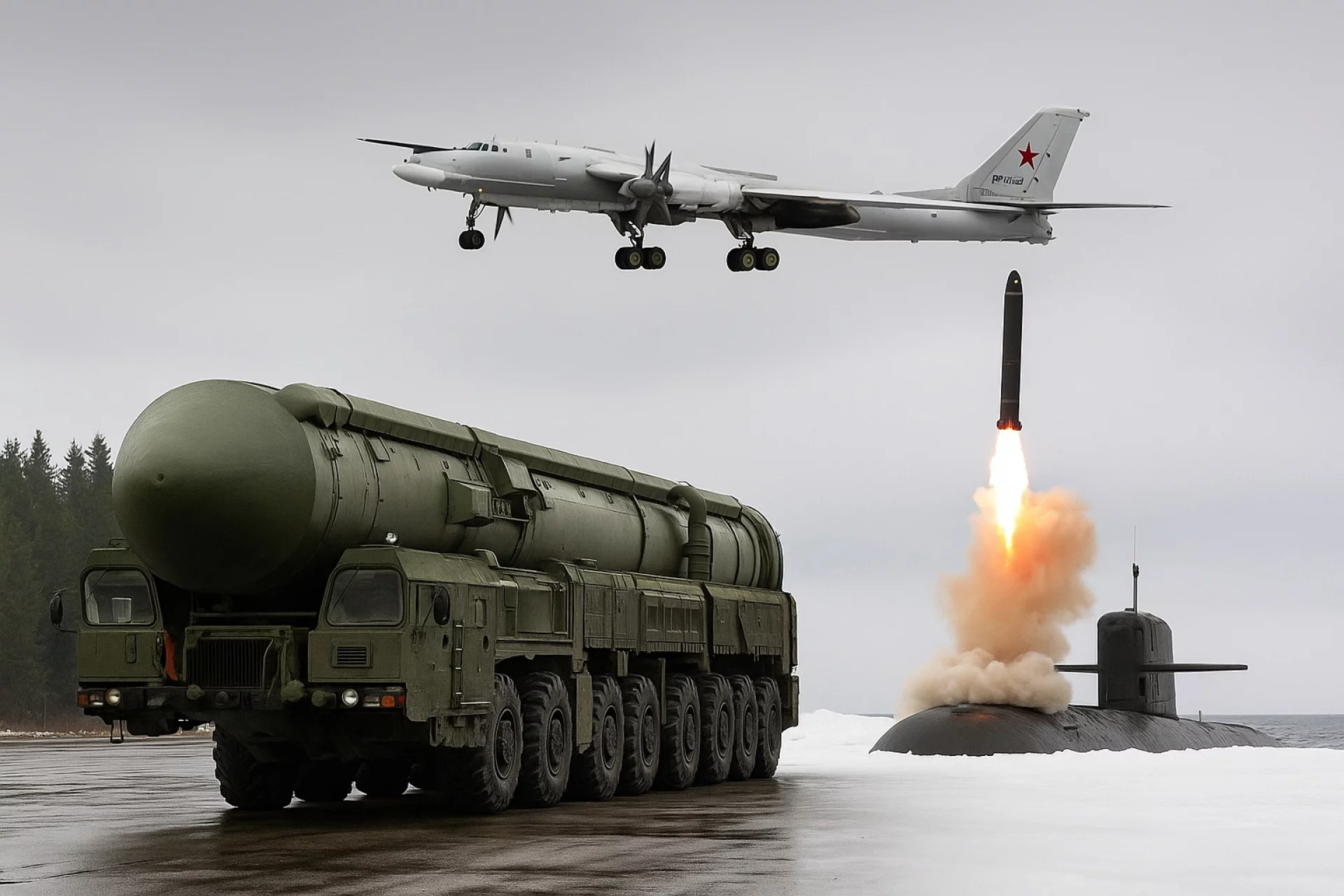
Russia has launched a nationwide strategic nuclear exercise under the direct supervision of President Vladimir Putin, testing the full nuclear triad — land-based, sea-based, and airborne components. The timing coincides with NATO’s annual “Steadfast Noon” nuclear-deterrence drill, drawing global attention to the signaling competition between Moscow and the Alliance.
According to the Kremlin, the exercise featured a Yars ICBM launched from Plesetsk toward Kamchatka, a Sineva SLBM fired from the nuclear-powered submarine Bryansk in the Barents Sea, and cruise missile launches by Tu-95MS bombers. Russian authorities stated that all objectives were successfully achieved, emphasizing the readiness of command elements and the proficiency of operational crews.
The drill — personally overseen by President Putin — highlighted the integration of Russia’s triad capabilities, reaffirming Moscow’s ability to coordinate land, sea, and air nuclear assets under centralized command.
Meanwhile, NATO’s “Steadfast Noon 2025”, hosted by the Netherlands from 13–24 October, focuses on procedures, safety protocols, and coordination among dual-capable aircraft. Alliance officials stress that no live nuclear weapons are involved and that the exercise targets no specific country.
Though both sides describe their drills as routine, the 2025 context — defined by the ongoing war in Ukraine, the erosion of arms-control agreements, and NATO’s expanded membership — lends these maneuvers heightened strategic meaning.
Analysts view Russia’s synchronized triad demonstration as a signal of command confidence and second-strike assurance, while NATO’s decision to proceed as planned projects steadiness and credibility in its deterrence posture.
Ultimately, the simultaneous exercises underscore both the continuity of nuclear readiness and the critical need for transparency to prevent miscalculation. In today’s tense deterrence landscape, true stability depends not only on missiles and maneuvers but also on disciplined communication and responsible signaling between nuclear powers.
