

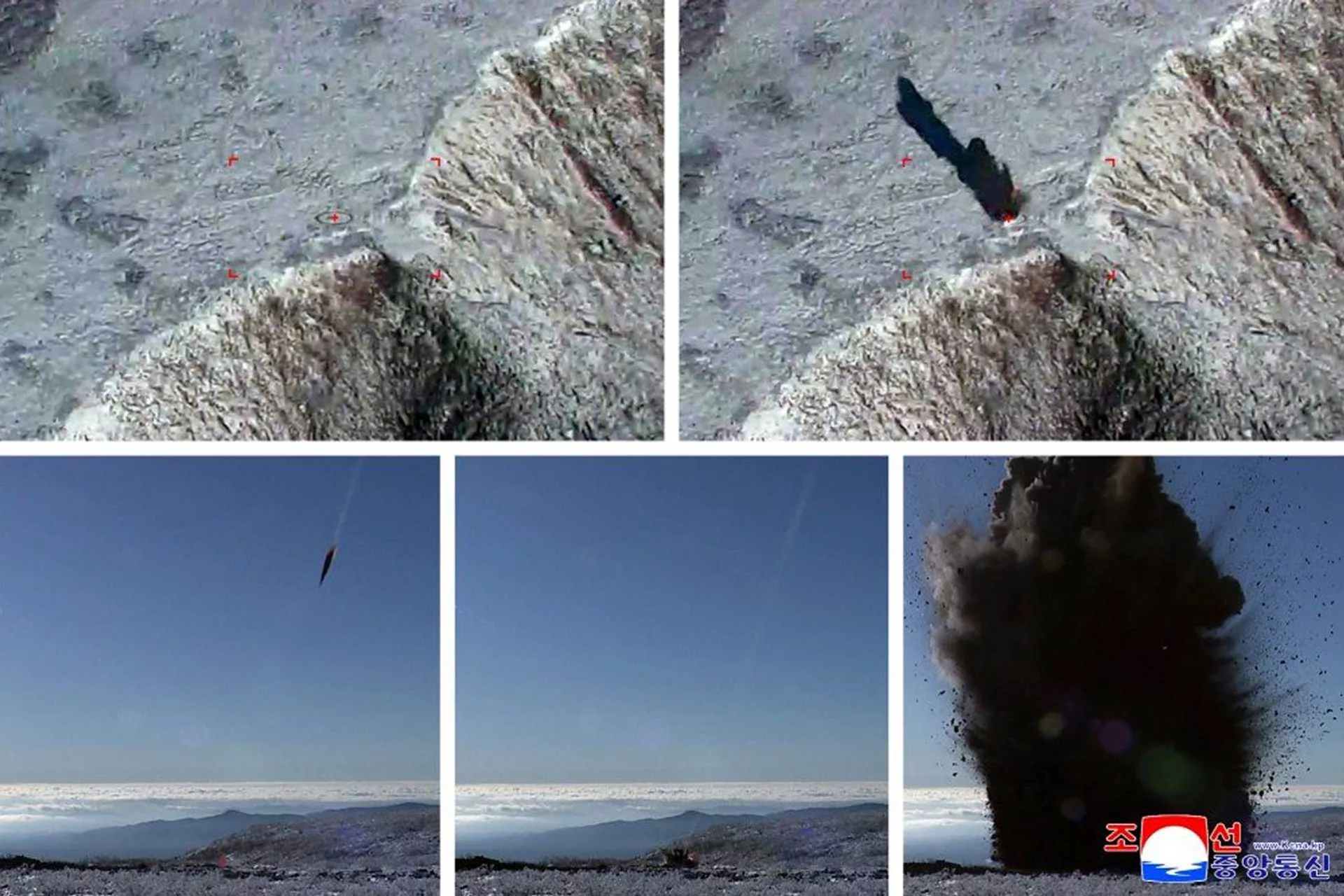
North Korea has conducted a new hypersonic missile test, firing two projectiles from an area near Pyongyang toward targets in the country’s northeast, according to state media reports on October 23. The test marks another step in Pyongyang’s ongoing effort to enhance its long-range precision strike capability amid rising regional tension.
The Korean Central News Agency (KCNA) reported that both missiles accurately hit their designated targets, describing the launch as a successful validation of the country’s next-generation hypersonic weapons system. Although leader Kim Jong Un was not present, defense analysts view the test as a key milestone in North Korea’s missile modernization campaign.
Hypersonic weapons, which travel at speeds exceeding Mach 5 and perform evasive maneuvers during flight, are designed to penetrate advanced air and missile defense systems such as THAAD, Aegis, and Patriot PAC-3. By integrating hypersonic glide vehicle (HGV) technology, Pyongyang aims to achieve fast, precise, and survivable strike capabilities against high-value regional targets.
Since unveiling the Hwasong-8 missile in 2021, North Korea has accelerated its pursuit of hypersonic technology, testing improved variants such as Hwasong-16B and Hwasong-18 in 2022 and 2023. These designs reportedly incorporate solid-fuel propulsion, allowing for faster launch readiness and improved maneuverability. Satellite imagery indicates continued experimentation at launch sites near Pyongyang and along the east coast.
The latest launch appears to build upon these advances, likely testing refined glide vehicle aerodynamics and reentry stability. The use of dual launches may also demonstrate salvo or coordinated targeting capabilities intended to saturate regional missile defense networks in a real-world scenario.
The timing of the test coincides with renewed regional friction following joint U.S.–South Korea–Japan military exercises, which Pyongyang has denounced as hostile. Analysts say the test serves both as a technical milestone and a political message of defiance.
If successfully fielded, North Korea’s hypersonic systems could significantly shorten warning times and strain existing defense architectures, compelling neighboring nations to enhance radar coverage and interceptor readiness.
Experts note that Kim Jong Un’s absence may reflect growing institutional confidence within the program, signaling that the system is transitioning from experimental trials toward limited operational deployment with the Strategic Forces of the Korean People’s Army. KCNA’s references to “cutting-edge technologies” suggest iterative refinements in propulsion and guidance rather than a completely new missile family.
Regional defense authorities in Seoul and Tokyo are analyzing trajectory and telemetry data to assess the missile’s technical parameters. While official reactions remain measured, both governments are expected to review their missile defense posture in response to Pyongyang’s latest demonstration of advanced strike capability.
