

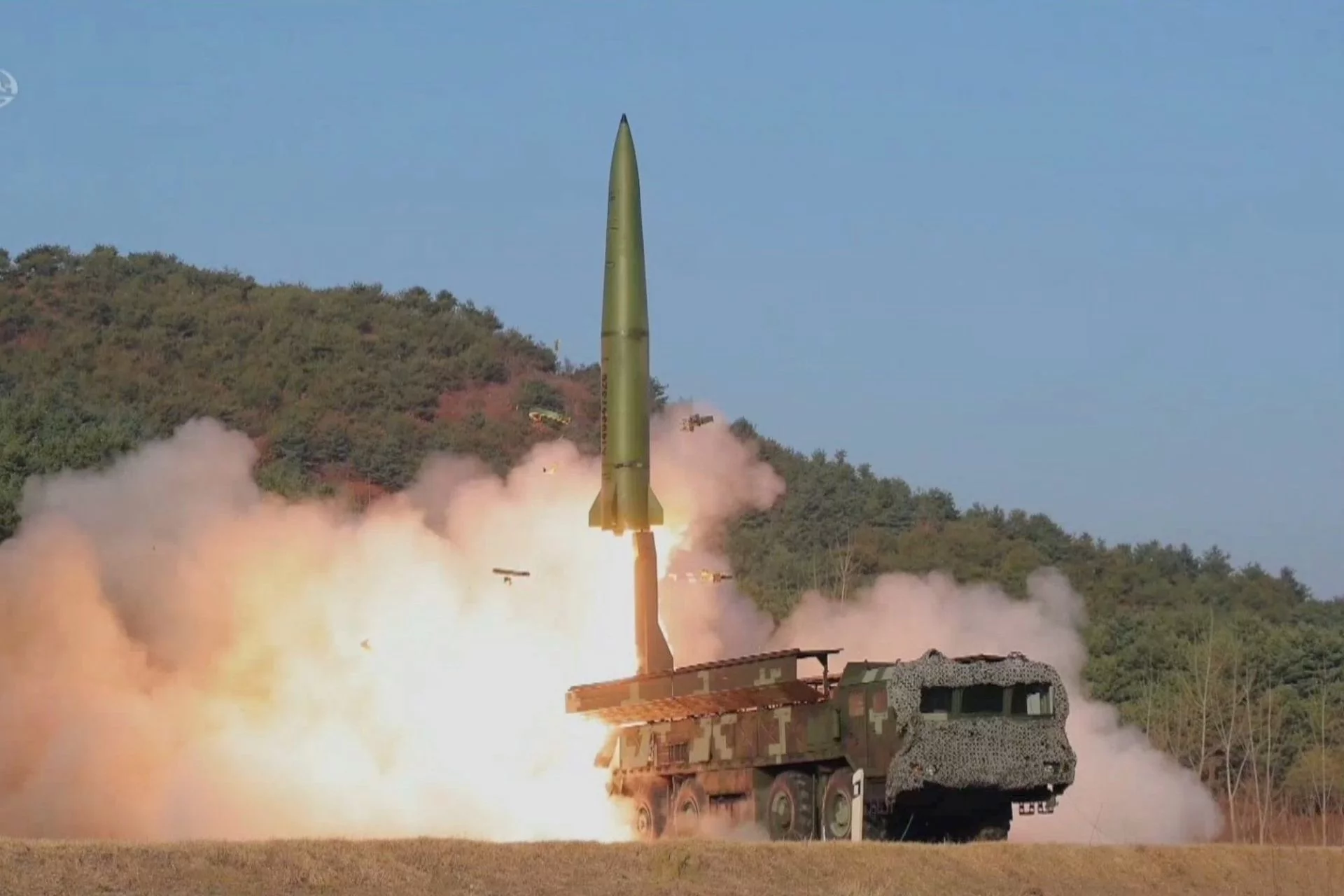
North Korea launched multiple short-range ballistic missiles (SRBMs) from an area south of Pyongyang early Tuesday, flying about 350 kilometers before landing inside its own territory, according to South Korea’s Joint Chiefs of Staff. The launches come one week before South Korea hosts the APEC Economic Leaders’ Meeting, marking the first missile test under President Lee Jae-myung’s administration.
The missiles, identified as Hwasong-11A (KN-23), were launched in a pattern consistent with previous salvo-style tests aimed at political signaling rather than direct provocation. The timing, just days before the arrival of U.S. President Donald Trump and China’s Xi Jinping, reflects Pyongyang’s recurring tactic of using strategic tests to send calibrated diplomatic messages ahead of major international events.
Real-time coordination among Seoul, Washington, and Tokyo confirmed that the test followed a standard SRBM salvo profile, serving as a signal test of allied detection and response networks. South Korean authorities emphasized that the projectiles remained within North Korean borders, underscoring that the launch was a demonstration of capability rather than escalation.
North Korea’s SRBM arsenal has grown increasingly diverse. The KN-23 features quasi-ballistic flight paths with terminal maneuvering, while the KN-24 and KN-25 extend engagement ranges and warhead flexibility, all using solid propellant for rapid firing and enhanced mobility. These systems enable saturation attacks designed to overwhelm regional missile defense sensors.
Beyond short-range systems, Pyongyang continues to expand its intermediate and intercontinental missile inventory, including the Hwasong-12, Hwasong-15/17, and the new solid-fuel Hwasong-18, which shortens launch preparation and detection times. The Hwasong-20, unveiled in the October 10 parade on an eleven-axle TEL, suggests increased payload and range capabilities.
Parallel developments in the Pukguksong submarine-launched missile series, including the new Hwasong-11S, show efforts to diversify basing modes and improve survivability through distributed launch platforms.
For South Korea and its allies, the launches underscore the need for stronger Kill Chain resilience and interoperability within the Korea Air and Missile Defense (KAMD) framework. This includes expanding mobile radar coverage, hardening C2 networks, improving electronic control procedures, and enhancing real-time data sharing with U.S. and Japanese systems to maintain situational awareness under salvo or decoy conditions.
Politically, the event casts a shadow over APEC week, thrusting deterrence credibility, trilateral cohesion, and sanctions enforcement back into focus. By unveiling the Hwasong-20 in front of Chinese and Russian guests, Pyongyang appears to be broadening its diplomatic maneuvering space while testing allied responses.
Across the wider Indo-Pacific — and extending to regional defense partners such as Australia and Türkiye — the launches reaffirm the urgency of persistent ISR coverage, layered missile defense, and crisis-management mechanisms capable of withstanding prolonged tension cycles without ceding tempo to an adversary.
