

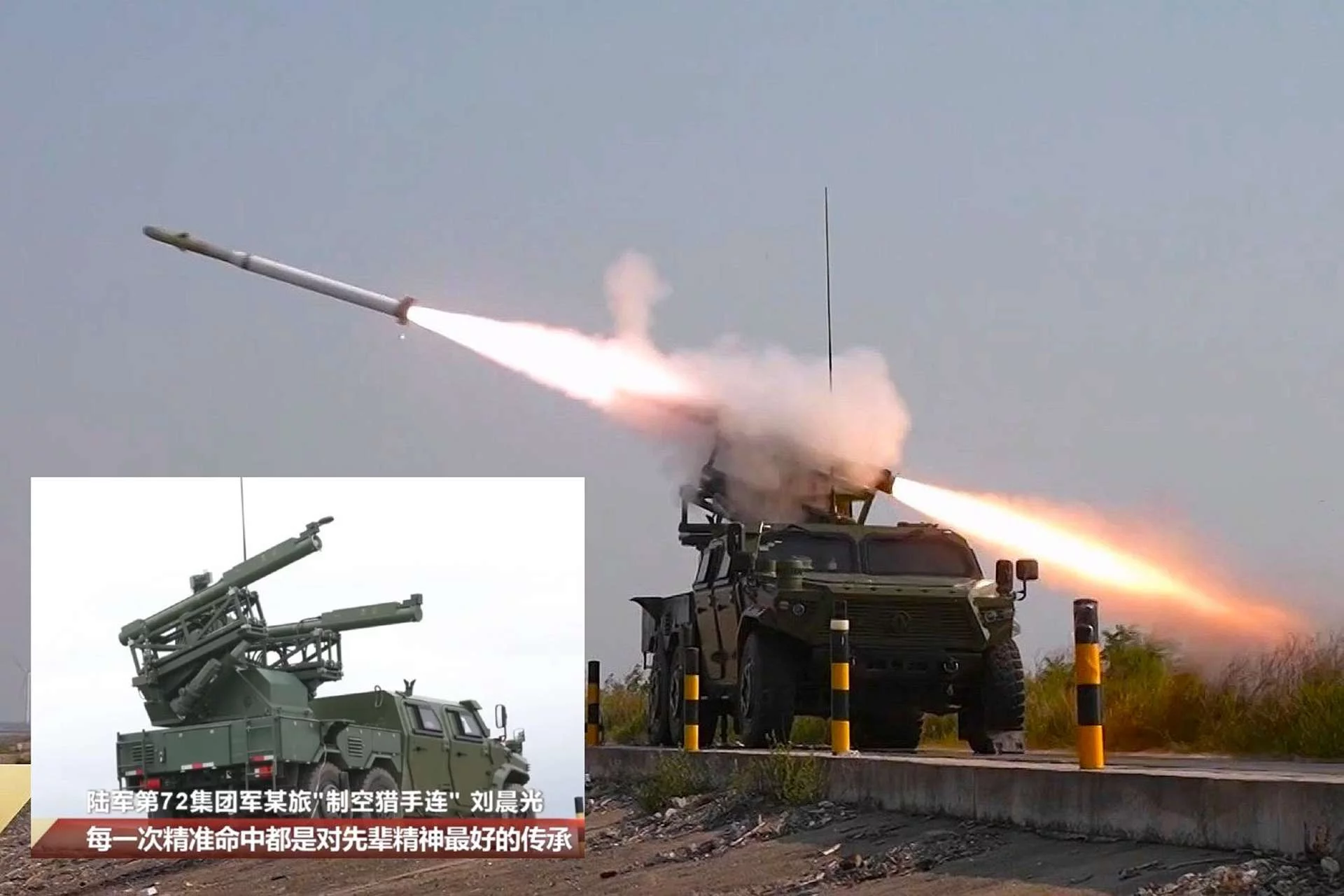
China has showcased a vehicle-mounted short-range air defense (SHORAD) system intended to provide on-the-move air protection for frontline ground units. State media footage gives an initial look at a compact, highly mobile package apparently designed to counter low-altitude, low-observable threats—from armed drones to cruise missiles—while keeping pace with maneuver formations.
Broadcast frames show the system fitted on a Dongfeng Mengshi 6×6 all-terrain chassis, combining a compact rotating search radar and twin roof-mounted missile rails into a single mobile fire unit. The launcher layout resembles SWS3-style gun-missile concepts but in a slimmer configuration without the 35 mm cannon, retaining a two-rail missile fit. The footage depicts elements of the PLA’s 72nd Group Army conducting simulated drills followed by a live firing—consistent with rapid induction and early operational testing.
Open-source observers assess the interceptor as a short-range missile linked to the FB-10A family and tentatively referenced in some reports as an HQ-13 variant in PLA service. If correct, the system’s intended mission set includes point defense against helicopters, low-flying fixed-wing aircraft, shore-approaching cruise missiles and Group-1 to Group-3 UAS at brigade level.
What differentiates this package is the integration of mobility, sensors and effectors at the vehicle level. The Mengshi chassis provides high cross-country mobility and shoot-and-scoot survivability that reduce exposure to counter-battery and loitering munitions. The on-board rotating radar and electro-optical sensors visible in the footage suggest each vehicle can independently search for, track and engage targets, while remaining capable of networked operations to feed and receive a battalion/ theatre air picture.
That dual capability—credible autonomous kill chains plus the option to operate as a node in an integrated air-defense picture—addresses a central SHORAD challenge: sustaining coverage for dispersed, maneuvering formations under electronic attack or GPS-degraded conditions. Organic sensors shorten the sensor-to-shooter loop and improve reaction times against pop-up threats such as terrain-masked helicopters or low-level cruise ingress.
Operational advantages emphasize survivability, responsiveness and logistical simplicity. A single-vehicle fire unit that can co-move with motorized or light combined-arms brigades closes the classic gap opened when heavy batteries are tied to fixed sites. The compact form factor reduces the signature footprint relative to larger tracked or towed systems, and training footage implies a doctrine focused on rapid fielding and immediate combat proficiency.
Strategically, deploying this type of mobile SHORAD tightens the PLA’s layered air-defense fabric across potential hotspots—most notably the Taiwan Strait and the East and South China Seas—complicating low-altitude air planning and compressing safe approach corridors for rotary-wing infiltration or stand-off weapon arcs. Geostrategically, it aligns with Beijing’s push for a dense, multi-tier IADS that places point-defense assets closer to maneuver units, increasing the cost of saturation raids and drone swarms.
It is important to note there is no formal technical release identifying the system’s official designation, missile model or performance envelope. The available evidence—imagery, broadcast narration and expert commentary—supports a cautious working assessment: a Mengshi-mounted SHORAD package likely armed with FB-10A-family (or HQ-13-type) short-range interceptors, currently visible at least at one 72nd Group Army unit. If validated, the capability would extend credible counter-UAS and counter-cruise protection directly to maneuver brigades and raise the risk and resource cost of low-altitude operations against PLA forces on the move.
