

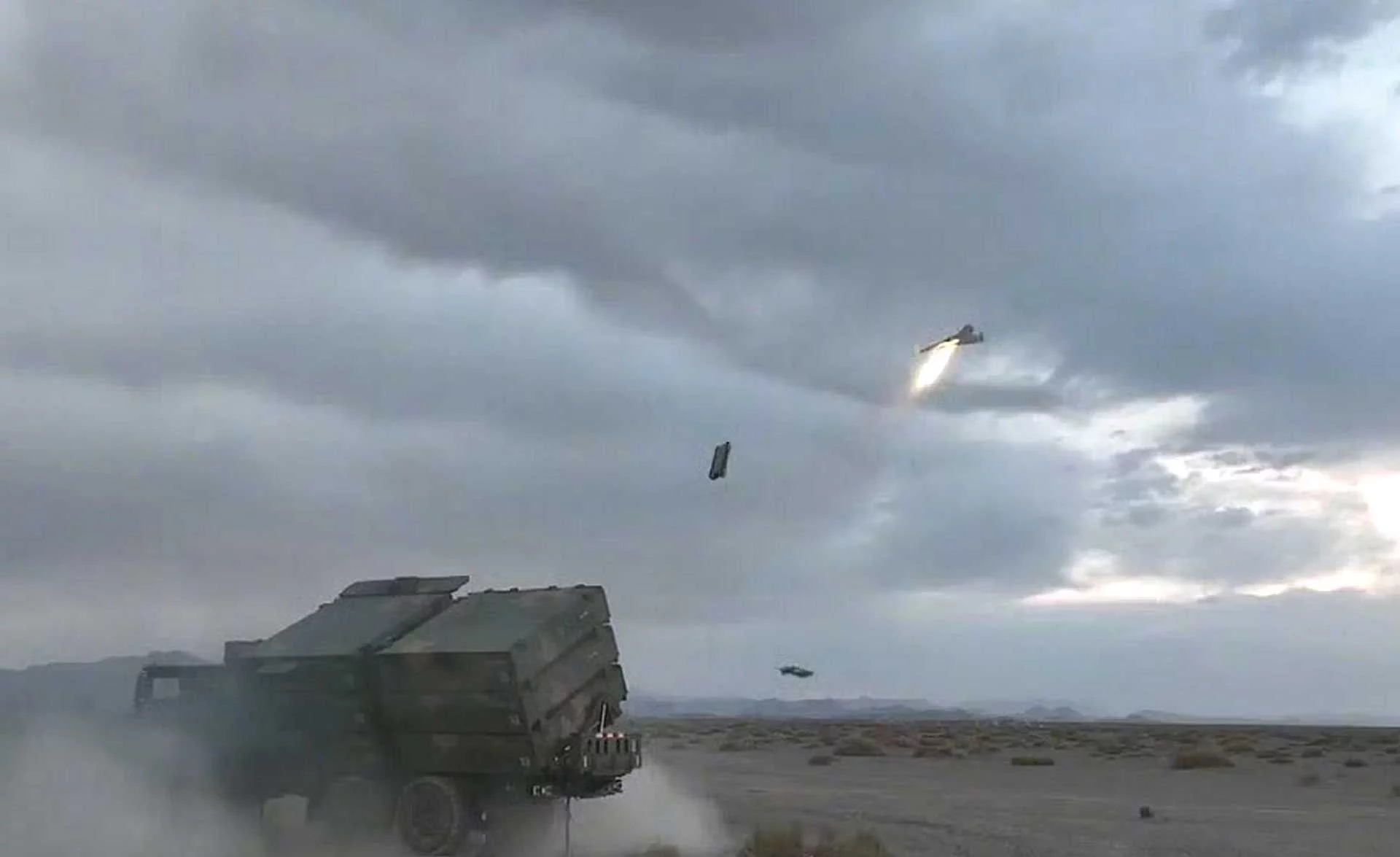
China’s People’s Liberation Army (PLA) Eastern Theater Command has published video of a live-fire exercise featuring the ASN-301 anti-radar loitering munition, confirming the weapon’s transition into operational service. The move highlights Beijing’s expanding capability to threaten U.S. and allied radar networks across the Western Pacific.
The rare footage showcases the PLA’s growing unmanned strike toolkit. Once seen mainly at defense exhibitions, the ASN-301 has now been fielded to locate and destroy radar emitters that form an integral part of air defense architectures.
The released clip shows a highly mobile, truck-mounted launcher fitted with six sealed canisters — each housing a single ASN-301. The launcher appears to be built on a modified FAW MV3 6×6 tactical truck chassis, a vehicle already widely used across the PLA for moving artillery and missile systems. This setup allows salvo launches of up to six drones and rapid repositioning to reduce exposure to counter-fire.
For U.S. forces and allies in the Indo-Pacific — notably Taiwan, Japan and forward-deployed U.S. units — the system presents a fresh threat to radar-dependent defenses. ASN-301s can be fired from long distances and loiter near contested areas until radar systems become active, enabling near-real-time targeting of assets such as Aegis-equipped warships, airborne early-warning planes and ground surveillance radars.
Mass launches from mobile platforms could saturate radar coverage and disrupt command-and-control cohesion in the opening stages of a conflict, potentially producing temporary or permanent gaps in early warning and leaving high-value assets vulnerable to follow-on drone or missile strikes. Unlike conventional air-launched anti-radiation missiles, the ASN-301’s ability to remain airborne for extended periods forces radar operators into a dilemma: shut down to avoid detection or remain on and risk being targeted.
Technically, the ASN-301 is reported to detect signals across roughly 2–16 GHz, spanning frequencies commonly used by early-warning and fire-control radars. The drone features a delta-wing layout, rear-mounted pusher propeller driven by a small piston engine, and is reported to weigh about 135 kg with a 2.5 m fuselage and ~2.2 m wingspan. Published performance figures list a top speed near 220 km/h, an operational range around 288 km and loiter times approaching four hours. Its warhead is a high-explosive fragmentation type with a laser proximity fuse, dispersing roughly 7,000 pre-formed fragments to disable antennas, sensor arrays and control electronics. The radar-homing seeker is said to have a terminal acquisition radius up to about 25 km.
ASN-301s are cold-launched from canisters and then activate their engines, navigating via GPS-inertial systems; some variants may support in-flight data-link updates for targeting adjustments or mission aborts. The launcher’s ability to quickly move after firing makes the system well-suited to mobile strike formations.
The deployment within the Eastern Theater Command — the joint regional command primarily assigned responsibility for Taiwan and the East China Sea — underlines the system’s operational role in contingency plans for the eastern flank. Analysts note the ASN-301’s appeal: mobile, inexpensive, hard to detect and purpose-built to blind enemy radar networks. Its operational use signals a shift from testing to active employment as a tactical tool for suppressing sophisticated air defenses.
If export is permitted, ASN-301 sales could provide smaller militaries a cost-effective SEAD option and extend China’s influence in global defense markets. As loitering munitions have already reshaped recent battlefields in Ukraine, Syria and Nagorno-Karabakh, China’s new platform adds another dimension to the global race in anti-radar drones.
At present, the confirmed operational use of the ASN-301 by the PLA Eastern Theater Command indicates the system is no longer theoretical: it is a mature capability integrated into a modern, mobile strike architecture intended to blind, degrade and neutralize high-end air defenses — a development defense planners across the Indo-Pacific and in NATO will watch closely.
