

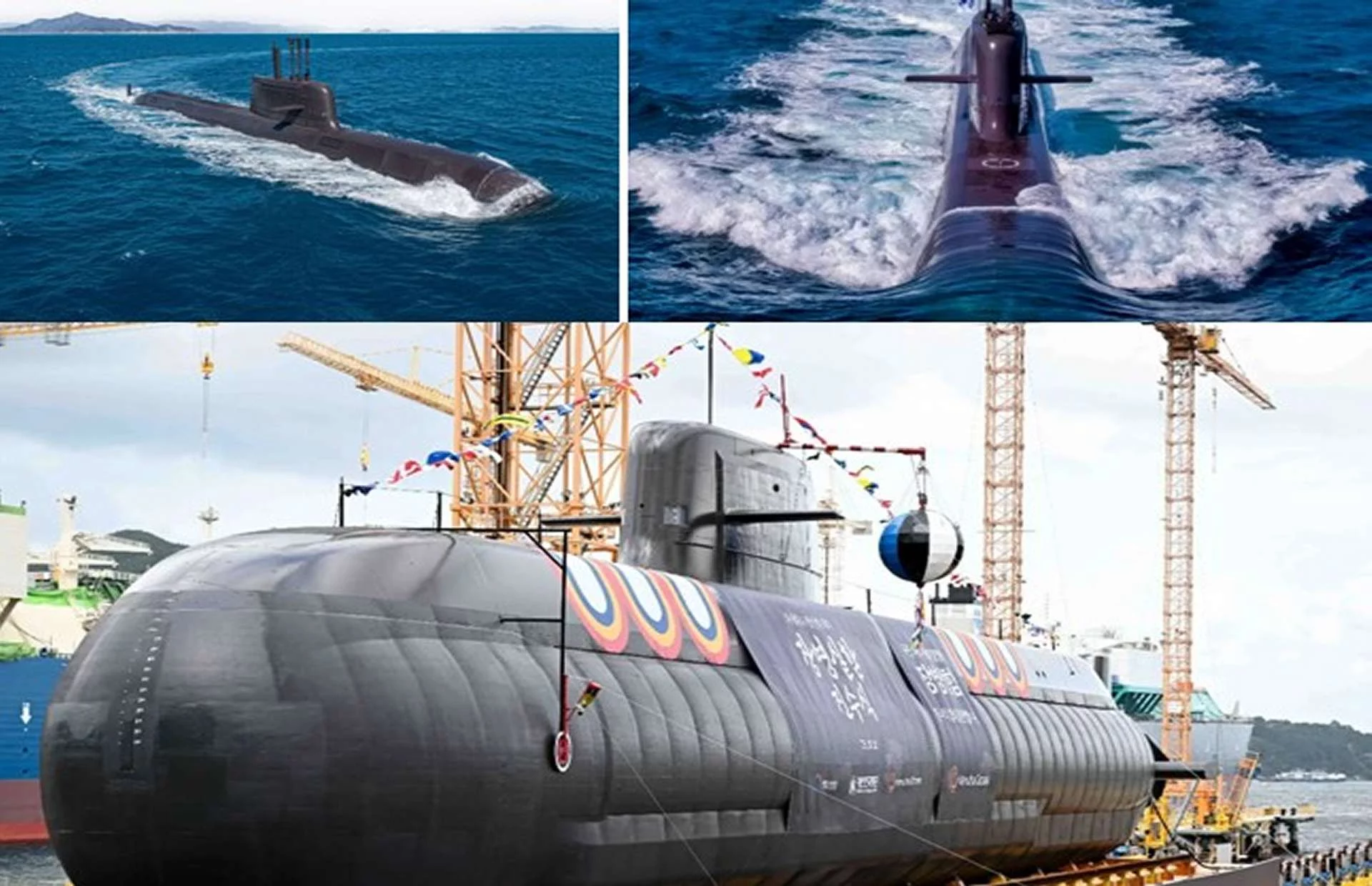
Canada has shortlisted two bidders for its new class of Arctic-capable patrol submarines, pitting South Korea’s Hanwha Ocean directly against Germany’s ThyssenKrupp Marine Systems (TKMS). The decision formalizes an Arctic-operable requirement and launches a head-to-head comparison on endurance, stealth, weapons fit and delivery tempo that will shape Canadian under-ice and blue-water patrols for decades.
Public Services and Procurement Canada announced on 26 August 2025 that it had advanced the Canadian Patrol Submarine Project and selected two qualified suppliers for up to 12 conventionally powered boats: TKMS with the Type 212CD and Hanwha Ocean with the KSS III. Since the shortlist, Seoul has pursued an assertive campaign to secure the contract.
Seoul’s Offensive Campaign
Hanwha has moved aggressively: signing an exclusive in-service-support teaming agreement with Babcock Canada, hosting Canadian officials at its Geoje shipyard, and promoting an accelerated training pipeline to qualify Royal Canadian Navy crews in Korea prior to handover. South Korean media reported a Canadian working team visiting Geoje in late October, and Hanwha has floated delivery pledges — including four hulls before 2035 if contracted in 2026.
Hanwha is also offering industrial offsets — Canadian steel for shipbuilding, potential LNG deals, and partnerships with domestic space firms such as Telesat and MDA. Seoul argues its sustained security pressures keep production and sustainment lines hot, whereas European suppliers may be more exposed to political budget cycles. Germany and Norway counter with ministerial-level diplomacy and a value proposition built on deep NATO interoperability and partnered sustainment.
Design Trade-offs: KSS III vs Type 212CD
On paper, the KSS III Batch II is the heavyweight. The first Batch II boat, ROKS Jang Yeong-sil, launched on 22 October 2025 and is published at roughly 3,600 tons surfaced / 4,000 tons submerged, 89.4 m length, 9.7 m beam and 7.6 m draft. Propulsion pairs three MTU diesels with Bumhan PH1 fuel-cell AIP and a full lithium-ion battery suite — a mix that supports silent endurance and high-speed submerged sprints. Notably, KSS III carries six 533 mm tubes for heavyweight torpedoes and anti-ship missiles, plus ten VLS cells sized for the Hyunmoo-4-4 SLBM family, creating a potent conventional and long-range strike option.
The Type 212CD takes a different path: an evolution of the 212A optimized for extreme quiet and low observability. TKMS and Norwegian data place the 212CD at about 73 m length and ~2,500–2,800 tons displacement, with endurance near 41 days and >20 knots submerged. The hull uses a diamond cross-section to lower active sonar returns; propulsion centers on fourth-generation PEM fuel-cell AIP with planned lithium batteries. The package emphasizes stealth, with ORCCA combat-system integration, HENSOLDT optronics and Kongsberg navigation/min-avoidance sonar — a NATO-ready, low-signature design that trades vertical launch capacity for superior discretion.
The Choice Is Operational, Not Just Geographic
Canada’s decision will hinge on concept of operations. KSS III offers magazine depth and immediate strike relevance — a blunt, long-range option that answers presence and deterrence needs across oceans. Type 212CD delivers the quietest acoustic signature and a stealth-first doctrine that excels in contested littorals and under active sonar environments, backed by a Germany-Norway industrial-sustainment offer.
Ministers from Germany and Norway are actively lobbying Ottawa with industrial reciprocity and local-build incentives, while South Korea presses aggressive delivery schedules, Canadian teaming and on-site demonstrations to prove industrial capacity. Ottawa must now weigh delivery tempo, sustainment partnerships, industrial offsets and the operational concept each design enables for Canada’s twin-ocean, high-latitude posture.
