

American defense technology firm Saronic Technologies has announced a strategic partnership with NVIDIA to accelerate real-time, onboard artificial intelligence across its fleet of unmanned surface vessels (USVs), ranging from 6 to 150 feet. The companies highlight that NVIDIA’s hardware and software, already integrated into Saronic platforms, have reduced training and deployment cycles from days to hours — a shift that could significantly scale ISR, escort, mine countermeasures, and light logistics missions for the U.S. Navy and its allies.
Saronic’s deepening collaboration with NVIDIA aims to advance maritime autonomy by combining NVIDIA’s accelerated computing, AI libraries, and Physical AI toolchain with Saronic’s sensor suite, autonomy software, and simulation workflow. According to the company, NVIDIA modules now enable local execution of perception and navigation functions, significantly reducing reliance on data links and bandwidth.
Expanding Autonomous Vessel Family
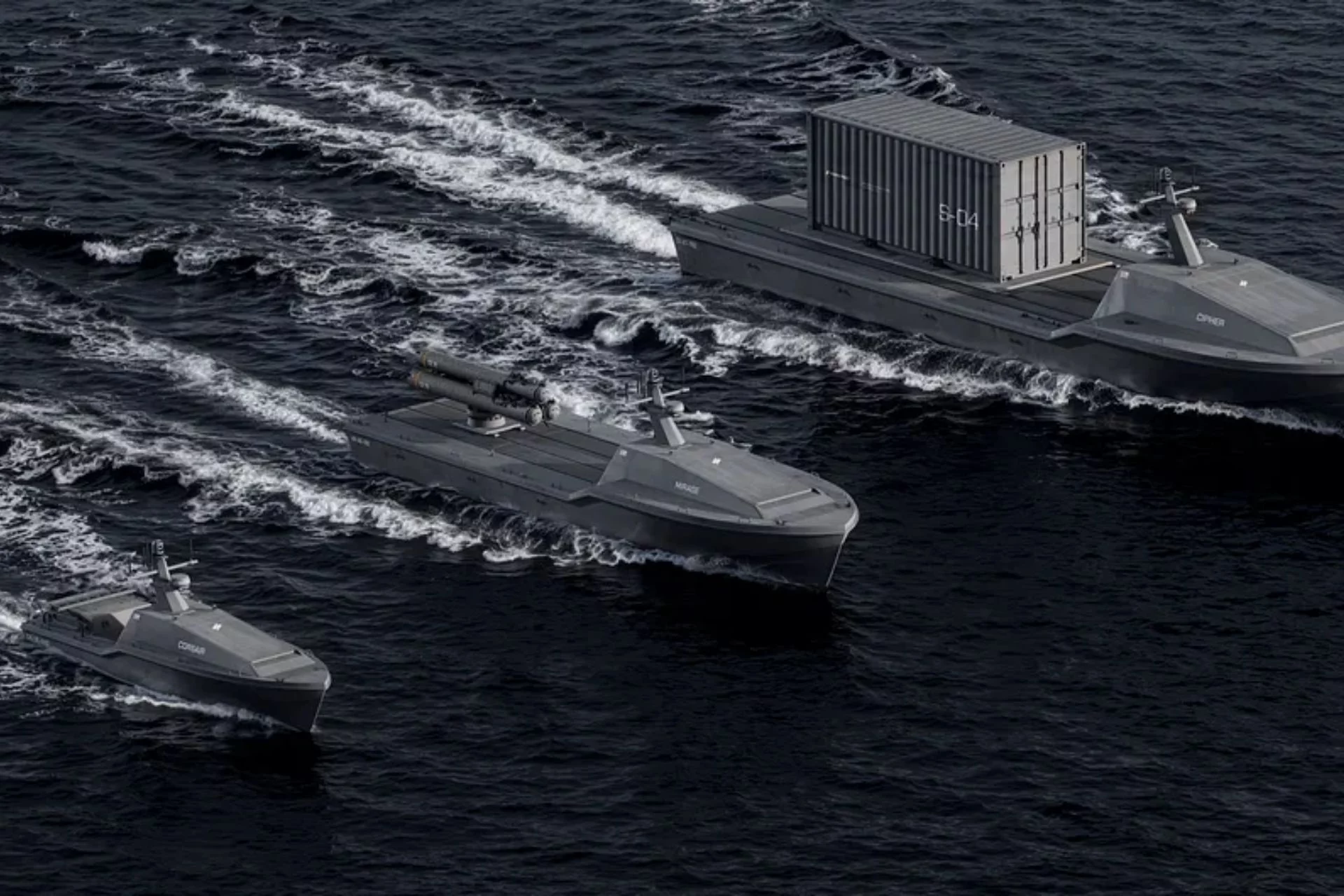
Saronic’s USV lineup spans a variety of mission profiles and sizes:
- Existing short-range models include Spyglass (6 ft), Cutlass (14 ft), and Corsair (24 ft).
- Newly introduced platforms Mirage (40 ft) and Cipher (60 ft) expand endurance and payload capacity.
The Cipher model carries up to 10,000 pounds with an endurance of 3,000 nautical miles, while Mirage offers 2,000 pounds and 2,000 nautical miles respectively. These platforms are tailored for coastal patrol, reconnaissance, light logistics, and mine countermeasure missions.
Above these, the company is developing Marauder, a 150-foot medium USV with a 40-ton payload capacity and 3,500 nautical mile endurance. The design emphasizes long-duration missions and modularity, including ISO container integration for ISR, hydrographic, or support payloads — bringing it closer to small manned patrol craft in operational flexibility.
Simulation-Driven AI Development
Saronic leverages digital twins and advanced simulation environments to accelerate its software development cycle. This approach allows for extensive pre-sea validation, reducing risk while speeding up algorithm qualification and sensor integration. With NVIDIA’s AI libraries and development environments, training, testing, and deployment cycles now complete within hours instead of days.
Operational Impact
Local data processing enhances resilience under emission control (EMCON) conditions, ensuring mission continuity with minimal communications exposure. Moreover, the alignment between simulation and real-world performance supports swarming operations and multi-agent coordination, expanding ISR coverage, maritime situational awareness, and reducing risks to manned vessels operating in contested environments.
Industrial and Strategic Dimensions
Beyond technology, the partnership holds industrial and strategic significance. It aligns with U.S. initiatives such as the “Restoring America’s Maritime Dominance” executive order and SHIPS Act, emphasizing digitized design, simulation-led testing, and rapid, modular production.
As the U.S. and allied navies seek to maintain persistent presence in regions like the Indo-Pacific, Red Sea, North Atlantic, and Mediterranean, scalable USV programs have become essential. The Saronic–NVIDIA partnership strengthens this trend by combining autonomy, speed, and industrial efficiency, helping reshape the U.S. naval and defense manufacturing landscape.
