

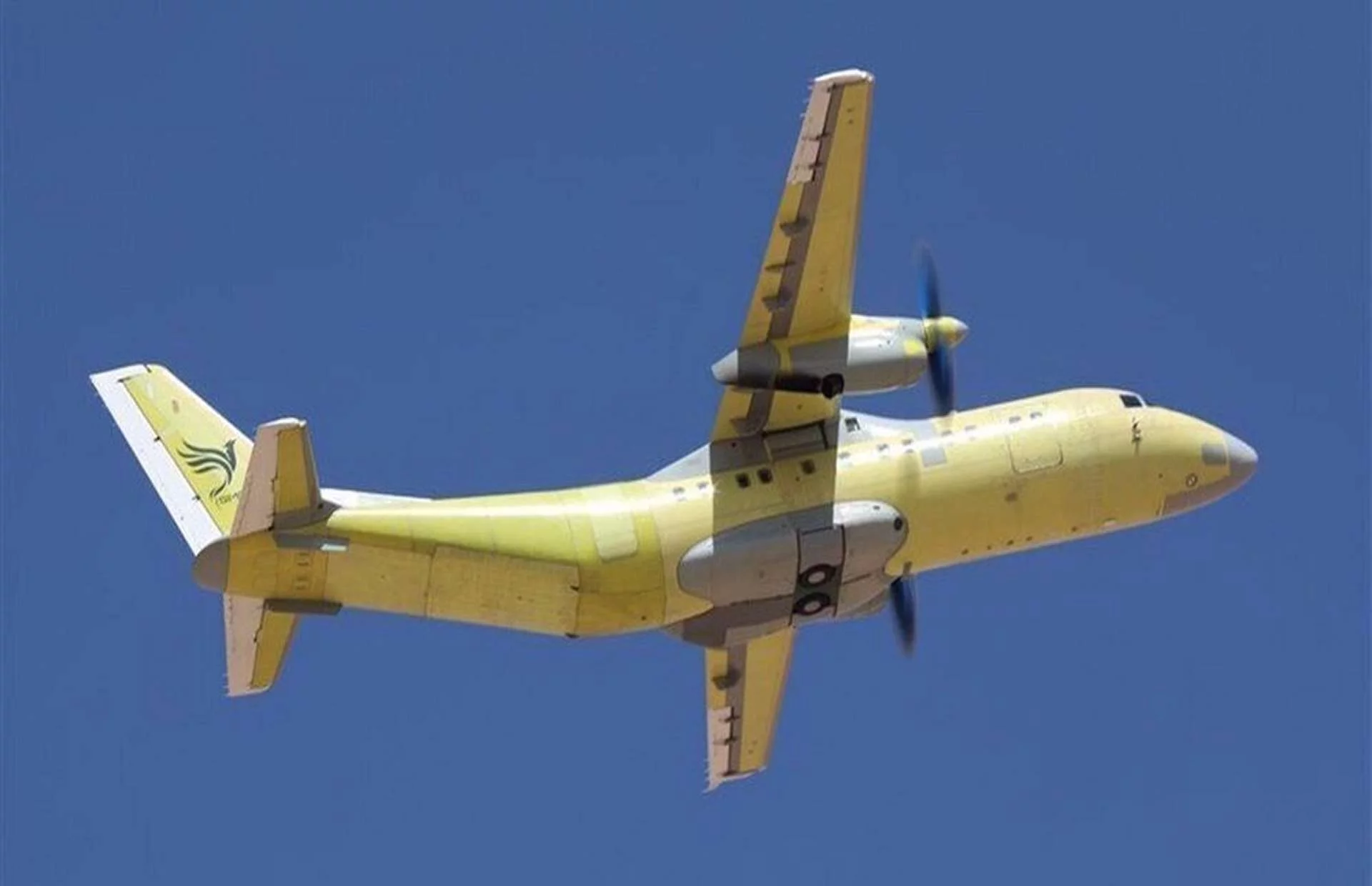
Iran has reached a major milestone in its long-running indigenous aircraft program. The Simorgh light transport aircraft, developed entirely by local engineers, has officially begun flight testing at Shahin Shahr after a ceremony attended by senior defense and transport officials. The event marks a significant step toward Tehran’s goal of achieving self-reliance in defense production despite years of international sanctions.
According to Iran’s Civil Aviation Organization, the Simorgh must complete 100 hours of flight testing under various operational and environmental conditions before certification for both military and civilian service.
Developed by HESA (Iran Aircraft Manufacturing Industries Company), the twin-turboprop Simorgh is derived from the IrAn-140 but features extensive redesigns to its fuselage, powerplant, and cargo systems. The aircraft offers a 6-ton payload, 3,900 km range, top speed of 500–533 km/h, and maximum takeoff weight of 21.5 tons, along with short takeoff and landing capabilities.
A key enhancement is the rear cargo ramp, which allows Simorgh to carry 463L pallets, light vehicles, aircraft engines, and medevac stretchers. It can be configured for troop transport, airdrop missions, or medical evacuation, aligning it with modern tactical airlifters and providing a domestic alternative to Iran’s aging C-130 Hercules fleet.
Analysts note that Simorgh’s specifications place it in the same class as aircraft such as the CN-235, An-26, C-212, and M28. The program underscores Iran’s continued efforts to restore and sustain its airlift capabilities under sanctions by developing a self-sufficient production and maintenance ecosystem.
Officials have also hinted at a civilian variant of Simorgh, which could stabilize production and support dual-use applications. If successful, the aircraft will give Iran’s armed forces and national carriers a reliable homegrown transport platform, easing pressure on its limited fleet of legacy aircraft.
