

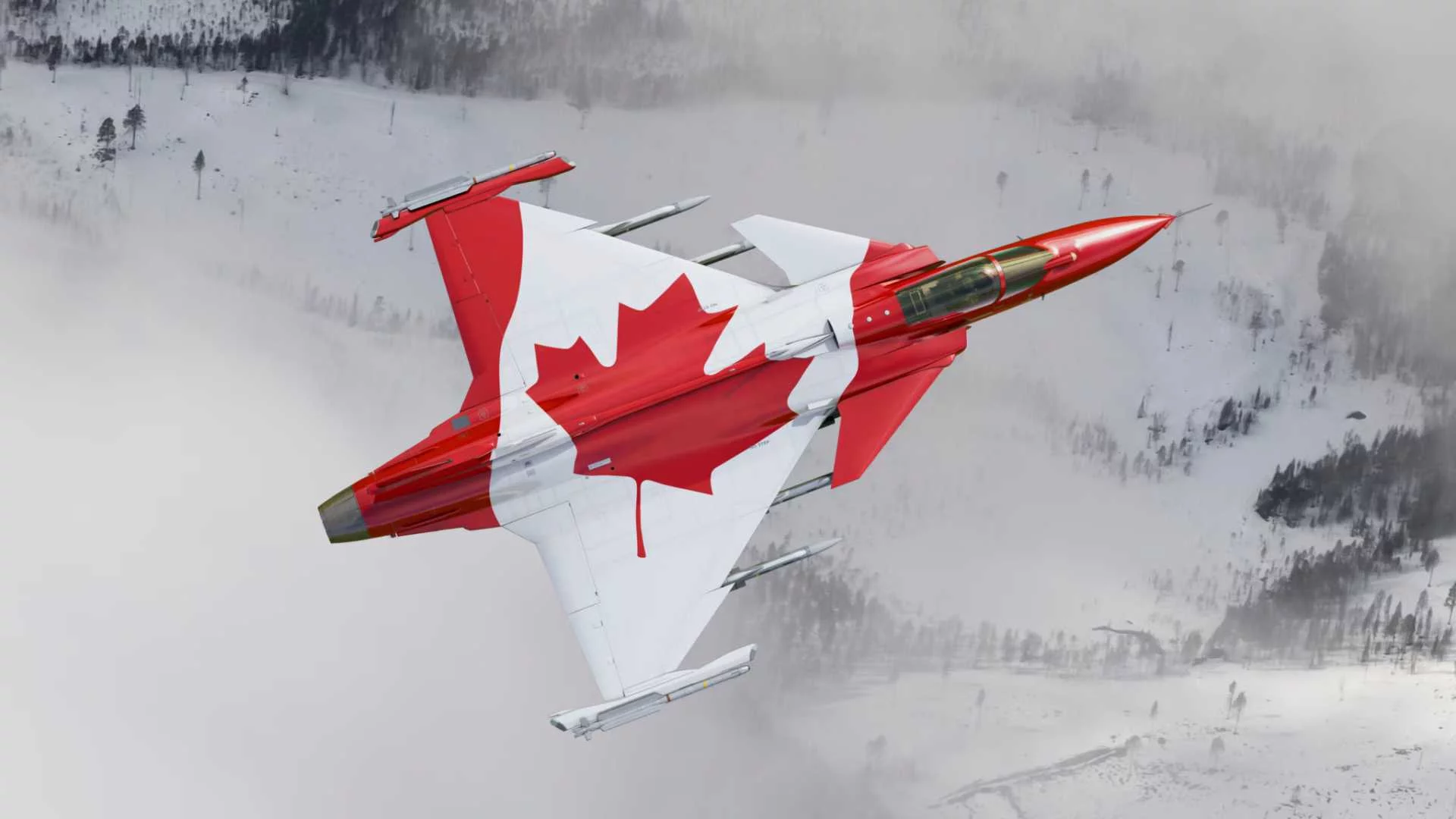
Swedish defense manufacturer Saab is reportedly considering Canada as a potential assembly site for Gripen fighter jets, as part of efforts to boost production capacity and meet growing global demand. The move follows the letter of intent signed between Sweden and Ukraine for the potential supply of up to 150 Gripen aircraft.
Saab CEO Micael Johansson confirmed that Canada is being evaluated as part of a broader expansion plan, noting that the large-scale Ukrainian program could nearly double the company’s current production rate. “Establishing new assembly and testing facilities will both increase capacity and ensure production continuity,” Johansson said.
Canada Emerges as a Key Node in Saab’s Global Production Network
This initiative marks a significant step toward Saab’s goal of creating new production centers outside Sweden and Brazil. If realized, Canada would become the first North American site for Gripen assembly, strengthening Saab’s strategy to diversify its manufacturing footprint and deepen defense partnerships across Europe and the Americas.
Saab Canada President Simon Carroll emphasized that Canada’s advanced aerospace sector is well positioned for such an investment:
“Canada has the industrial and engineering capacity to meet global defense demand. Saab continues to expand its partnerships with Canadian firms for both domestic and export projects.”
Saab already supplies the Canadian Armed Forces with several systems, including the Carl Gustaf shoulder-launched weapon, the RBS 70 NG short-range air defense system, the Sea Giraffe AMB radar used on Halifax-class frigates, and live training and simulation systems. The company also works with Bombardier on the GlobalEye airborne early warning and control aircraft, with Canadian-built airframes integrated in Sweden.
Production Capacity to Double for Ukraine
Under the preliminary agreement with Ukraine, Saab is planning to produce between 100 and 150 Gripen aircraft, which would “nearly double” its current output. Johansson said new assembly sites in Canada or Europe are under consideration, adding that the initiative may be partially financed through European Union funds or frozen Russian assets.
Ukraine favors the Gripen due to its short takeoff and landing capability, low maintenance costs, and operational flexibility under wartime conditions. Saab’s design philosophy emphasizes fast servicing and rearming — essential traits for dispersed operations in contested environments.
Modular and Digital Manufacturing System
The Gripen E features a modular production architecture supported by a fully digital assembly system. Facilities in Linköping (Sweden) and São Bernardo do Campo (Brazil) already use this structure, enabling components built in different countries to be seamlessly integrated. This approach reduces assembly time by up to 40 percent.
Saab plans for any future assembly sites to share the same digital quality assurance infrastructure, ensuring identical standards across all Gripen aircraft produced in Sweden, Brazil, Canada, or Ukraine.
Global Demand Accelerating
To date, Saab has delivered 60 Gripen E/F aircraft to Sweden, 36 to Brazil, and 4 to Thailand. With ongoing negotiations in Latin America, Central Europe, and Asia, the company’s total order backlog has reached 200 billion SEK. Saab has raised its 2025 sales growth forecast to 20–24 percent, citing strong demand for fighters, radars, missiles, and training systems.
Johansson stated that increasing production capacity will remain Saab’s top priority into 2026:
“Our new investment plan will not only accelerate production but also strengthen defense industry cooperation with partner nations.”
