

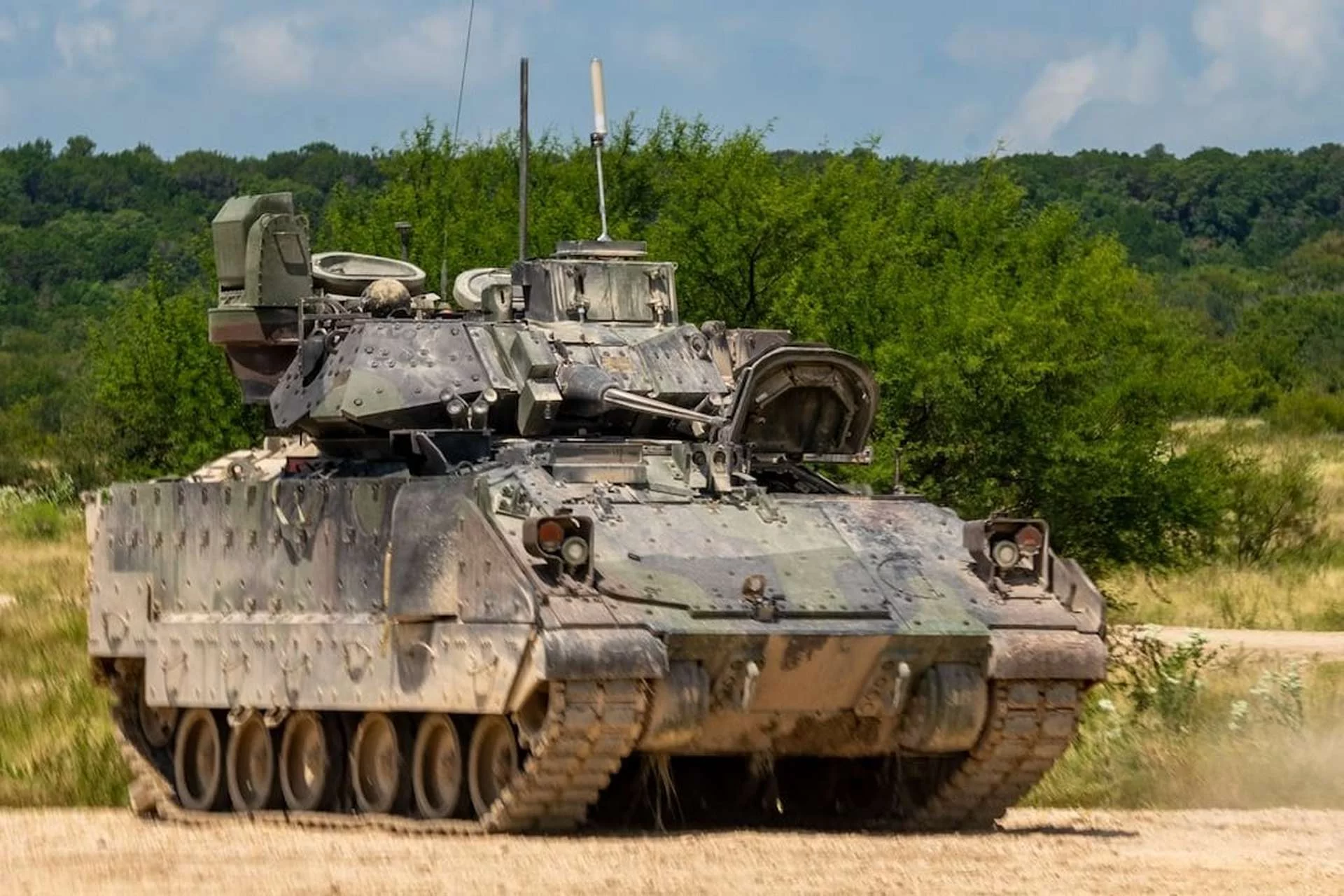
Rheinmetall’s U.S. subsidiary has secured a $31 million contract to help the U.S. Army and Ukraine repair battle-damaged Bradley infantry fighting vehicles near the front lines. The agreement marks a strategic shift from one-time deliveries to long-term sustainment support for Kyiv’s forces.
Rapid Repair Capability Near the Front
Awarded through the National Center for Manufacturing Sciences (NCMS), the 18-month contract tasks Rheinmetall America with creating an expeditionary Rapid Damage Assessment and Repair (RDAR) model. The concept envisions forward-deployed maintenance teams capable of diagnosing damage, conducting standardized repairs, and linking into a responsive parts network — without relying on distant depots.
The program runs through March 2027, when the first Bradleys restored under this model are expected.
Designed for the Ukrainian Battlefield
Ukraine has operated hundreds of U.S.-supplied M2A2 ODS-SA Bradleys since early 2023, using them for armored assault, troop transport, and medical evacuation under fire.
A repair system that can return these vehicles to service within days rather than months is a major operational advantage for Kyiv’s forces.
A Layered Sustainment Architecture
The contract complements, rather than replaces, BAE Systems’ ongoing rebuild and modernization work in the United States.
Washington is effectively constructing a layered sustainment chain: BAE manages depot-level rebuilds, while Rheinmetall demonstrates forward-repair logistics closer to the fight.
This approach aligns with NATO’s long-term vision of distributed, resilient maintenance capacity along Europe’s eastern flank.
Preparing for a Long War
Strategically, the award shows that the United States now expects a prolonged, high-consumption conflict in Ukraine — one where readiness will depend on regeneration speed, not just new deliveries.
Countering Russian Narratives
Russian forces have sought to exploit imagery of destroyed Western vehicles for propaganda. The new repair-and-return model undermines that effort, showing that NATO’s industrial base can rapidly restore combat vehicles, maintaining political and military credibility.
Though modest in dollar terms, the $31 million project signals a new endurance-centered doctrine: keeping U.S. platforms fighting through sustained, allied industrial cooperation. If Rheinmetall’s model proves successful by 2027, it will demonstrate that complex U.S. combat vehicles can be kept operational near active fronts — turning Western aid from consumable assets into reusable power.
