

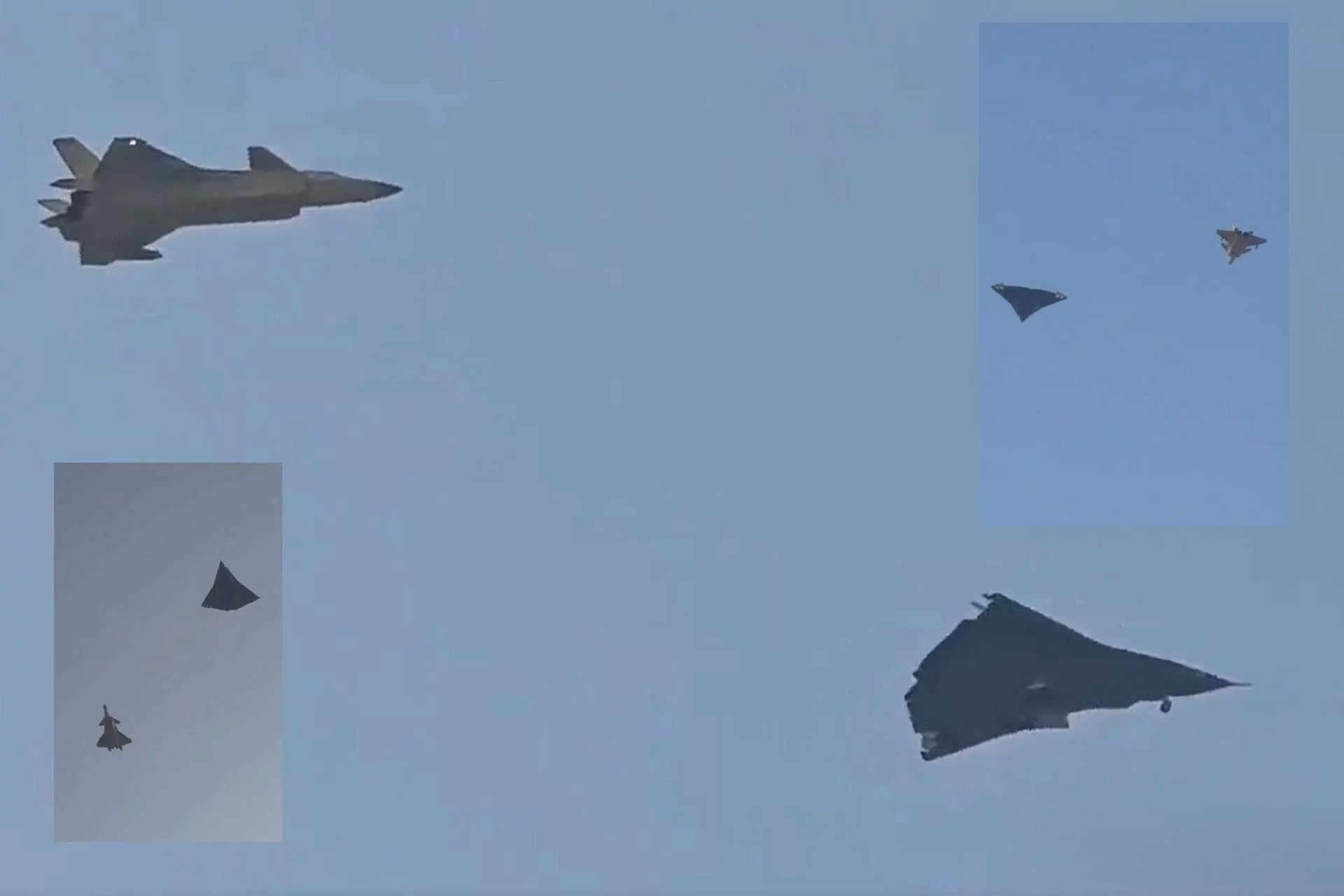
China’s experimental sixth-generation stealth fighter, the J-36, has been seen flying in formation with the fifth-generation J-20, marking the first public appearance of a combined flight between two generations of Chinese stealth jets. Footage taken on October 31, 2025, near Chengdu Aircraft Corporation’s facilities, suggests that the People’s Liberation Army Air Force (PLAAF) has begun testing the J-36 not just as a prototype, but as an operationally networked platform integrated with its current fleet.
What Makes the J-36 Different
Unlike the J-20, which serves as China’s frontline air-superiority fighter, the J-36 appears to be a larger, tailless stealth aircraft optimized for long-range missions. Its wide fuselage and deeper frame hint at expanded internal bays capable of carrying long-range air-to-air missiles, standoff precision munitions, or advanced surveillance payloads. Observers believe this aircraft could act as a “heavy tactical node” — a hybrid between a stealth bomber and a command aircraft designed to lead networked operations.
Early sightings of the jet in 2024 and early 2025 had already shown its distinctive diamond-shaped frame and possibly three-engine configuration, consistent with a platform focused on range, payload, and persistent stealth. Its aerodynamic shape and upper-fuselage air intakes suggest a design meant to remain hidden from radar while sustaining deep-penetration missions into contested zones.
The Role of the J-20 and “Manned Teaming”
In the recent flight, the twin-seat J-20S version appeared to accompany the J-36, likely serving as a sensor and command hub. The J-20S was built to coordinate drones and manned aircraft, allowing the rear-seat operator to manage mission data, target tracking, and unmanned systems. Pairing the mature J-20 with the experimental J-36 allows Chinese engineers to test data links, sensor fusion, and cooperative targeting without risking two prototypes simultaneously — a development strategy similar to how the U.S. Air Force tests its Next Generation Air Dominance (NGAD) aircraft with F-35 and F-22 support.
Strategic Implications for the Indo-Pacific
The combined J-36/J-20 flight highlights Beijing’s intent to field mixed-generation strike formations — formations where the J-36 could lead deep-penetration missions as a stealth pathfinder while J-20s provide protection and situational awareness. This doctrine would enable China to penetrate U.S. and allied air defense networks in the Western Pacific, using the J-36 to detect, jam, or strike key assets while maintaining human oversight through J-20S pilots.
By allowing such footage to circulate online, China also sends a deliberate strategic message. To the United States, it signals that Beijing’s sixth-generation fighter program is advancing faster than expected, potentially narrowing the technological lead of America’s NGAD. To regional powers like Japan, South Korea, and Australia, it underscores China’s determination to develop aircraft capable of breaching their layered defense systems.
Industrial and Geopolitical Momentum
The J-36’s flight alongside a combat-ready J-20 also reinforces the industrial rivalry and cooperation between China’s major aerospace firms, Chengdu and Shenyang. It demonstrates that Chengdu’s program has moved beyond mere prototypes toward integrated, operational testing, positioning China as the second country in the world — after the United States — to visibly advance a sixth-generation combat aircraft project.
In essence, the J-36’s appearance marks China’s transition from experimental development to operational validation. The aircraft is no longer a mysterious prototype — it’s the emerging centerpiece of Beijing’s future airpower network, one designed to dominate the skies and challenge U.S. air superiority across the Indo-Pacific by the 2030s.
