

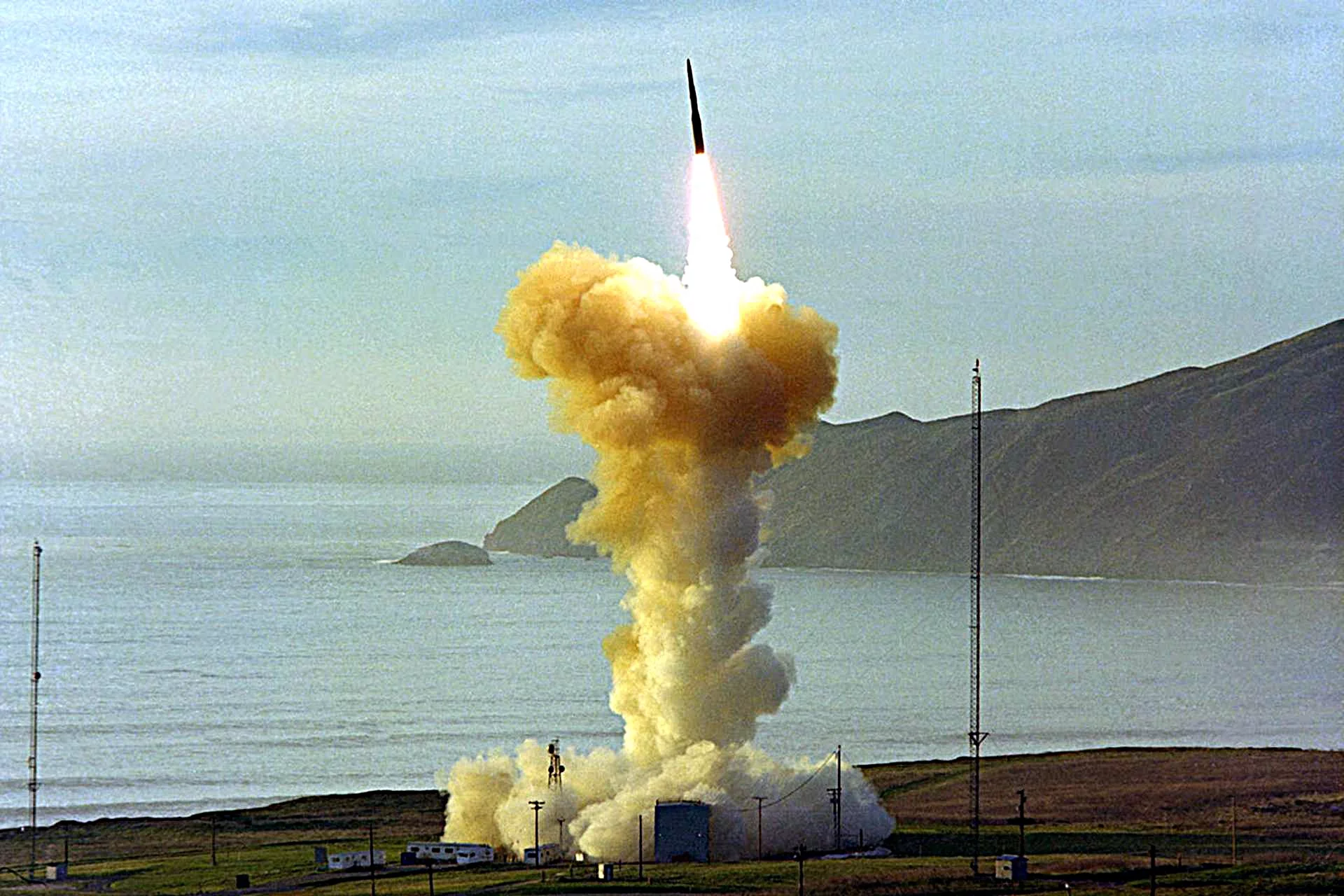
The United States armed forces plan to launch an unarmed LGM-30G Minuteman III from Vandenberg Space Force Base in California during a scheduled window on the night of 4 November, between 23:01 and 05:01 Pacific Time. The timing coincides with a sensitive period following President Donald Trump’s directive to resume certain aspects of nuclear testing; however, officials have been clear that this is not a test involving a nuclear detonation.
According to a Vandenberg Space Force Base announcement and reports from Russian news agency TASS, the U.S. military aims with this operational test launch—which is part of routine activity but occurs amid current debates about nuclear tests—to demonstrate the missile’s accuracy and operational readiness. Because the launch comes just days after President Trump’s recent statements on the nuclear program, it sends a sharpened strategic message to Beijing and Moscow.
The LGM-30G Minuteman III is a land-based ICBM with rapid-launch capability and forms an important element of nuclear deterrence. This three-stage, solid-fuel missile has a range in excess of 9,600 kilometers. Entering service in the early 1970s and continuously modernized since, the system is currently deployed in a single-warhead configuration consistent with present U.S. policy. Its technical capability, however, can accommodate multiple independently targetable reentry vehicles (MIRVs) depending on configuration. The missile combines an inertial guidance system with GPS or star-sighting updates on newer variants, giving it high-precision strike capability against hardened, fixed targets, and it constitutes the land leg of the U.S. nuclear triad alongside sea- and air-based forces.
Since entering service in the 1970s, the Minuteman III has undergone refurbishment and life-extension programs continuing through 2015. The Air Force spent roughly $7 billion to sustain the fleet, which officials describe as “almost new except for their outer skins.” More than 300 flight tests have been conducted over decades; these are considered pre-planned activities independent of external developments. Today, roughly 400 missiles are deployed across the U.S. Midwest.
The Minuteman III’s advantages include immediate response capability, short time-to-target, and a dispersed basing strategy that complicates enemy targeting. By contrast, Russia emphasizes mobile, MIRV-capable systems such as the Yars, while China fields new mobile ICBMs like the DF-41. The U.S. preference for single-warhead Minuteman IIIs supports stability during crises. Although the older system will eventually be replaced by Sentinel ICBMs, frequent tests like this one demonstrate the current system’s continued reliability.
Strategically, tonight’s test conveys multiple messages. Geopolitically, coming amid heightened great-power tensions and just after Trump’s Oct. 29 remarks, it reassures allies that Washington’s extended deterrent is functioning and measurable. Geostrategically, similar to the May test, a likely flight path from California to Kwajalein demonstrates a full-range capability along a Pacific test corridor without violating nuclear test bans. Militarily, the collected trajectory, guidance, and control timeline data contribute to reliability measurements for a force that must remain safe, secure, and effective at all times.
In short, while the Minuteman III launch is routine, it publicly reaffirms deterrent capability as Washington debates the future of land-based missiles and transitions toward Sentinel. By announcing the pre-planned test and using designated Pacific corridors, the U.S. emphasizes its readiness without breaching test bans—sending a signal to rivals while assuring allies that the nuclear backbone is being validated with real flight data.
