

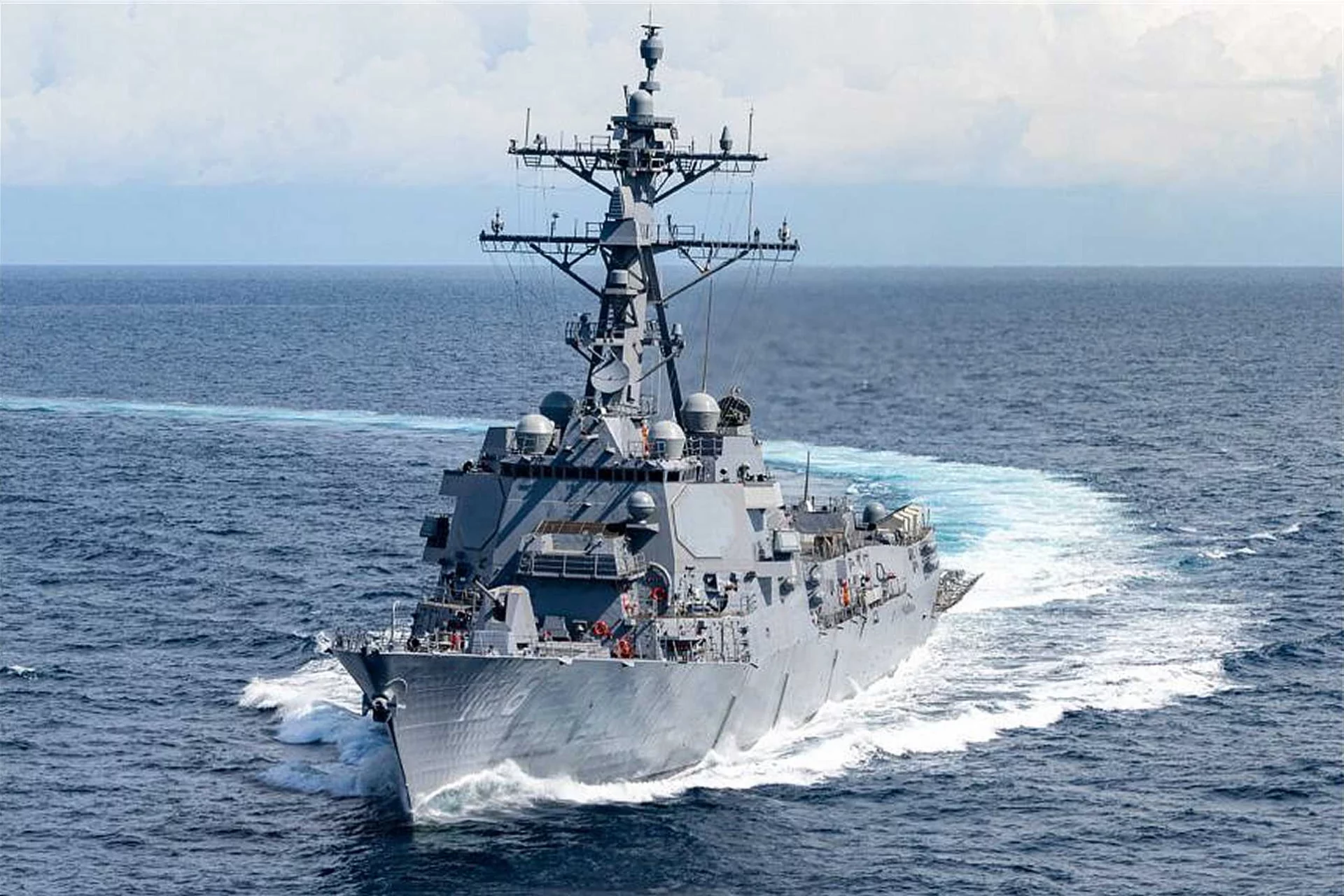
The future Arleigh Burke-class Flight III destroyer USS Ted Stevens (DDG 128) has successfully completed its second set of builder’s sea trials, equipped with the US Navy’s most advanced SPY-6(V)1 radar. The achievement marks a major milestone ahead of the ship’s delivery and underscores the Navy’s progress in fielding its next-generation surface combatants.
Raytheon announced on October 30, 2025, that the SPY-6-equipped USS Ted Stevens had concluded its second round of builder’s trials. The state-of-the-art radar, designed and built by Raytheon, dramatically enhances the Navy’s ability to detect and track air and missile threats across multiple domains. This success moves the destroyer closer to commissioning and highlights a significant leap in naval sensor integration.
As the second Flight III destroyer to undergo sea trials, Ted Stevens represents the Navy’s transition toward a fully networked and multi-domain force. Named after the late Alaska Senator Ted Stevens, a key figure in US defense policy, the destroyer is scheduled for commissioning in 2026. The vessel was built at HII’s Ingalls Shipbuilding facility in Pascagoula, Mississippi — one of the Navy’s main production hubs for large surface warships.
The SPY-6(V)1 radar system comprises four active electronically scanned array (AESA) faces, each containing 37 Radar Modular Assemblies (RMAs), providing uninterrupted 360-degree coverage. It enables simultaneous tracking of ballistic and hypersonic missiles, cruise missiles, manned aircraft, UAVs, and surface targets while maintaining resilience against electronic warfare environments.
Offering over 30 times the sensitivity and range of the legacy SPY-1D(V) radar, SPY-6 expands battlespace awareness and allows earlier engagement of advanced threats. Integrated with Aegis Baseline 10, the system transforms DDG 128 into a multi-mission sensor hub for carrier strike groups, amphibious task forces, or independent operations.
Beyond its technical strength, the radar’s successful integration signals the Navy’s modernization drive. The Flight III Arleigh Burke destroyers serve as the technological bridge between today’s surface fleet and future platforms like DDG(X), expected to dominate air and missile defense roles in the Indo-Pacific during the next decade.
The successful completion of these trials confirms the maturity of propulsion, navigation, auxiliary systems, and combat system integration ahead of final Navy acceptance tests. Raytheon currently holds contracts for more than 30 SPY-6 variants destined for destroyers, amphibious ships, and carriers — with interest also coming from allies including Japan and Australia.
The USS Ted Stevens stands as a symbol of the US Navy’s modernization trajectory — merging proven ship design with cutting-edge radar technology — reaffirming that in future naval warfare, sensor dominance may well decide the outcome of the first critical minutes of conflict.
