

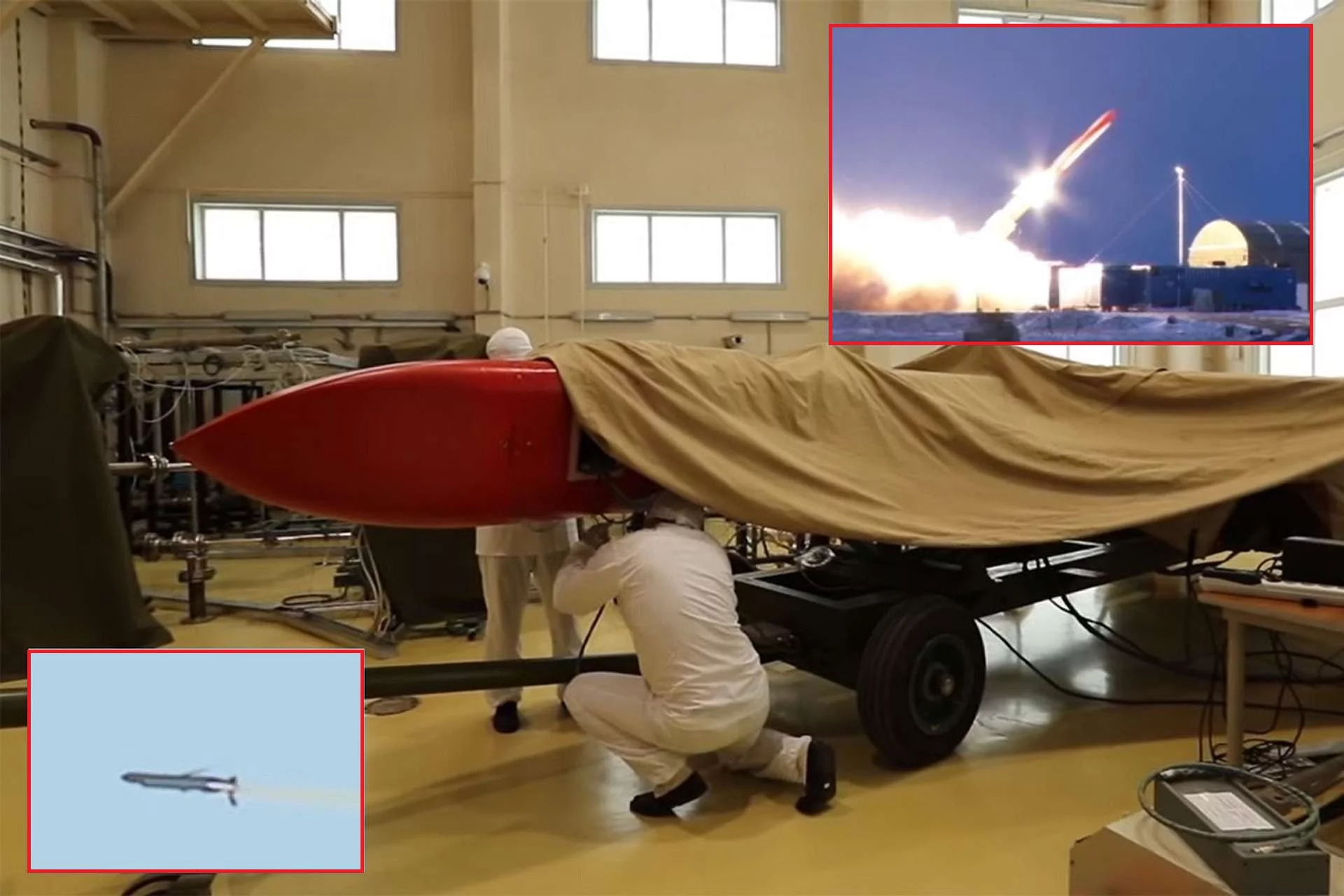
Russia has officially announced the development of a new generation of nuclear-powered cruise missiles, with President Vladimir Putin confirming a target speed of Mach 3 and a long-term goal of achieving hypersonic performance. The statement, delivered during a Kremlin ceremony honoring the Burevestnik and Poseidon development teams, marks a strategic shift from a single demonstrator system to an entire family of nuclear-powered missiles.
From Burevestnik to a New Generation
First revealed in 2018, the Burevestnik (NATO: SSC-X-9 “Skyfall”) integrates a miniature reactor into a low-flying, nuclear-armed cruise missile offering virtually unlimited range. In October, Russian officials claimed a test covering 14,000 km over 15 hours, suggesting a successful long-endurance flight. Putin’s latest remarks now expand that vision, signaling serial development and multiple operational variants under a unified concept.
Toward Supersonic and Hypersonic Flight
Putin’s mention of “Mach 3 and hypersonic in the future” suggests a transition from Burevestnik’s traditional subsonic nuclear-ramjet design to higher-energy air-breathing propulsion cycles. The concept recalls the U.S. Project Pluto/SLAM designs of the 1950s–60s, which explored nuclear-thermal ramjets but were never deployed due to safety and control challenges. Moscow’s emphasis on cutting reactor start-up time to “seconds” underscores advances in miniaturized reactor technology, a prerequisite for sustained supersonic or hypersonic flight.
Multi-Platform Deployment and Strategic Purpose
If Russia proceeds toward serializing this missile family, it may pursue ground-based mobile, naval, and air-launched variants. Each would offer different operational advantages—from survivability and range flexibility to multi-axis strike options that could overwhelm layered air and missile defenses. An air-launched version from Tu-160M or Tu-95MSM bombers would be particularly flexible but raises acute safety concerns due to the onboard reactor.
Opportunities and Dangers
A diversified nuclear-powered missile portfolio would expand Russia’s strategic penetration capabilities, reduce dependence on ballistic systems, and complicate U.S. and NATO missile defense planning. However, such systems carry grave safety, environmental, and political risks, including radiological hazards during testing or accidents—risks highlighted by the 2019 Nyonoksa explosion, widely linked to the Burevestnik program.
If realized, these next-generation nuclear-propelled cruise missiles would mark a new phase in the global arms race—one where endurance, speed, and unpredictability redefine deterrence dynamics and the limits of arms control.
