

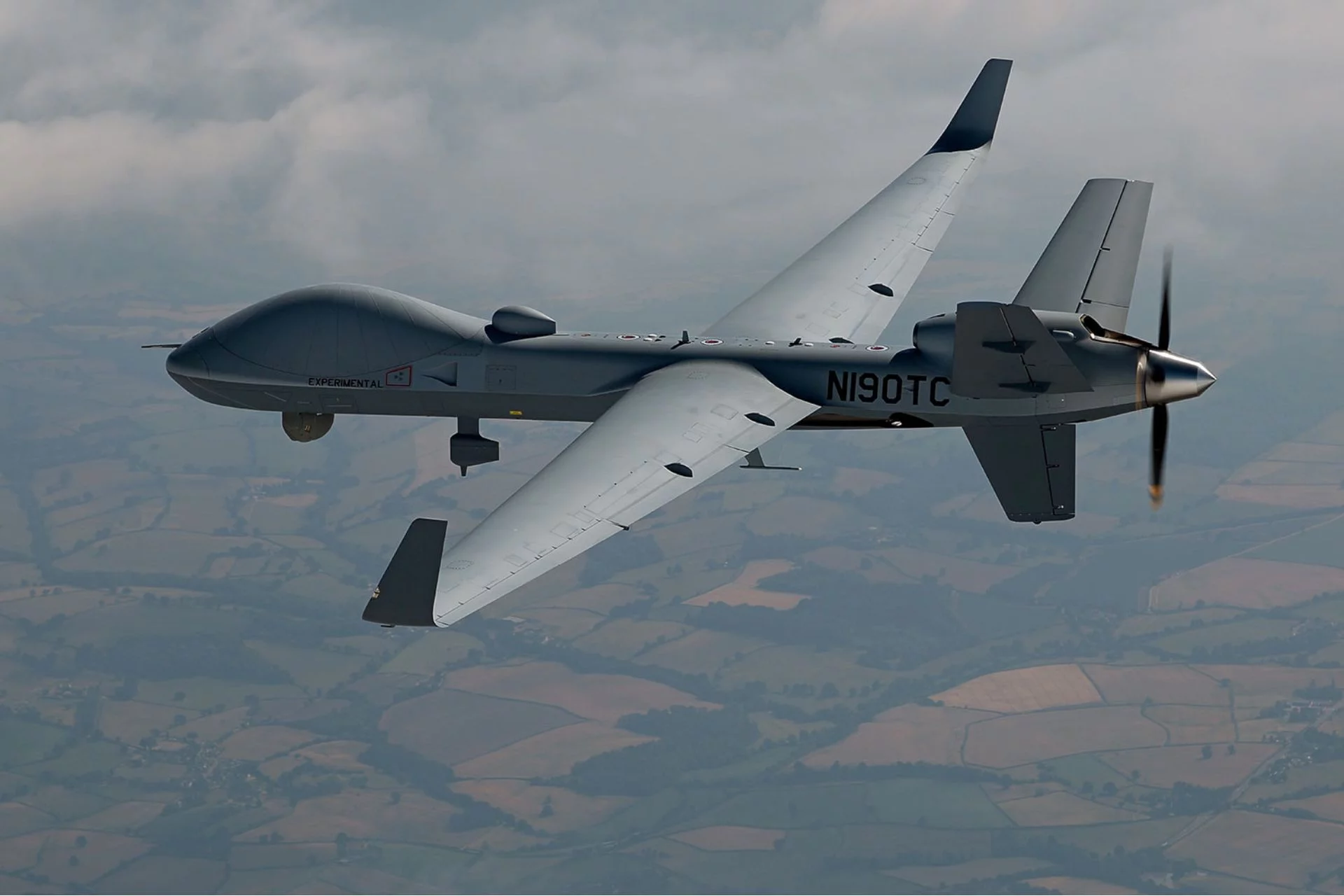
Taiwan’s air arm expects the first two U.S.-built MQ-9B SkyGuardian unmanned aircraft to arrive in the third quarter of 2026, with a second two-aircraft delivery due in 2027. The four-platform buy — contracted through U.S. channels — includes ground control stations and sustainment support aimed at strengthening Taiwan’s persistent surveillance and target-designation capabilities across its maritime approaches.
Key capabilities and specifications
The MQ-9B is a medium-altitude, long-endurance (MALE) system designed for extended ISR and operations in controlled airspace. With an approximate 24-meter wingspan, turboprop endurance measured in multiple tens of hours and an operational ceiling above 40,000 feet, the platform can carry a mix of external and internal payloads — electro-optical/infrared sensors, synthetic-aperture radar, maritime surveillance radar and electronic/signals packages — enabling long-range maritime and overland monitoring.
How it will change Taiwan’s operational picture
Fielding SkyGuardians will expand Taiwan’s ability to sustain continuous observation arcs to the east and south, improving detection of surface groups, low-signature vessels and undersea contacts when configured for ASW tasks. Persistent tracks from MQ-9Bs can be fused into joint command-and-control networks to speed sensor-to-shooter cycles and free manned fighters for air-dominance missions.
Integration, resilience and basing
Taipei plans to rely on beyond-line-of-sight SATCOM links, automatic takeoff/landing routines and an open mission system to permit modular sensor upgrades and reduce runway dependence. The limited ground footprint supports dispersed basing — main airfields, forward detachments or temporary strips — and offers emission control options that complicate an adversary’s targeting.
Strategic context and timeline implications
The 2026–2027 delivery window plugs an intelligence and targeting gap while other modernization programs — including fighter and ground systems — mature. Regional partners see such sensor persistence and information sharing as a way to compress adversary decision windows and strengthen denial-based deterrence, prioritizing sustainable, interoperable capabilities over high-profile effects.
