

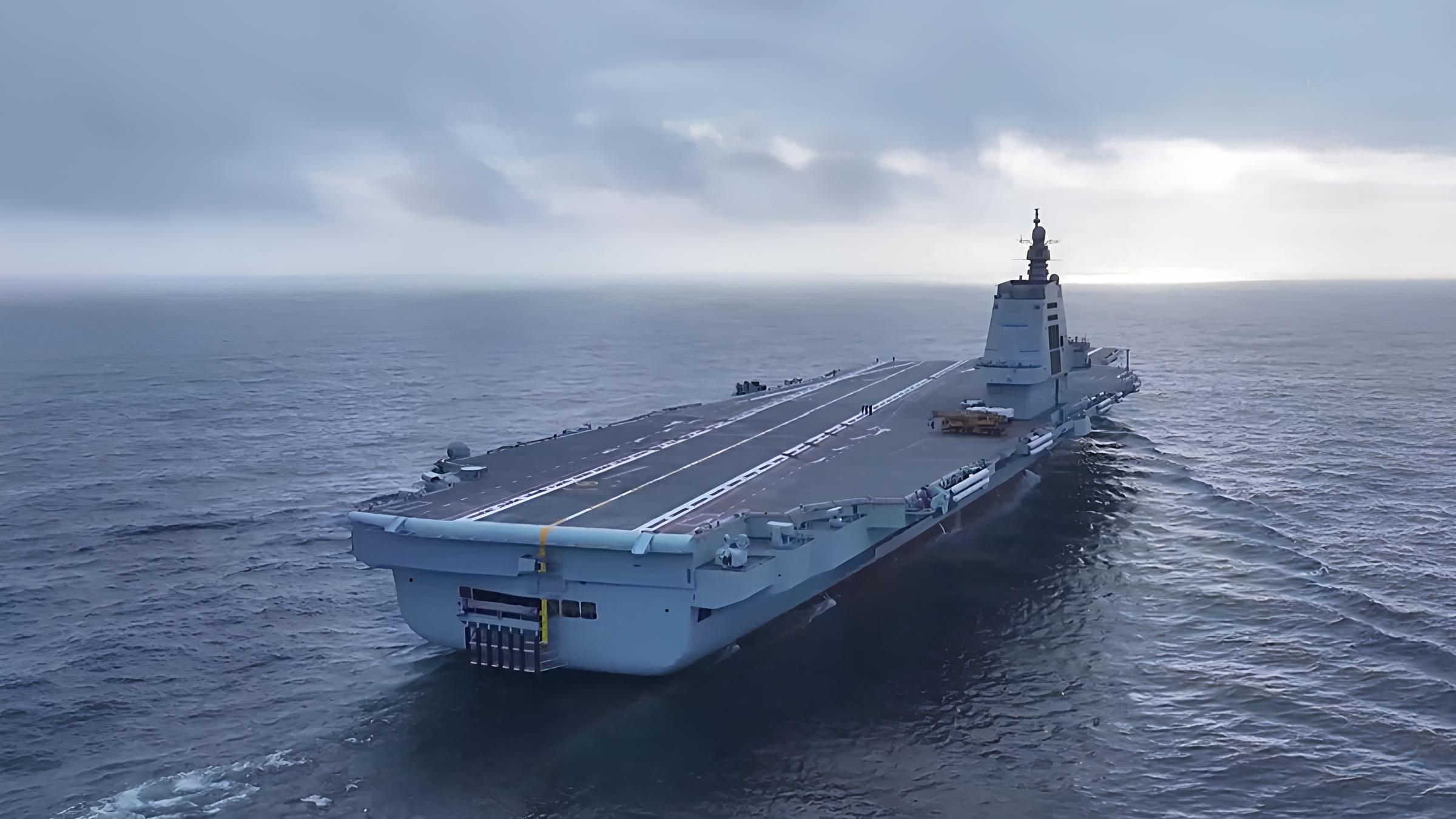
China has officially commissioned its most advanced aircraft carrier, the Type 003 Fujian, marking a historic leap into next-generation naval aviation and placing it in direct comparison with the U.S. Navy’s Gerald R. Ford-class supercarriers. The move underscores a growing rivalry between the two maritime powers for dominance in the Indo-Pacific.
Fujian: China’s Entry into the EMALS Era
The Fujian is China’s first carrier equipped with an Electromagnetic Aircraft Launch System (EMALS) — a breakthrough technology previously exclusive to the United States. This advancement enables the People’s Liberation Army Navy (PLAN) to launch heavier and more capable aircraft, transitioning from ski-jump takeoff carriers to full CATOBAR (Catapult Assisted Take-Off But Arrested Recovery) operations.
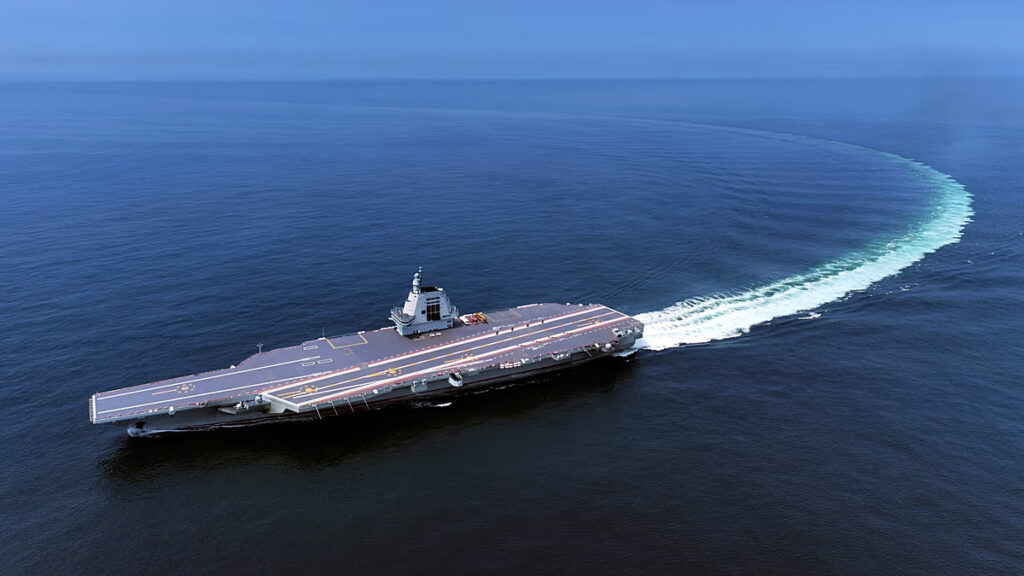
Weighing around 80,000–85,000 tons and measuring 316 meters in length, Fujian is conventionally powered, likely using a gas-turbine or diesel-electric propulsion system. Its three EMALS catapults and indigenous arresting gear system mark China’s bold step into the future of carrier warfare. However, analysts suggest its electromagnetic launch power is still behind that of the Ford class.
Ford-Class: Benchmark for 21st-Century Naval Power
The USS Gerald R. Ford (CVN-78), displacing 100,000 tons, remains unmatched in endurance and capability. Powered by two A1B nuclear reactors, it can operate indefinitely without refueling and supports up to 160 sorties per day during surge conditions. Its advanced radar, automated systems, and 600-megawatt electrical capacity enable integration of next-generation weapons and sensors.
The Ford typically carries about 75 to 90 aircraft, including F/A-18E/F Super Hornets, EA-18G Growlers, E-2D Hawkeyes, F-35C Lightning II stealth fighters, and MQ-25 Stingray refueling drones. Its proven air wing allows global power projection and sustained operations unmatched by any other navy.
Fujian’s Developing Air Wing
China’s Fujian is expected to host 60 to 75 aircraft, including:
- J-15T Flying Shark fighters (catapult-compatible variant)
- J-35 stealth fighters, still undergoing carrier trials
- KJ-600 early warning aircraft
- Z-18F/Z-20 helicopters and potential GJ-11 stealth UAVs
While this represents a major capability boost for China, these platforms are still in testing or early operational stages. Analysts emphasize that PLAN carrier aviation is still decades behind U.S. experience in integrated, large-scale air operations.
Endurance and Strategic Reach
Endurance remains the defining difference. The Ford can operate continuously for 20–25 years without reactor refueling, while Fujian’s conventional propulsion restricts it to 90–100 days at sea before replenishment. This limits China’s global deployment capacity, though it marks significant progress for regional power projection.
Strategic Implications
The Fujian-Ford comparison highlights contrasting naval doctrines:
- The U.S. Navy operates globally, emphasizing nuclear power, interoperability, and expeditionary reach.
- The PLAN, though advancing rapidly, remains regionally focused with conventional logistics and limited experience.
Yet, the launch of Fujian and the development of a nuclear-powered fourth carrier signal China’s intent to close the gap. For defense planners, this marks the beginning of a new phase in global carrier competition, redefining power projection across the Indo-Pacific.
