

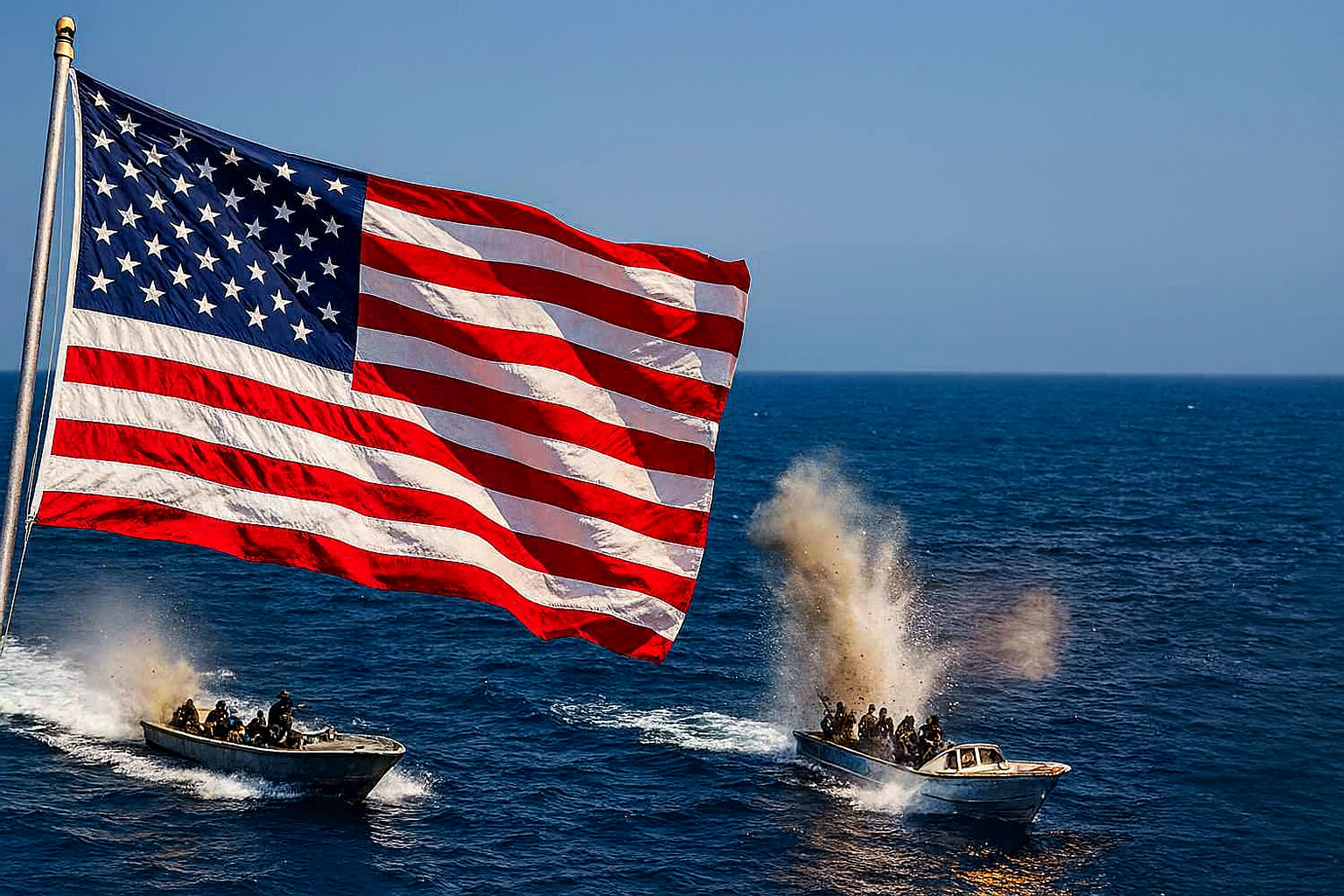
U.S. Secretary of War Pete Hegseth announced on November 10 that American forces carried out two lethal strikes a day earlier against vessels suspected of drug trafficking in the Eastern Pacific Ocean. The attacks, ordered directly by President Donald Trump, reportedly killed six individuals — three on each vessel — with no U.S. casualties. The Pentagon has yet to confirm operational details.
According to U.S. intelligence, the targeted boats were navigating a known narcotics corridor in international waters, operated by criminal networks linked to terrorist organizations. Surveillance assets confirmed the presence of narcotics before the strikes were authorized.
Redefining Threats: Cartels as Terror Networks
Secretary Hegseth said the operation was part of a broader strategy under President Trump’s national security directives, which reclassify transnational drug cartels as terrorist entities. This redefinition grants the Department of Defense the authority to engage cartel-linked actors under wartime rules, bypassing the limits of law enforcement operations.
President Trump has repeatedly framed the influx of synthetic opioids and fentanyl precursors as a national security emergency, arguing that drug cartels are waging an “indirect war” on the United States. His administration asserts that if such organizations cause tens of thousands of American deaths annually, they qualify as armed adversaries subject to preemptive military action.
Strategic Focus Shifts to the Pacific
Analysts note that targeting the Eastern Pacific signals a geographical shift in cartel logistics, moving away from the Caribbean toward open Pacific routes. This has prompted the U.S. Navy to expand its maritime surveillance and strike presence across the region, employing advanced sensors and unmanned systems to interdict high-value targets at sea.
Defense sources suggest that MQ-9 Reaper drones equipped with maritime targeting systems likely played a central role in the operation, tracking the boats in real time before precision strikes were launched.
A Military Approach to the Drug War
Experts describe this campaign as a hybrid warfare model applied to counter-narcotics — integrating intelligence-based targeting, persistent surveillance, and precision engagement. The goal is to destroy smuggling networks and deny them freedom of maneuver.
The policy marks a broader militarization of the U.S. drug-control strategy, transforming what was once a law enforcement mission into an extended defense operation. While Latin American nations may raise concerns over the growing use of force in nearby international waters, Washington insists that preemptive action is justified to protect national security.
For the U.S. defense community, this represents a new mission set — requiring faster kill-chain integration, deeper ISR coverage across maritime zones, and advanced strike capabilities. Contractors developing unmanned platforms, precision weapons, and intelligence fusion systems are expected to play a key role as the campaign expands.
This operation underscores a historic shift: the U.S. is no longer treating drug cartels as criminals to arrest, but as enemy combatants to defeat on the global stage.
