

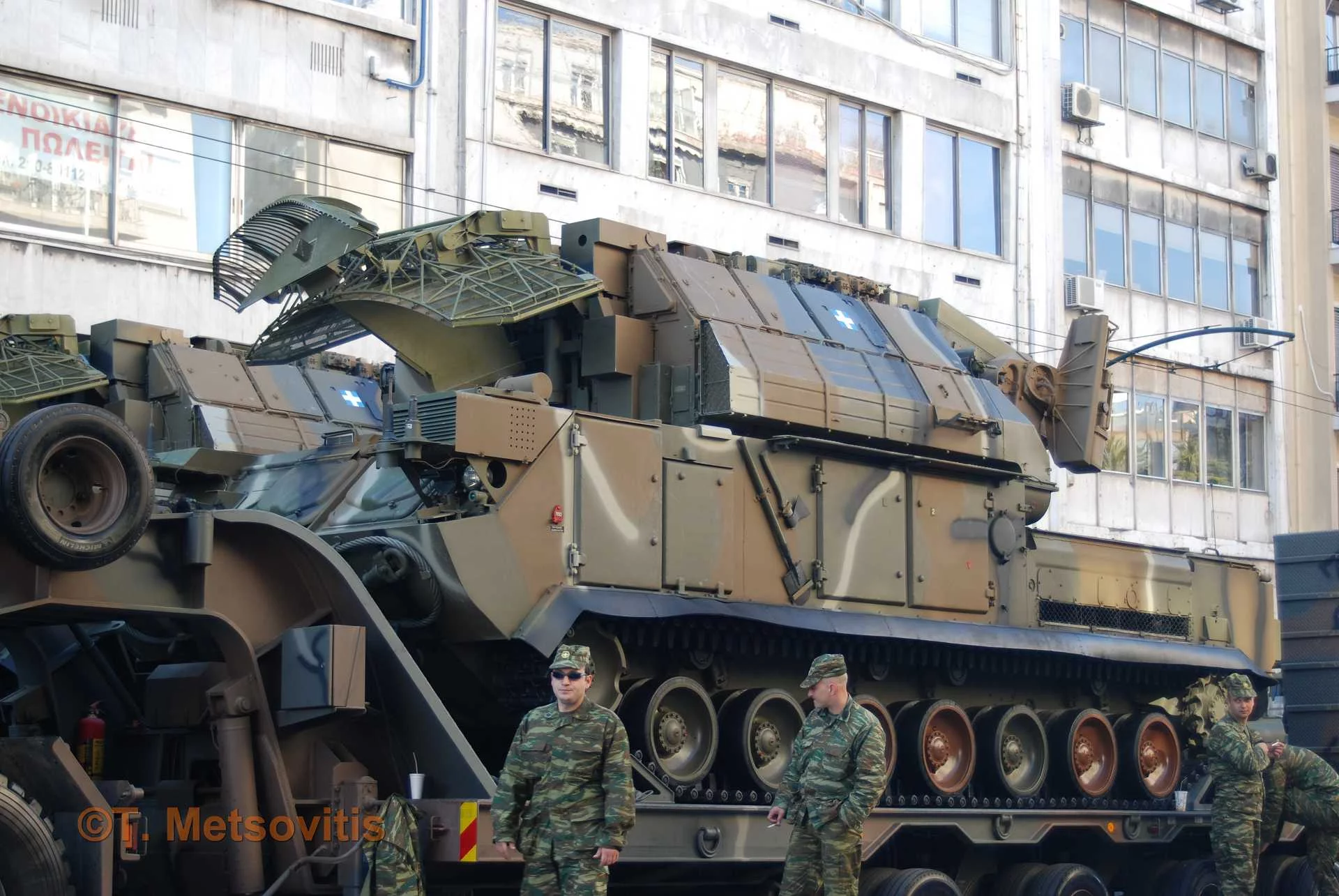
Greece is entering a $3.5 billion modernization phase under its new air defense initiative, “Achilles’ Shield.” According to Greek City Times, the project aims to replace existing Russian and U.S.-made systems with a highly integrated, multi-layered air defense network largely sourced from Israeli technology.
This move deepens Athens’ strategic cooperation with Israel in defense technology and marks the most comprehensive upgrade to Greece’s air defense architecture in decades.
Complete Transition to Israeli Systems
Announced by the Greek Ministry of Defense in early 2025, the Achilles’ Shield program represents the first stage of a 12-year modernization effort valued at up to €28 billion. The current $3.5 billion phase focuses on renewing short-, medium-, and long-range surface-to-air missile systems.
Under the plan, the SPYDER (Surface-to-air PYthon and DERby) system—developed by Rafael Advanced Defense Systems and Israel Aerospace Industries (IAI)—will replace Greece’s aging OSA-AK and TOR-M1 short-range air defense units. SPYDER stands out for its fast reaction time, high mobility, and capability to intercept UAVs, cruise missiles, and low-flying aircraft.
For the medium-range layer, the Barak MX system will succeed the U.S.-made MIM-23 Hawk batteries. Featuring a modular and software-defined design, Barak MX can track and engage multiple targets simultaneously across diverse threat environments.
At the long-range level, Israel’s SkyCeptor interceptor—derived from the Stunner missile used in the David’s Sling system—is expected to replace Greece’s Russian S-300 PMU-1 systems. The SkyCeptor is designed to counter advanced threats such as tactical ballistic missiles while ensuring full interoperability with NATO’s defense architecture.
A Geopolitical Shift
Greece’s decision to transition from Russian-origin systems to Israeli technology marks both an operational and geopolitical turning point. EU and NATO restrictions on Russian military equipment have made maintenance increasingly difficult, while evolving drone and precision-strike threats demand a faster, more networked air defense posture.
The Israeli systems, battle-proven through extensive operational use, offer enhanced reliability and responsiveness. Greece’s goal is to build a digitally networked, NATO-integrated air defense structure capable of operating effectively in contested environments.
Defense Industry Integration
Procurement decisions have favored Israeli systems due to shorter delivery timelines, lower maintenance costs, and greater industrial participation. Following IAI’s 2023 acquisition of Intracom Defense, Greece will be able to locally assemble, maintain, and upgrade components of the Achilles’ Shield systems.
Implementation Timeline
Although official contract details and delivery schedules have not been released, local sources indicate that the first systems are expected to enter service in 2026, with full operational capability targeted by late 2028. Interim defensive measures will be implemented to safeguard critical infrastructure during the transition period.
Strategic Implications
Valued at $3.5 billion, the Achilles’ Shield initiative represents Greece’s largest missile procurement program in recent decades. Beyond strengthening NATO interoperability, it will further integrate Athens into Western and Israeli defense supply chains.
The transformation significantly enhances Greece’s deterrence posture in the Aegean and Eastern Mediterranean, while laying the groundwork for a new era of long-term defense-industrial cooperation between Greece and Israel.
