

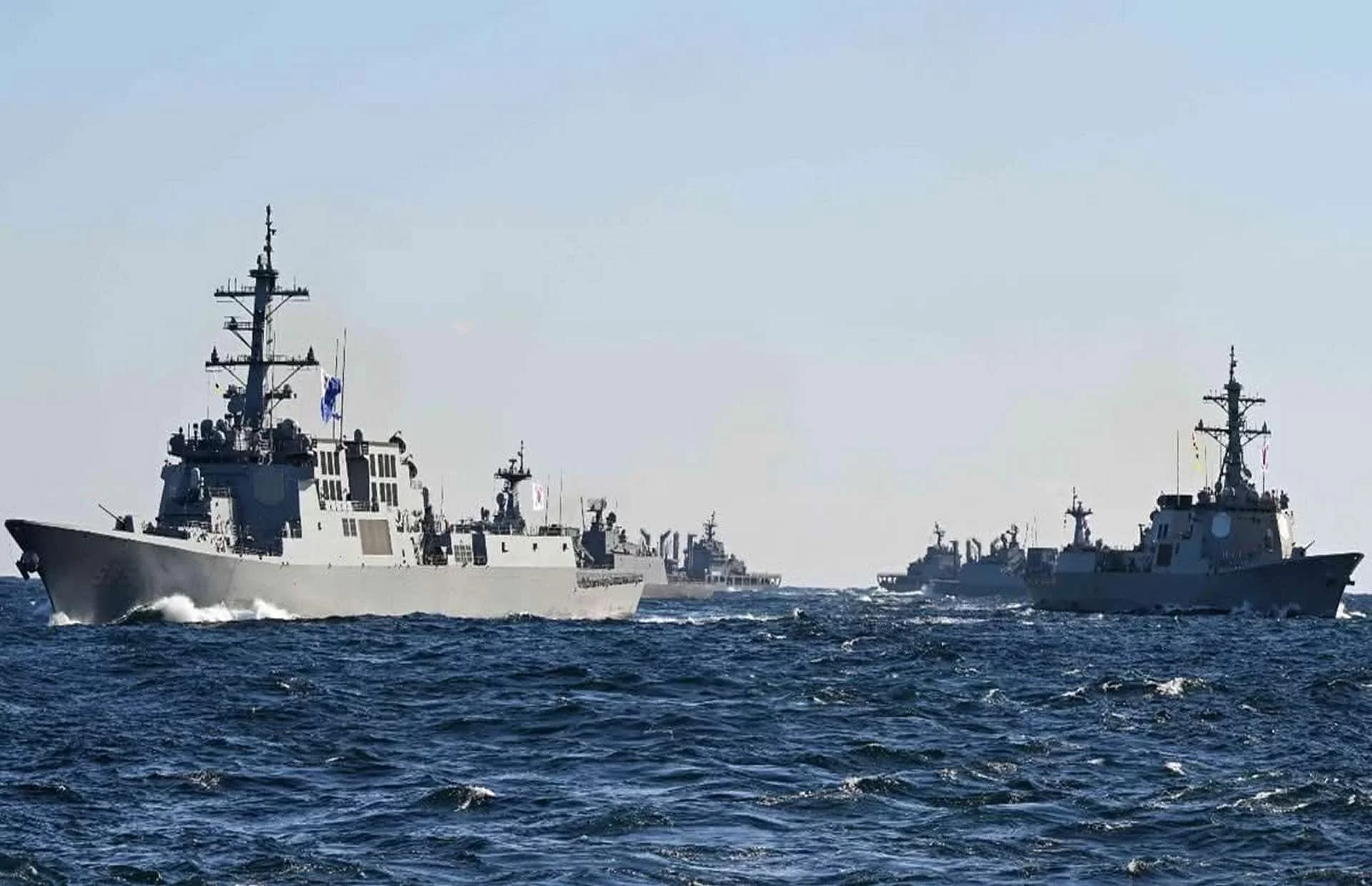
South Korea has completed its first major naval maneuver under the newly established Task Fleet Command, signaling a decisive shift toward a more mobile, missile-defense-oriented maritime posture. The three-day drill, conducted across the East and South Seas, integrated Aegis destroyers, logistics escorts and maritime aircraft into a single fleet staff—marking a significant step in Seoul’s effort to counter North Korea’s missile salvos and China’s expanding naval presence.
Held from 9 to 11 November to commemorate the ROK Navy’s 80th anniversary, the exercise brought together seven warships and three aircraft to rehearse anti-ship warfare, submarine hunting, air defense operations and ballistic-missile tracking. The Task Fleet—formally activated in February 2025 and headquartered on Jeju Island—unifies ten destroyers and four support vessels into a blue-water striking force free from the geographic limits of Korea’s traditional three-fleet structure.
At the heart of the formation was ROKS Jeongjo the Great, South Korea’s newest KDX-III Batch II Aegis destroyer. Equipped with the Baseline 9.C2 “KII” combat system and the AN/SPY-1D(V) radar, the ship is designed to anchor the future of Korea’s sea-based missile shield. Its mixed vertical-launch architecture—including Mk 41 cells for SM-2/3/6 interceptors and KVLS-II tubes for heavier land-attack options—supports both Korea Air and Missile Defense and the long-range strike arm of the nation’s three-axis doctrine.
Flanking the flagship were the earlier Sejong the Great–class destroyers, among the world’s most heavily armed surface combatants with 128 vertical-launch cells. During the drill, their combat information centers executed simulated SM-2 engagements to test track management and timing under dense air-defense conditions.
Chungmugong Yi Sun-sin–class destroyers provided the outer ASW and air-defense perimeter, while Cheonji-class support ships sustained the formation at sea. The ability to maneuver across two seas for three days without returning to port validated Seoul’s aim of keeping a missile-defense-ready fleet continuously on station.
The exercise came shortly after North Korea launched another short-range ballistic missile from Taegwan County, flying roughly 700 km into the East Sea. The timing made the drill a deliberate strategic message: South Korea can integrate Aegis sensors, national C4I networks and airborne platforms into a layered response to North Korean SRBM threats, while retaining options for precision strikes on command nodes and transporter-erector-launchers.
The operation also aligns with growing trilateral cooperation among South Korea, Japan and the United States. Korean Aegis destroyers engaged in this drill routinely participate in ballistic-missile defense exercises such as Freedom Edge, forming the backbone of an emerging U.S.–Japan–ROK sensor-to-shooter network across the Western Pacific.
Beyond the North Korean threat, South Korean planners are increasingly focused on China’s naval build-up. With the PLA Navy projected to field more than 395 ships by 2025, Seoul sees a mobile, heavily armed Task Fleet as essential to safeguarding its maritime space—from contested waters in the Yellow Sea to critical routes in the East China Sea.
This inaugural fleet-wide exercise demonstrates that South Korea is not only expanding its operational reach but also reshaping itself into a more agile, integrated and strategically influential maritime actor.
