

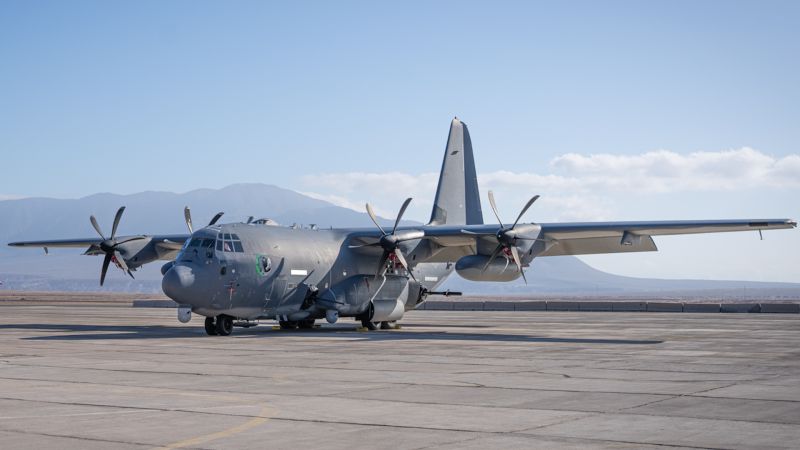
The United States has stationed an AC-130J Ghostrider attack aircraft and additional military assets at Comalapa International Airport in El Salvador. Satellite imagery and flight data show operations ramped up in mid-October, marking the first verified deployment of U.S. strike-capable aircraft to the country since the Cold War. The deployment supports counter-narcotics efforts, contingency operations, and signals increased pressure on Venezuela.
Operated by Air Force Special Operations Command (AFSOC), the AC-130J is a multi-role gunship equipped with a 30 mm chain gun, 105 mm howitzer, small diameter bombs, and Hellfire/Griffin missiles. This marks the first time a U.S. strike-capable aircraft has been forward-deployed in El Salvador for potential combat operations.
Alongside a P-8A Poseidon maritime patrol plane and a C-40 Clipper, the Ghostrider provides precise engagement capabilities against both land and sea targets. Analysts note that the deployment enhances SOUTHCOM’s operational readiness and extends the U.S. aerial footprint across Central America’s Pacific corridor.
Originally established in 2000 for counter-narcotics missions, the Comalapa facility has evolved into a forward-operating site for armed deterrence. The regional buildup includes roughly 10,000 personnel, multiple drones, bombers, and naval vessels. The deployment demonstrates U.S. capability to rapidly project force and maintain operational deterrence in the Caribbean and Central America.
The AC-130J represents the fifth generation of the C-130-based gunship family. Powered by four Rolls-Royce AE 2100D3 turboprops with a range of approximately 4,800 km, it is designed for extended loitering over operational areas, close air support, convoy protection, and precision strike operations in both urban and maritime environments. Its design allows operations from austere airfields and integrates with joint command networks for coordinated targeting and engagement.
