

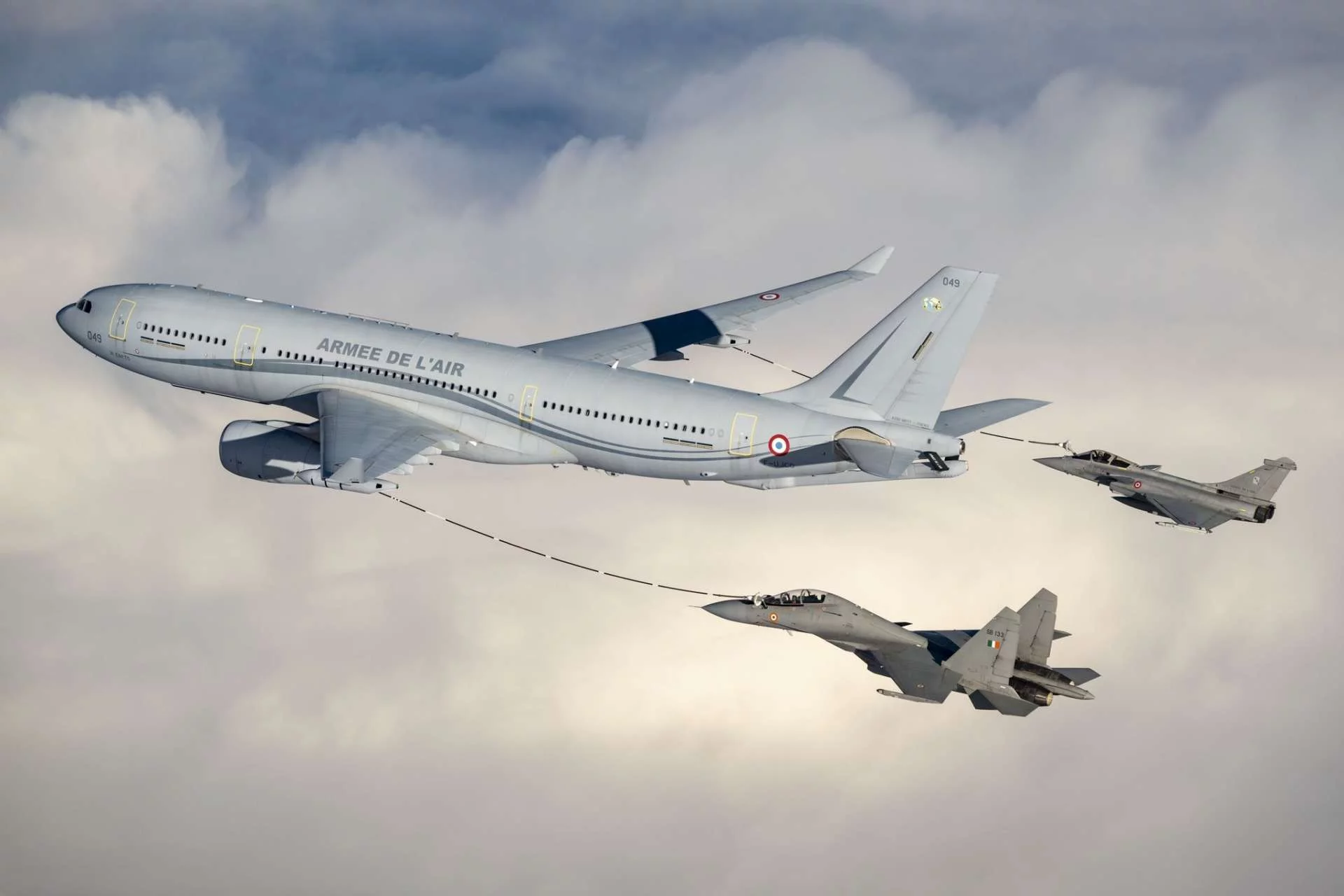
Indian Air Force Su-30MKI fighters are conducting rare mixed close-formation flights with French Rafale and Mirage 2000 jets during Exercise Garuda 25, held from 16–27 November at Mont-de-Marsan Air Base in southwestern France. The latest edition of the Indo-French air exercise has brought together more than 500 personnel and roughly 25 aircraft for demanding air combat scenarios aimed at strengthening interoperability from Europe to the Indo-Pacific.
Cockpit footage released on 21 November shows six Indian Su-30MKIs flying wing-to-wing with French Rafales, with several missions supported by an A330 MRTT Phénix tanker, according to the French Air Force. Such tight and mixed formation flights are rarely practiced and highlight the deepening military alignment between Paris and New Delhi amid increasingly complex global security dynamics.
A Complementary Triad: Su-30MKI, Rafale, and A330 MRTT Phénix
The images reflect a blend of three key platforms:
- The Rafale, France’s flagship omnirole fighter capable of air superiority, deep strike, reconnaissance and nuclear deterrence;
- The Su-30MKI, India’s long-range heavy fighter equipped with thrust-vectoring engines and a sophisticated avionics suite;
- And the A330 MRTT Phénix, providing airborne refueling capability that transforms the combined air package into a long-endurance, expeditionary force.
Together, these platforms demonstrate how both nations are investing not only in advanced aircraft but also in mutually compatible procedures and tactics.
Garuda’s Increasing Complexity
Since its inception in 2003, Exercise Garuda has shifted from basic air combat drills to high-end composite air operations featuring layered threat environments, beyond-visual-range engagements and joint strike missions. Both the Rafale and Su-30MKI bring real-world operational experience, adding value to the simulated contested environment of Garuda 25.
Strategic Significance
Images of Su-30MKIs and Rafales flying in tight formation send a clear message about the maturing Indo-French partnership.
- For India, training alongside a major NATO air force reinforces its vision of cooperating with technologically advanced partners while maintaining strategic independence.
- For France, hosting Indian crews supports its broader Indo-Pacific strategy and diversification of security relationships.
Each edition of Garuda advances interoperability in planning, communications, and execution, laying the groundwork for potential joint or parallel operations in crisis situations. The rare mixed formations documented this year reflect how the defence relationship has progressed from basic familiarity two decades ago to genuine operational synergy.
