

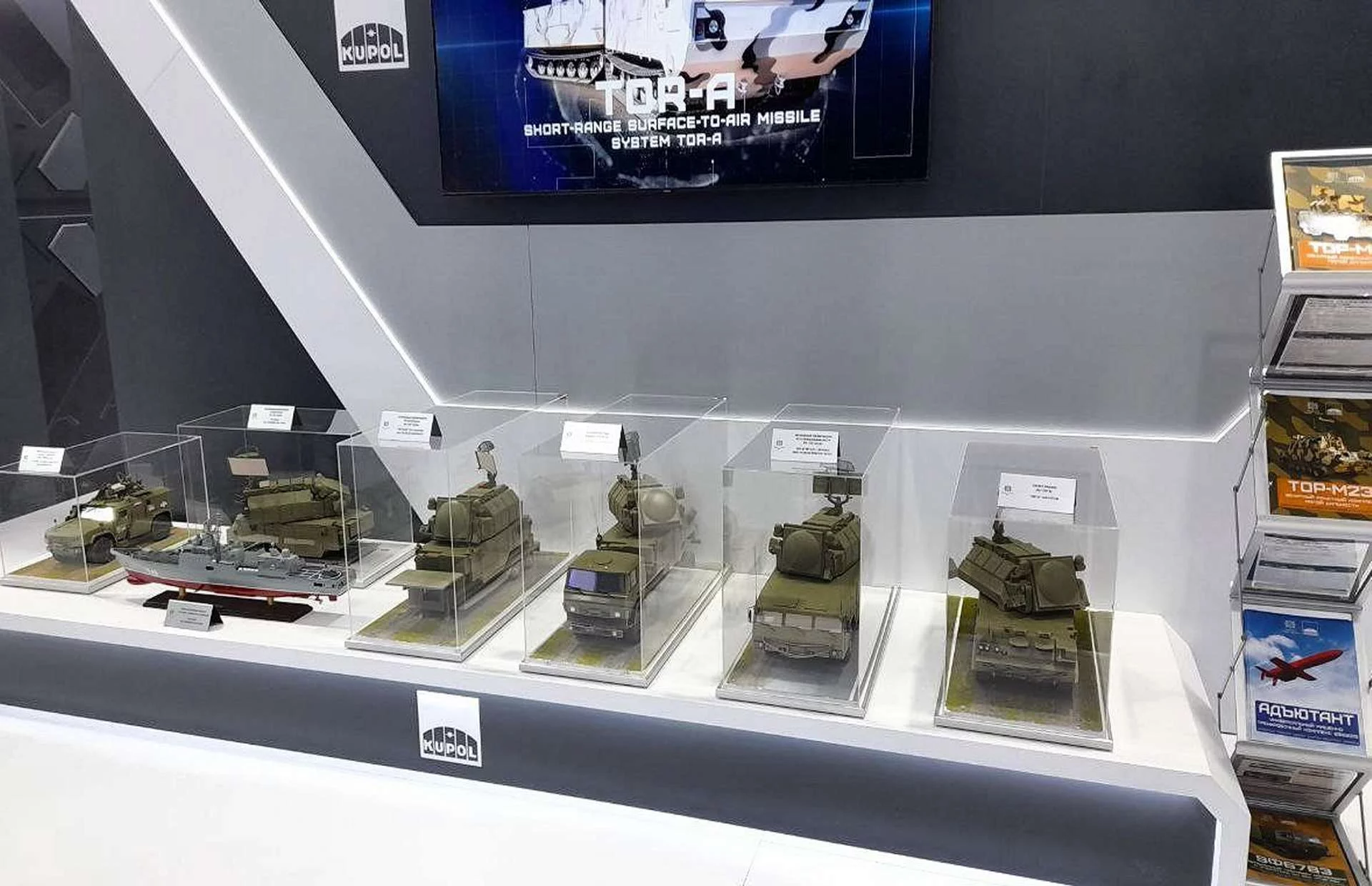
Russia brought the Tor-E2 short-range air defense system to an international venue for the first time at Dubai Airshow 2025, signaling its determination to regain ground in the global SHORAD market after years of declining arms exports.
Information posted online on November 21 indicates that Tor-E2 was one of more than 850 Russian systems exhibited at the event, forming a key part of Moscow’s air defense portfolio. For Almaz-Antey and the Izhevsk Electromechanical Plant Kupol, delivering a full operational system to the UAE served both as a technical demonstration and a political message aimed at potential buyers.
Capabilities and Technical Features
An export evolution of the Tor-M2 series, Tor-E2 integrates search radar, tracking radar and vertical-launch missiles on a single combat vehicle. Offered in wheeled, tracked and modular variants, the platform carries 16 ready-to-fire missiles.
The system can intercept targets at 12 km — or up to 15 km when equipped with 9M331D missiles — at altitudes reaching 10 km. With four simultaneous engagement channels and sensitivity to targets as small as 0.05 m² RCS, Tor-E2 is optimized for counter-UAV and precision-munition defense.
Analyses and Rosoboronexport data suggest that the 9M338KE missile extends engagement range to roughly 16 km and provides improved lethality against fast, low-RCS threats. Its vertical cold-launch architecture delivers true 360-degree coverage and shortens reaction time for rapid follow-up shots.
Kupol engineers report that the system can transition from road march to full combat readiness in about three minutes and fire from short halts or limited movement, a key advantage for forces under drone or loitering-munition attack.
Operational Role and Mission Set
Tor-E2 is marketed as a core SHORAD asset for maneuver brigades, airbases and strategic facilities. It can counter aircraft, helicopters, cruise missiles, anti-radiation missiles, guided bombs and UAVs under heavy electronic warfare conditions, day or night.
A four-vehicle battery can engage up to 16 targets simultaneously. The system automatically prioritizes threats and can operate in paired “link” mode, where one vehicle remains in electronic silence while receiving target data from the other — a concept tailored to survive anti-radiation missile strikes.
Rosoboronexport also highlights Tor-E2’s ability to integrate into various air defense command systems, including networks built to NATO standards, appealing to operators with mixed inventories.
Development Background and Potential Buyers
Tor-E2 is the latest iteration of a family that began with the 9K330 Tor introduced in the mid-1980s. Building on the Tor-M2, it features doubled missile capacity, improved phased-array radar and enhanced automation. The broader Tor series has been combat-tested in Syria and Ukraine, a point frequently emphasized by Russian officials.
Although Moscow has claimed interest from several foreign states since 2019, it has yet to announce a confirmed export contract. Likely early adopters are thought to include long-time Tor users in the Middle East, Asia and the CIS.
Strategic Context: A Test Case for Russia’s Export Comeback
SIPRI data shows Russian arms exports dropping sharply — more than 50% between the previous two reporting cycles. Rostec CEO Sergey Chemezov acknowledged that exports have halved since 2022 due to wartime production demands, though he predicts a recovery as additional capacity comes online.
Within this context, Tor-E2’s debut abroad is seen as more than a routine unveiling. It represents Russia’s bid to reassert itself in a SHORAD market that Western militaries are still rebuilding. Securing Tor-E2’s first public export customer would signal both a capability boost for that operator and a tangible step in Russia’s effort to revive defense exports beyond wartime mobilization.
