

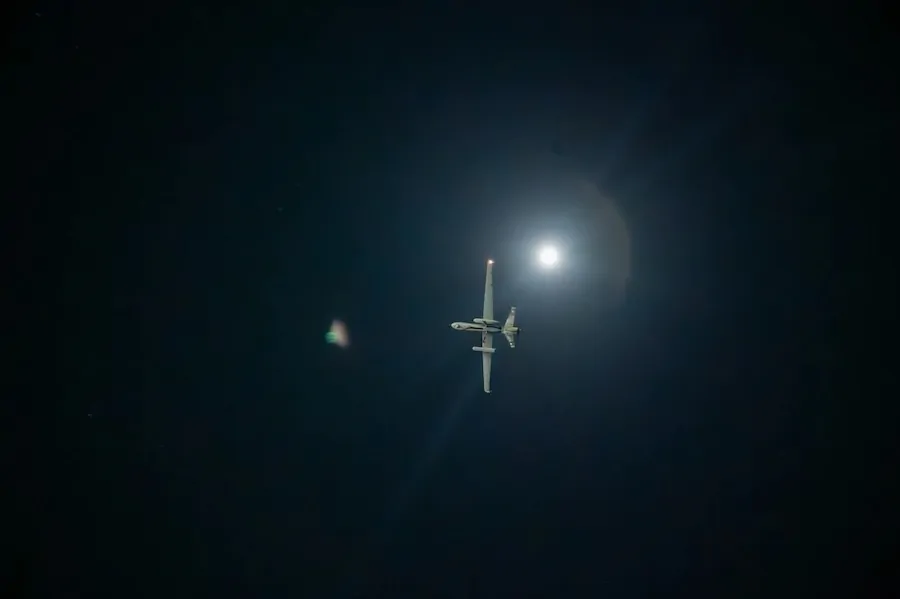
The U.S. Air Force successfully conducted a landmark test on 8 October 2025 at Kadena Air Base, Japan, launching and recovering an MQ-9 Reaper without the use of a traditional runway. The event marked a first in the Air Force’s operational history and was carried out under the 319th Expeditionary Reconnaissance Squadron’s Project Lima BEAN, an initiative aimed at evaluating unmanned aircraft in austere, improvised environments.
During the test, the MQ-9 utilized a shortened taxiway for both takeoff and landing, demonstrating the platform’s agility and the squadron’s ability to adapt to challenging field conditions. “We are using somewhat nonstandard procedures in order to build new standard procedures,” said 1st Lt. Wesley Fulford, MQ-9 pilot with the 319th ERS. “All of this is brand-new.”
The operation supported the Air Force’s Agile Combat Employment (ACE) strategy, which focuses on increasing the flexibility and survivability of air operations across dispersed and unpredictable locations. Test results confirmed that the MQ-9 can reliably operate under unconventional conditions and generated critical data for future contingency planning.
“This success opens new operational possibilities,” Fulford added. “It enhances our rapid global mobility by expanding where and how we can operate, giving commanders greater flexibility across the Indo-Pacific.” The mission also showcased seamless cross-continental coordination: local pilots conducted the initial takeoff, then transferred control to a crew based in the United States.
The demonstration highlighted how automation can strengthen mission efficiency and elevate operational safety across long distances. Project Lima BEAN further solidified the 18th Wing’s role in advancing unmanned capabilities and emphasized how innovation directly contributes to readiness throughout Pacific Air Forces.
As the “Keystone of the Pacific,” the 18th Wing continues to advance PACAF’s mission by ensuring airpower remains agile, resilient, and ready to respond anywhere, anytime.
