

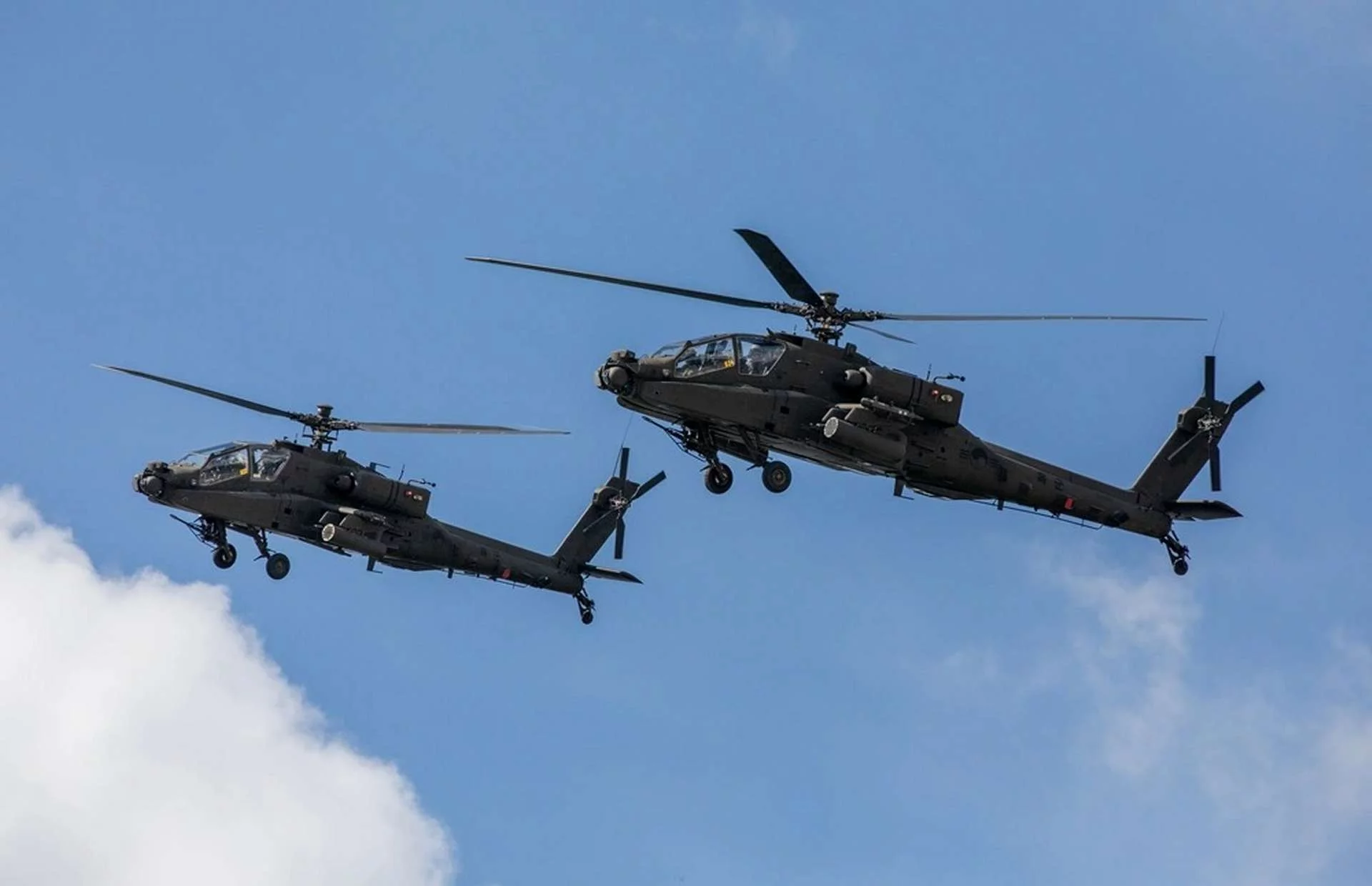
The U.S. Army has signed a massive $4.7 billion contract with Boeing to procure new-build AH-64E Apache Guardian helicopters, Longbow crew trainers, and a comprehensive support package. Funded through Foreign Military Sales (FMS) for Poland, Egypt, and Kuwait, the award secures the Apache production line in Mesa, Arizona well into the next decade.
Production Secured Through 2032
According to the Department of War announcement on November 25, the firm-fixed-price contract (W58RGZ-26-C-0002) will run through May 30, 2032. The order is a major reinforcement of the Army’s decision to rely on the AH-64E as its primary attack helicopter fleet for the foreseeable future.
Estimated 35–45 New Helicopters
Although the award does not specify quantities, recent FMS approvals provide a likely estimate. Analysts suggest the $4.685 billion package—along with Longbow trainers—corresponds to roughly 35 to 45 AH-64E helicopters for the three partner nations. This order complements ongoing modernization and remanufacture programs already underway for Egypt and Kuwait.
The AH-64E Guardian: A Modernized, Network-Centric Attack Helicopter
The latest AH-64E variant incorporates significant hardware and software upgrades, including:
- T700-GE-701D engines & composite rotor blades
- Open mission systems architecture
- Upgraded Arrowhead targeting and night-vision system
- Link 16 and STT radio for real-time data sharing
- Longbow radar or MUMT-X for manned-unmanned teaming
- Hellfire, JAGM, and APKWS-guided rockets
These features enable the Apache to perform precision strike missions, deep attack roles, and—importantly—counter-drone operations using its advanced sensors and networked targeting capabilities.
A Central Element of the Army’s New Aviation Doctrine
The AH-64E is fully embedded in the U.S. Army’s updated FM 3-04 doctrine for multi-domain operations. Rather than operating as isolated hunter-killer platforms, Apaches now function as network nodes integrated with artillery, unmanned systems, air-defense assets, and electronic warfare units.
The 2024 Aviation Investment Rebalance confirmed this approach by cancelling the Future Attack Reconnaissance Aircraft (FARA) program and consolidating the Army’s aviation fleets around UH-60M, CH-47F, and AH-64E.
Global Demand Continues to Rise
The new award aligns the U.S. Army with a broad and expanding group of AH-64E operators, including the U.K., Japan, South Korea, India, the Netherlands, Qatar, Saudi Arabia, UAE, and now Poland and Australia. Many nations are integrating the Apache into drone-centric, networked strike ecosystems, reflecting its evolving role in modern warfare.
