

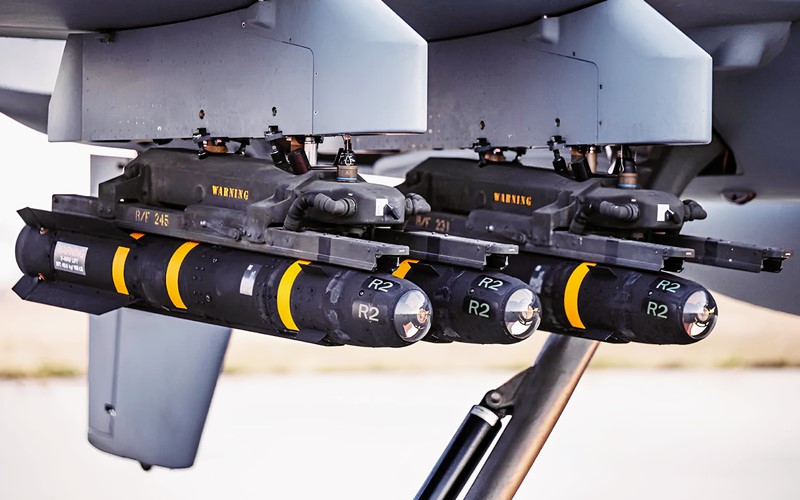
A newly released U.S. Navy photo shows sailors from Helicopter Maritime Strike Squadron 79 loading an AGM-114 Hellfire missile onto an MH-60R Seahawk aboard the destroyer USS Roosevelt in the Gulf of Aden. Taken on November 22 and published by DVIDS on November 27, the image underscores how U.S. surface combatants are keeping their embarked helicopters armed for immediate use amid persistent regional threats.
Regional Security Context
The photo follows nearly two years of Houthi missile and drone attacks on commercial shipping throughout the Red Sea and Gulf of Aden. Despite ongoing multinational patrols, several merchant vessels have sustained damage or been abandoned. The image therefore reflects not a routine deck evolution but a real operational posture aimed at protecting one of the world’s most vital maritime corridors.
MH-60R Capabilities
The MH-60R Sea Hawk is the U.S. Navy’s premier multi-mission maritime helicopter, combining anti-submarine warfare, anti-surface warfare, and wide-area surveillance. Operating from Arleigh Burke-class destroyers, it can carry Mk 54 torpedoes, sonobuoys, machine guns, 20/30 mm cannons, and up to eight Hellfire missiles. In the Gulf of Aden—where threats include fast attack craft and explosive-laden USVs—this transforms the helicopter into a forward strike platform for the ship.
Hellfire at Sea
Originally designed for land combat, the Hellfire missile has been adapted to engage small, high-speed maritime threats. The missile’s effectiveness in naval use was demonstrated in December 2023, when MH-60R helicopters neutralized Houthi boats attempting to seize a merchant vessel in the Red Sea. The U.S. is currently transitioning toward the AGM-179 JAGM, though Hellfire remains central to naval helicopter strike operations.
Tactical Impact
Arming the MH-60R with Hellfire missiles extends the destroyer’s surveillance and strike reach well beyond the horizon. Using radar, EO/IR sensors, and datalinks, the helicopter can identify small vessels hidden within dense maritime traffic and execute precision strikes at stand-off range. This reduces risk to the ship and preserves high-value air-defense missiles for more complex threats such as cruise missiles or large unmanned aerial systems.
Strategic Outlook
The armed Seahawk aboard USS Roosevelt reflects the broader U.S. strategy of maintaining a ready and credible naval presence in the Red Sea and Gulf of Aden. During Operation Prosperity Guardian (2023–2025), multinational escort operations were formalized to secure commercial routes after repeated attacks. Although the 2025 ceasefire reduced some tensions, recent incidents—including strikes on foreign-flagged vessels—show that threats remain.
Naval Adaptation
The image of HSM-79 arming a Hellfire missile represents an evolving U.S. naval approach to layered sea control. The Hellfire, once a land-focused weapon, is now an essential component of maritime security operations. Given continued risks to shipping, forward-deployed U.S. warships are likely to maintain fully armed helicopters as a core element of rapid threat response.
