

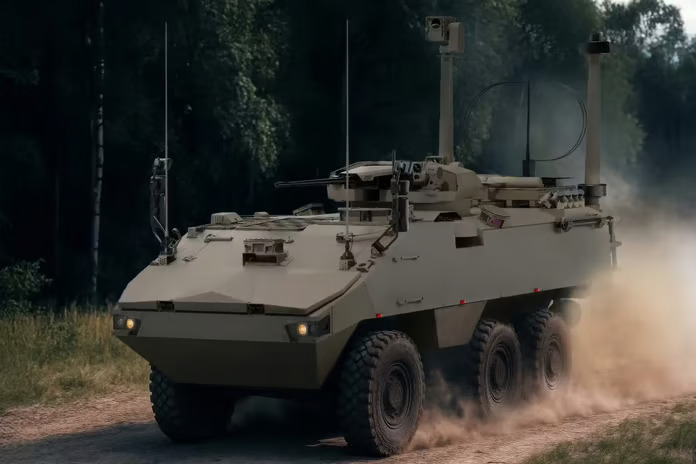
German defence technology firm HENSOLDT has secured a major contract to supply the Bundeswehr’s new LUCHS 2 reconnaissance vehicles with an advanced suite of sensors and mission systems. The agreement was concluded with General Dynamics European Land Systems (GDELS), the prime contractor overseeing development of the next-generation platform.
The contract, estimated to be in the upper triple-digit million-euro range, ranks among the most significant reconnaissance system orders in HENSOLDT’s history. It encompasses system development, integration of prototypes and pre-series vehicles, and two subsequent phases of full-rate production. In the first stage, equipment will be delivered for 274 vehicles, with provisions for further expansion under future procurement rounds. The package includes mission computers, multispectral sensor units, software infrastructure, spare parts, training programmes, and long-term logistical support.
CERETRON: The Technological Backbone of the LUCHS 2 Fleet
Central to HENSOLDT’s involvement is the CERETRON mission system, a next-generation architecture designed to unify and process data from multiple sensor sources. By combining AI-enabled image analytics with automated target recognition, CERETRON provides real-time situational awareness and accelerates decision-making for crews operating in complex environments.
Built on a software-defined and modular framework, CERETRON can be upgraded through software updates, allowing the LUCHS 2 fleet to adapt to evolving mission demands without hardware replacement. This future-proof approach ensures the vehicle remains operationally relevant as battlefield requirements and technologies continue to change.
Strengthening Germany’s Modern Reconnaissance Posture
According to HENSOLDT officials, the contract represents a substantial enhancement of the Bundeswehr’s intelligence, surveillance, and reconnaissance (ISR) capability. They highlighted the increasing importance of information superiority within network-centric warfare and multi-domain operations.
With its low acoustic and thermal signature, high mobility, and state-of-the-art sensor suite, the LUCHS 2 is designed to perform effectively in both conventional reconnaissance tasks and high-threat environments. Once fielded, the vehicle is expected to bolster Germany’s border surveillance, target acquisition capacity, and tactical intelligence gathering—marking a significant step forward in the country’s modern reconnaissance doctrine.
