

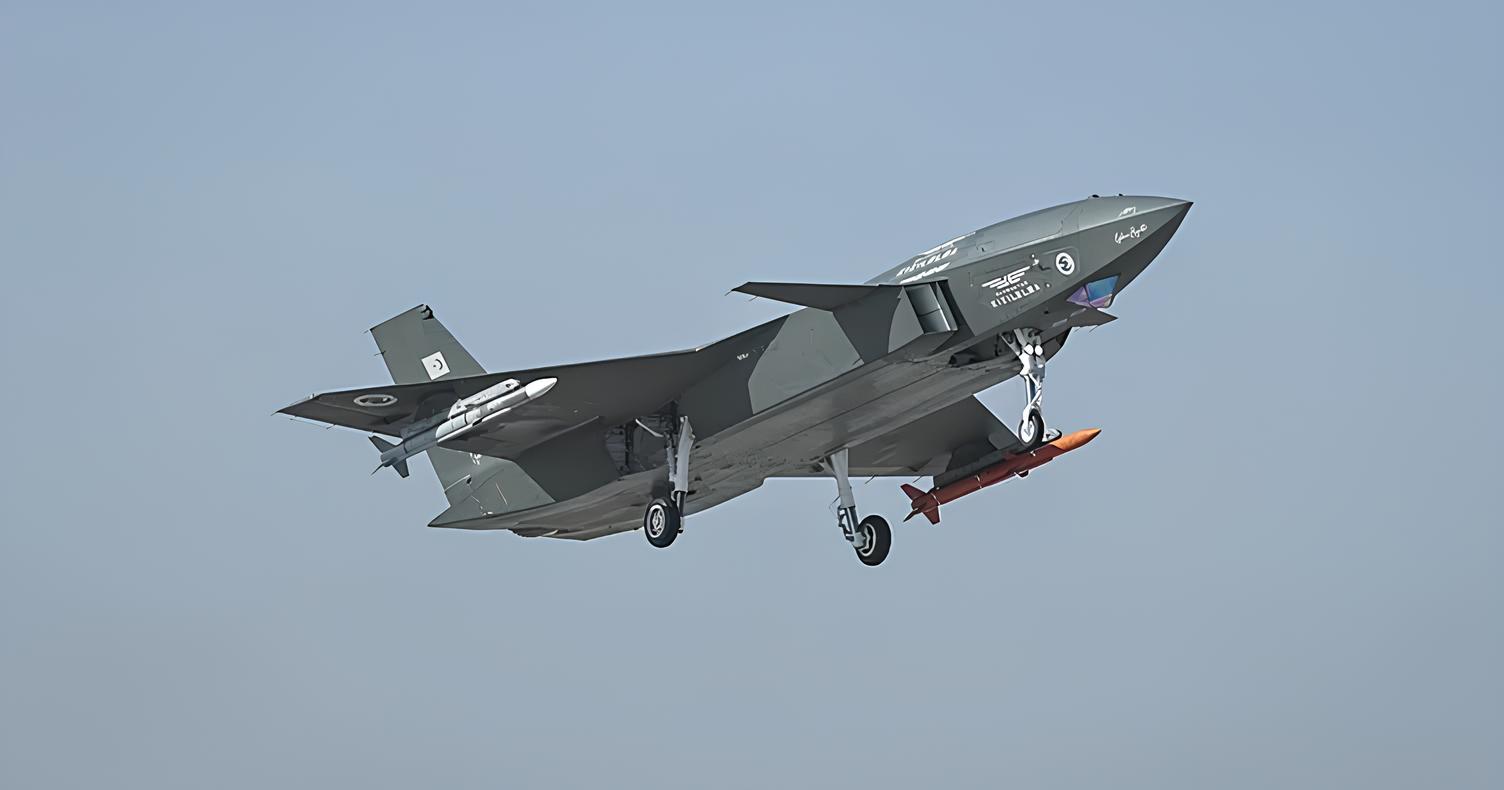
Turkey’s jet-powered unmanned fighter Bayraktar Kizilelma has made aviation history by executing the world’s first confirmed beyond-visual-range (BVR) air-to-air kill by a UCAV, marking a decisive leap toward operational sixth-generation air combat.
During a live-fire trial over the Black Sea on 30 November 2025, Kizilelma detected and destroyed a high-speed jet target using ASELSAN’s MURAD AESA radar and TÜBİTAK SAGE’s Gökdoğan BVR missile. The test confirms for the first time that an unmanned, jet-powered combat aircraft can independently complete a full end-to-end BVR kill chain.
A Landmark in Unmanned Air Combat
Baykar confirmed that the engagement—supported by onboard telemetry and external footage—successfully validated a real BVR missile shot from an unmanned fighter, transforming a previously theoretical capability into an operational one. The achievement positions Türkiye among the leading nations advancing unmanned fighter doctrine beyond experimentation.
Crewed–Uncrewed Teaming Demonstrated
The mission integrated five Turkish Air Force F-16s flying in formation with Kizilelma, simulating future manned-unmanned strike packages. Baykar CTO Selçuk Bayraktar observed the scenario from the rear seat of a two-seat F-16, while a Bayraktar Akıncı UAV recorded the engagement from above.
National Kill Chain: Radar, Missile, Platform, Link
The kill was executed through a fully sovereign system-of-systems:
- MURAD AESA radar detected and tracked the target,
- Toygun EO system provided passive long-range imaging,
- Gökdoğan BVR missile executed a lock-on-after-launch engagement,
- Kizilelma performed the full kill chain autonomously.
This combination demonstrates that Türkiye can conduct radar-guided BVR air combat without reliance on foreign subsystems or export-controlled technologies.
Capabilities of the Jet-Powered UCAV
Kizilelma’s key performance attributes include:
- Low-observable airframe
- Max take-off weight: ~8.5 tonnes
- Payload: ~1.5 tonnes
- Combat radius: ~500 nm
- Speed approaching Mach 0.9
- Compatibility with TCG Anadolu STOBAR operations
- Internal weapons bay for low-observable BVR missions
A New Air Superiority Concept
The test indicates that unmanned fighters will assume greater roles in:
- Loyal-wingman missions with F-16 and TF-Kaan
- High-risk penetration into contested airspace
- Multi-axis BVR attacks through networked swarming
- Long-range detection via combined active and passive sensors
Part of Türkiye’s Sixth-Generation Ecosystem
The achievement aligns with Türkiye’s emerging sixth-generation structure, where TF-Kaan is envisioned as a command node coordinating multiple unmanned assets such as Kizilelma and Anka-3. The verified Gökdoğan firing demonstrates that one of the core elements of this architecture—a networked unmanned shooter with indigenous BVR capability—is now operationally real.
A Turning Point in Global Air Warfare
The Sinop test shows that unmanned jets are now capable of performing long-range air-air engagements traditionally reserved for manned fighters. Analysts emphasize that this milestone will reshape procurement priorities, doctrines and tactical planning worldwide, as the decisive first shot in future air battles may come from a stealthy unmanned wingman rather than a pilot-flown aircraft.
