

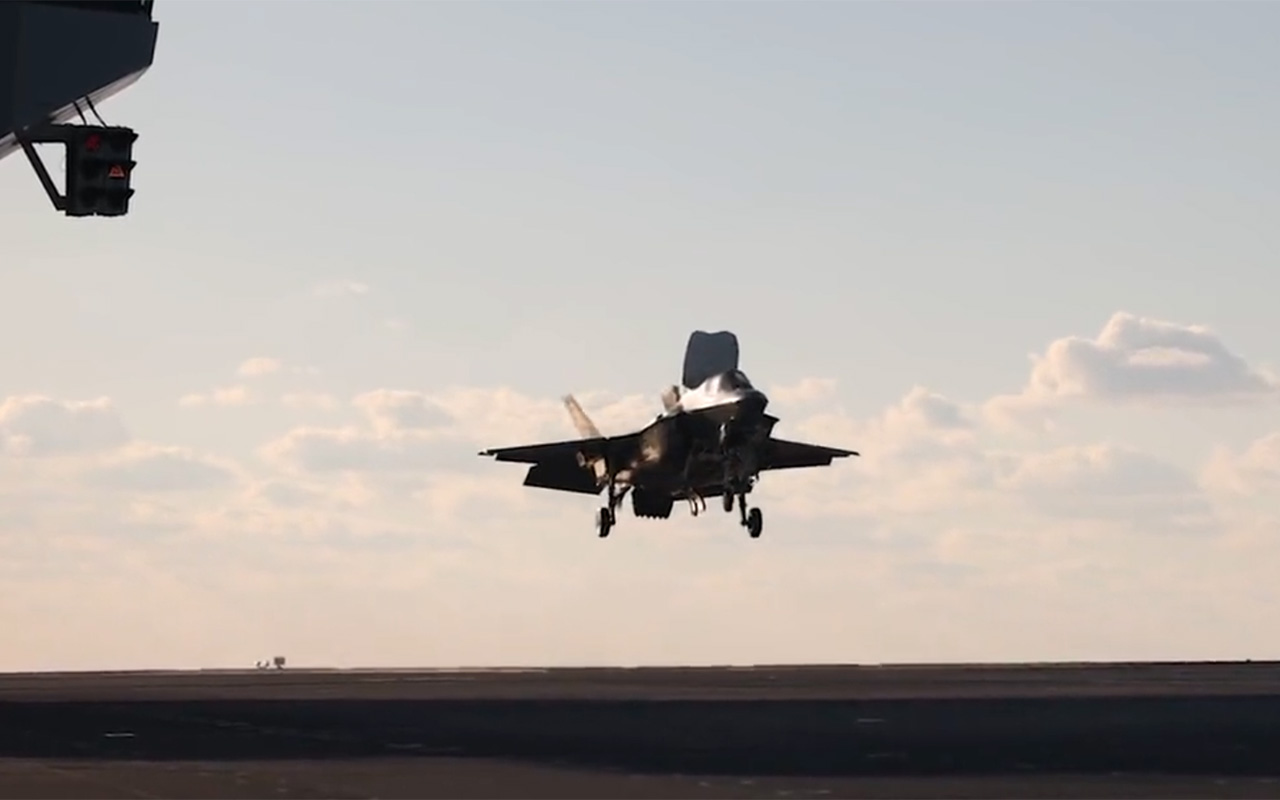
The UK Ministry of Defence has issued new statements to clarify the status of the Shipborne Rolling Vertical Landing (SRVL) programme for the F-35B Lightning II, following a series of parliamentary questions by Conservative MP James Cartlidge. Confusion had arisen after language in the 2024–25 defence accounts appeared to indicate that the upgrade had been cancelled.
Defence Minister Luke Pollard reaffirmed in three written responses that SRVL development is still underway and that the equipment already installed on HMS Prince of Wales remains unaffected. Pollard noted that the system underwent initial trials in 2023 and that a commercial partner is continuing to analyse the data. Once complete, the results will guide the MoD’s assessment of whether further development is cost-effective and operationally beneficial.
SRVL enables an F-35B to recover aboard an aircraft carrier at a higher bring-back weight by combining a short rolling landing with the jet’s vertical lift system. Concerns had previously emerged that removing the capability could force aircraft to discard fuel or ordnance before landing.
The misunderstanding originated from page 140 of the MoD’s annual accounts, which referenced a “SRVL upgrade cancellation” valued at around £300,000. Pollard clarified that this related solely to the planned installation of SRVL equipment on HMS Queen Elizabeth in 2025 — not to the wider programme. The MoD still retains the option to fit the system once the 2023 trial results are fully assessed.
According to Pollard, the decision is a resource-allocation judgement rather than a strategic reversal. This aligns with earlier government statements on 25 November 2025 confirming that SRVL “has not been cancelled” and that the programme timeline is being adjusted to match broader weapons-integration efforts.
What Is SRVL?
Shipborne Rolling Vertical Landing is a hybrid recovery technique that allows jets to land on carriers with greater weight. Rather than coming to a full hover, the aircraft maintains some forward motion to generate lift with its wings while using vertical thrust for controlled descent. This enables safer recoveries without discarding weapons or fuel, making it particularly advantageous for STOVL aircraft such as the F-35B.
