

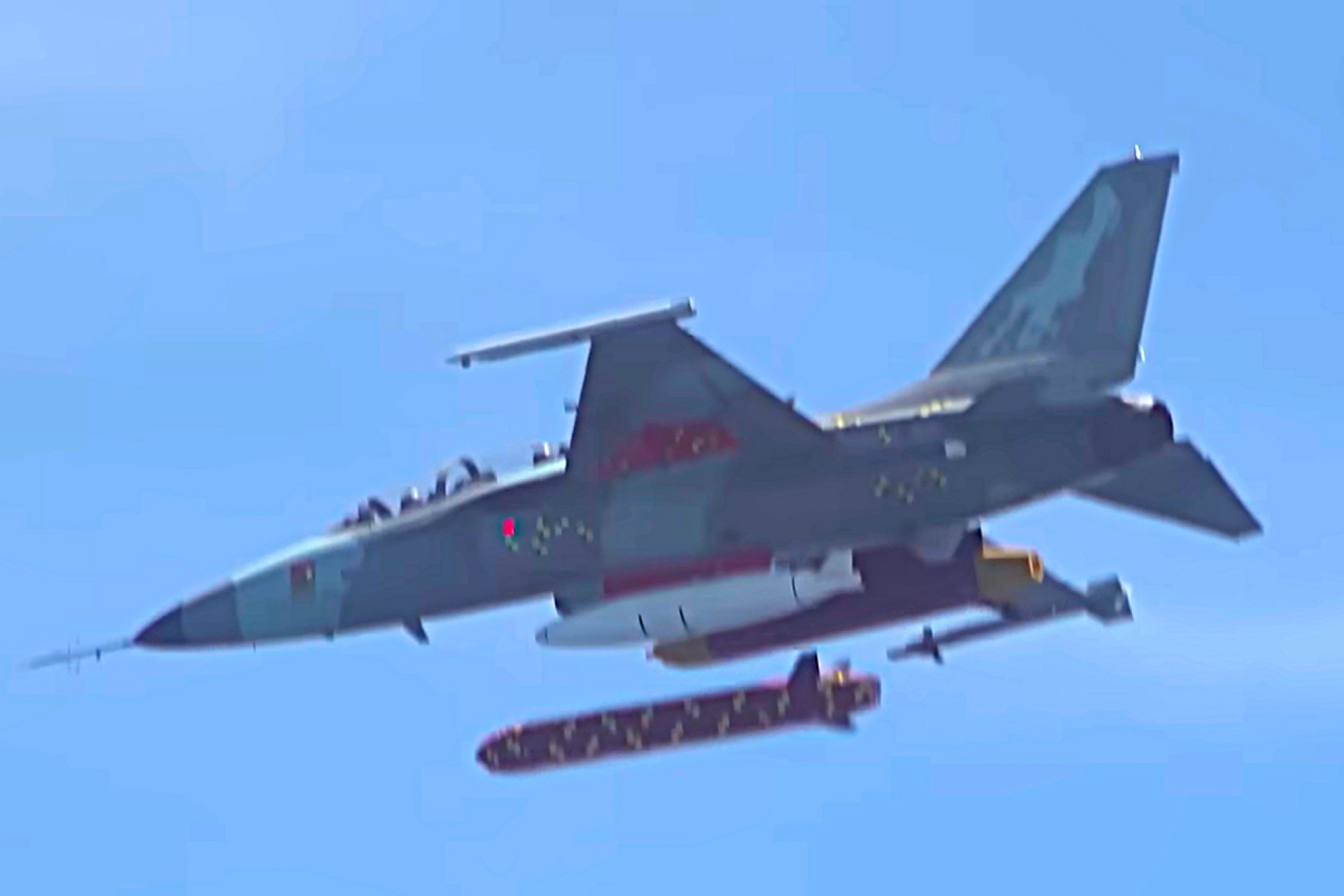
South Korea has reached a major milestone in its pursuit of strategic airpower autonomy with the successful test of a domestically developed long-range air-to-surface missile, designed for the nation’s next-generation KF-21 Boramae fighter jet. The test, conducted by the Republic of Korea Air Force’s 3rd Fighter Wing using an FA-50 aircraft, confirms the safe separation and aerodynamic integrity of the missile—marking a pivotal step in its journey toward full deployment.
While still unnamed, the stealth-optimized missile is informally dubbed the “Korean Taurus,” drawing comparisons to Europe’s Storm Shadow and the German Taurus KEPD 350 already in use by the ROKAF. However, this new system is wholly indigenous, developed by the Agency for Defense Development (ADD) and overseen by DAPA (Defense Acquisition Program Administration), signaling a shift away from reliance on foreign strike munitions.
A Missile Built for the Future of Korean Airpower
Launched under South Korea’s Phase 2 strike weapons initiative, the missile incorporates terrain-following capabilities, reduced radar cross-section, and a highly accurate GPS/inertial navigation system. With a range and lethality profile tailored to regional conflict scenarios, it is designed to neutralize high-value targets in early-phase strike operations while remaining concealed from enemy air defenses.
The recent test validated its safe release from a flying platform without compromising flight stability—an essential milestone before its full integration with the KF-21, which is slated for operational deployment before the end of the decade.
Technological Autonomy Meets Tactical Agility
What sets this missile apart is not just its stealthy profile or its stand-off range—it’s the fact that it’s 100% South Korean-made. In an age of volatile arms embargoes and shifting geopolitical alliances, Seoul’s ability to build and control its own strike inventory is increasingly vital. The missile’s modular design, advanced electronics, and maintenance-friendly features reflect lessons learned from imported systems, and represent a leap forward in digitally native munitions architecture.
The successful test follows over 30 flight sorties conducted between April and June 2025, focusing on flutter analysis, structural clearance, and missile control—proving the maturity of South Korea’s aerospace R&D ecosystem.
Beyond Deterrence: A Global Market Contender
This missile isn’t just a national asset—it’s a potential export catalyst. Paired with the KF-21, it offers international buyers a turnkey deep-strike solution: a stealth fighter and indigenous smart missile designed together from the ground up. Countries like Indonesia—already a co-developer of the KF-21—are considered key prospective buyers, alongside other NATO and ASEAN nations seeking to modernize their airpower without dependency on Western platforms.
DAPA’s broader vision includes €3.9 billion in next-gen air combat systems, of which over €1.1 billion is currently committed to this missile’s development. Further live-fire trials and full KF-21 integration tests are scheduled for 2027–2029, with initial operational capability projected before 2030.
Strategic Implications in the Indo-Pacific
Regionally, the missile reinforces South Korea’s preemptive and retaliatory strike doctrines, crucial for countering threats from North Korea and balancing China’s growing presence in the Pacific. Its long range allows launch from outside enemy engagement zones, protecting both pilots and platforms while enabling precision hits on hardened infrastructure.
Internationally, it strengthens South Korea’s hand as an emerging defense exporter and a partner in allied integrated operations. Compatibility with AI-enabled avionics, electronic warfare suites, and multirole targeting makes it future-proof for NATO-aligned air doctrine.
A Nation Asserting Its Strategic Voice
This missile test isn’t just a technical achievement—it’s a statement of intent. South Korea is no longer content to import its most critical defense tools. With the KF-21 and this new missile, it’s building an ecosystem of indigenous power projection, tailored to its needs and designed for the world stage.
As one DAPA official noted anonymously, “We’re not just developing a missile. We’re creating sovereign options.” And with each test flight, those options are taking flight.
