

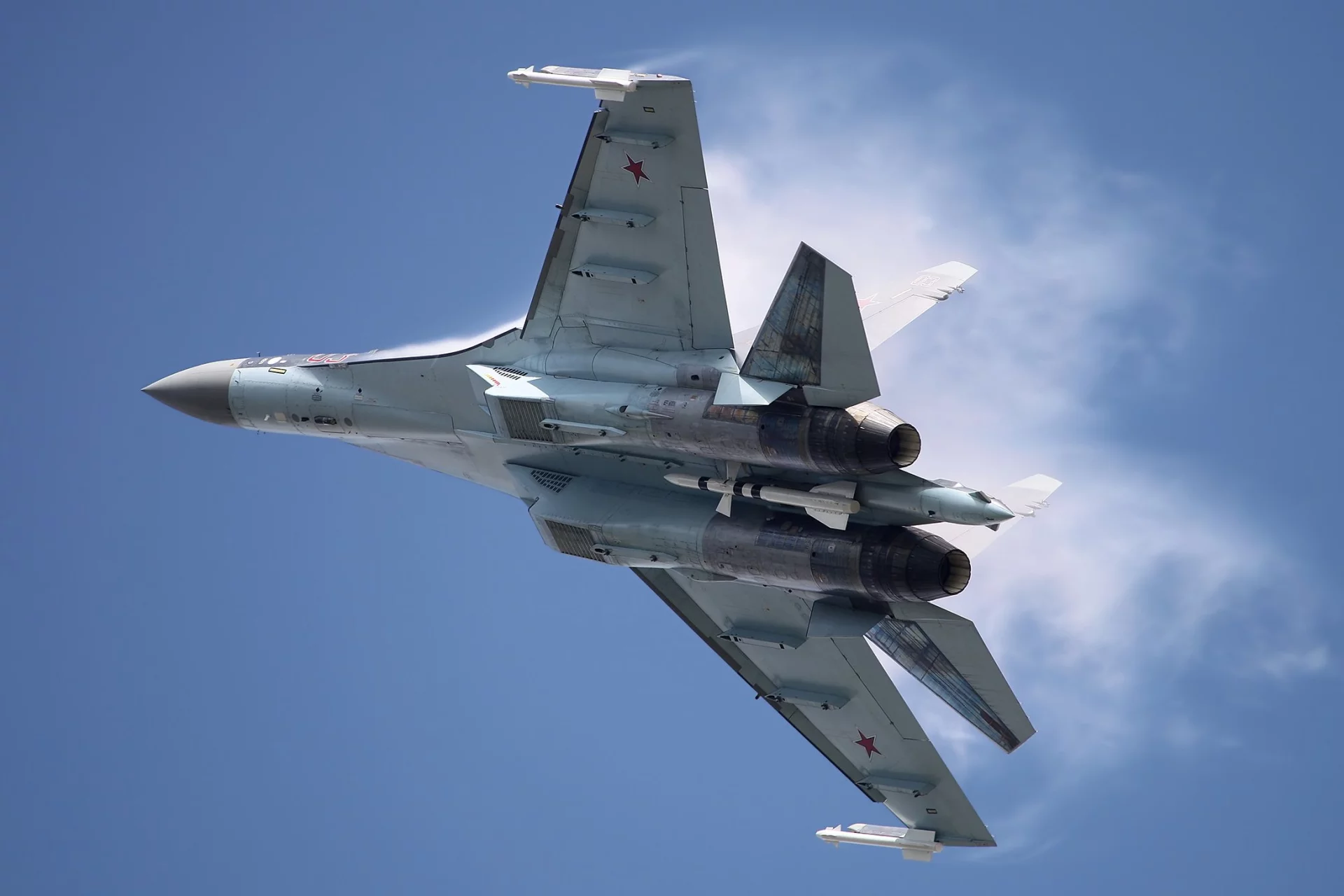
Despite facing persistent Western sanctions and supply chain restrictions, Russia’s defense aviation sector continues to push forward. On June 25, 2025, the United Aircraft Corporation (UAC), operating under state defense giant Rostec, handed over a fresh batch of Su-35S multirole fighter jets to the Russian Ministry of Defense, according to TASS. This delivery signals not only the ongoing production momentum of one of Russia’s most advanced non-stealth aircraft but also underscores the Kremlin’s determination to sustain air superiority capabilities, particularly in the context of the war in Ukraine.
The Su-35S, a deeply upgraded variant of the Su-27 and known to NATO as the Flanker-E+, combines elements of fifth-generation combat technology with the maneuverability and raw power of the 4++ generation. Designed to track multiple targets with its passive electronically scanned array (PESA) radar, and featuring plasma-ignition engines with thrust vectoring, the aircraft boasts exceptional agility. The redesign excludes forward canards and air brakes, relying instead on differential rudders for deceleration. It supports a diverse weapons loadout for both air combat and ground attack, and it can cruise supersonically without using afterburners—a rare capability outside of stealth-class platforms.
Though first envisioned in the early 2000s, the Su-35S only entered full-scale production in the mid-2010s. Since then, it has evolved into the most advanced operational fighter in the Russian arsenal ahead of the limited-production Su-57. The Su-35S has already seen extensive action, including in Syria and more recently in Ukraine, where it has been tasked with enforcing airspace control, escorting strike packages, and launching precision-guided munitions from stand-off distances. Serial production remains anchored at UAC’s Komsomolsk-on-Amur facility, which continues to meet delivery targets despite sanctions-related challenges.
What sets the Su-35S apart from peer platforms like the Eurofighter Typhoon or the F-15EX is its focus on supermaneuverability and kinematic dominance rather than stealth. It also outperforms similar Chinese designs like the J-16 in avionics and propulsion, although its survivability against modern Western air defenses such as Patriot or NASAMS remains debatable—particularly in Ukraine, where Russian aircraft face dense air defense networks.
Still, each new delivery bolsters Russia’s ability to maintain air superiority over contested zones and secure flight paths for cruise missile operations. The Su-35S has been exported to China and Egypt in the past, though fresh deals have slowed due to sanctions on critical avionics and engine technologies. Domestically, however, the fighter continues to serve as a cornerstone of Russia’s military aerospace production, helping retain skilled labor and keep industrial lines active.
Funded through Russia’s State Armaments Program, the Su-35S maintains a steady production rate despite financial opacity. Unit costs are estimated at roughly $40–45 million. While Egypt was the last confirmed foreign buyer, the status of those deliveries remains unclear. Rostec has announced a plan to improve production efficiency by 30% by 2030, aiming to offset external technology restrictions with domestic industrial scaling.
Operationally, in the Ukrainian theater, the Su-35S is critical for long-range patrols, missile escorts, and enforcing no-fly zones from afar using missiles like the R-37M. Due to the constant threat of Ukrainian mobile air defenses, Russian pilots tend to operate the aircraft conservatively, relying on stand-off tactics rather than dogfighting. Nevertheless, the platform remains vital for Moscow’s aerial campaign.
This latest batch of Su-35S jets confirms that Russia’s aerospace sector, while constrained, is far from paralyzed. As UAC continues to produce one of the most capable non-stealth fighters in global service, the Su-35S stands as both a functional asset and a strategic symbol—projecting Russia’s enduring ambitions to contest and control the skies across Eurasia.
