

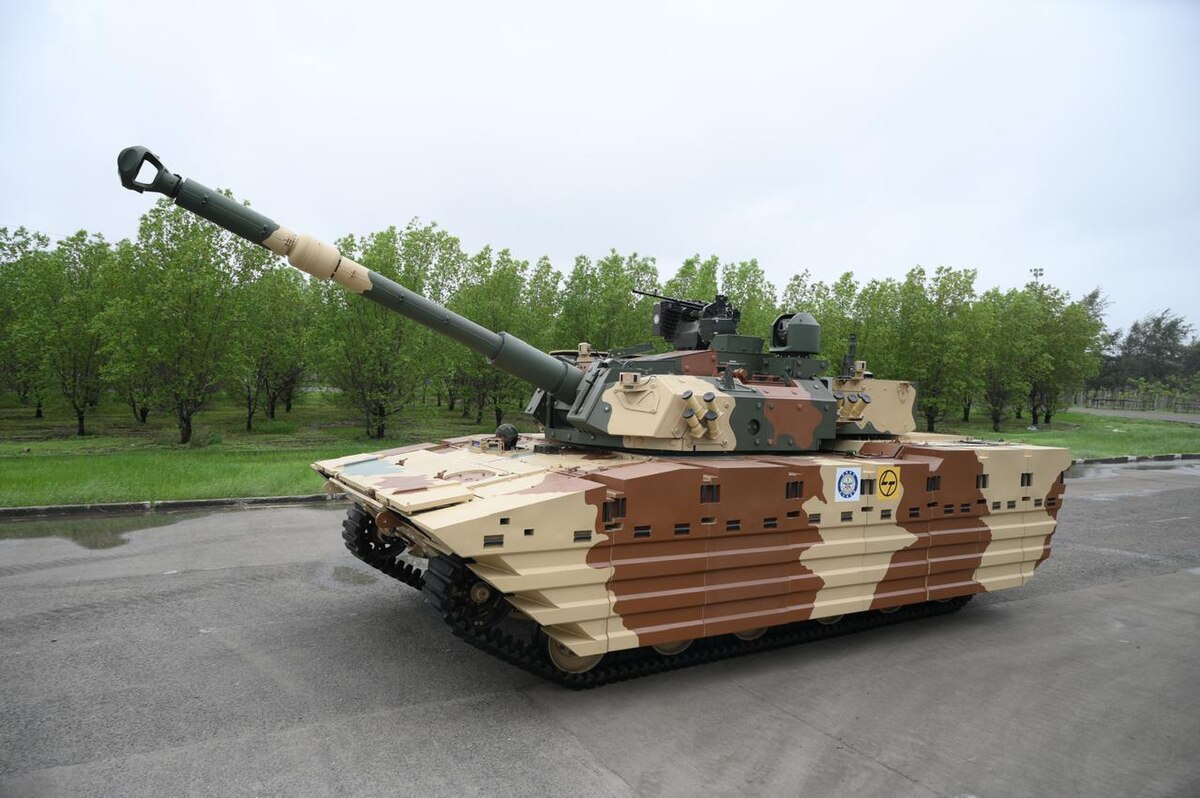
India’s defence modernization effort has gained fresh momentum as the Zorawar light tank, extended-range Pinaka rocket system, and the Future Infantry Combat Vehicle (FICV) mark major developmental milestones—demonstrating the country’s growing capability in building sophisticated indigenous military platforms.
Developed by the Defence Research and Development Organisation (DRDO) in partnership with Larsen & Toubro, the 25-ton Zorawar light tank has successfully completed its high-altitude trials in Nyoma, Ladakh, operating at over 4,200 meters above sea level. Named after the legendary Dogra warrior General Zorawar Singh, the tank has proven its mettle in extreme conditions, including precision firing drills, high mobility tests, and amphibious operations.
It also demonstrated airlift compatibility, showcasing its ability to be rapidly deployed by the Indian Air Force to remote battle zones. This mobility, combined with its combat performance in both desert and mountainous terrain, makes Zorawar a highly flexible asset for the Indian Army’s needs in the Himalayan region.
With one prototype already handed over to the Army and a second, upgraded unit incorporating soldier feedback, the user trials are set for July 2025, including evaluations in riverine areas like Pangong Tso. The Indian Army has placed an initial order of 59 tanks, with plans to induct around 300 units by 2027.
Meanwhile, DRDO is pushing the envelope on long-range artillery with the extended-range Pinaka multi-barrel rocket launcher (MBRL) system. While current systems have a 75 km range, upcoming variants will strike targets up to 150 km away. These next-generation Pinaka rockets, including guided versions, are scheduled for development trials by late 2025, promising both saturation bombardment and precision strike capabilities—a strategic edge for India’s northern command along volatile borders.
Adding to this momentum, the long-awaited Future Infantry Combat Vehicle (FICV)—set to replace the aging BMP-2 fleet—is nearly ready for trials. Built by private defence giants TATA and Bharat Forge, the FICV aims to bring superior protection, mobility, and digital combat integration to India’s mechanised infantry units. Testing is slated to begin in September or October 2025, aligning with India’s broader push for high-tech, modular battlefield systems.
Together, these advancements highlight a clear trajectory: a self-reliant India forging forward in defence innovation. As trials give way to deployment, the Indian Army will be significantly better equipped to counter emerging threats with homegrown, strategically tailored, and combat-proven platforms.
