

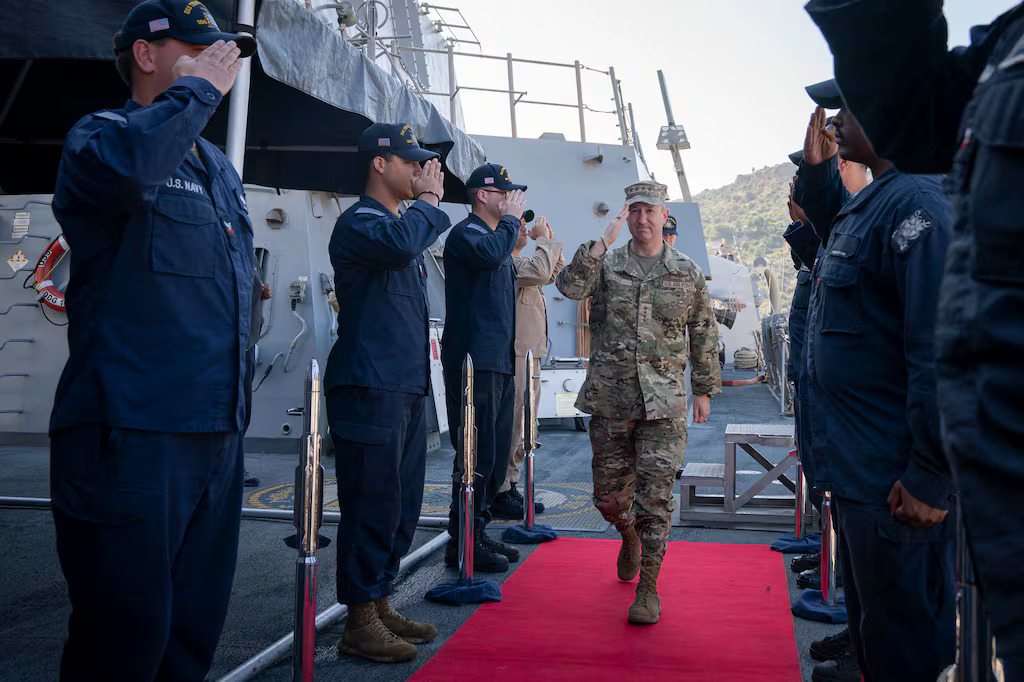
The U.S. Navy has confirmed that several Iranian ballistic missiles were successfully intercepted by American destroyers operating in the Eastern Mediterranean, marking a significant show of force amid escalating regional tensions.
According to a statement released Sunday by the Navy, five Arleigh Burke-class guided-missile destroyers—USS Thomas Hudner, USS Arleigh Burke, USS The Sullivans, USS Oscar Austin, and USS Paul Ignatius—have been stationed in the region since mid-June to bolster defensive operations near Israel. These vessels are equipped with the Aegis Weapon System, a cutting-edge defense platform capable of detecting, tracking, and neutralizing airborne threats within seconds.
Since June 14, the warships have intercepted multiple Iranian ballistic missiles, though the Navy withheld specific details about the missile trajectories or intended targets. The operation underscores the U.S. commitment to protecting allied nations and deterring potential acts of aggression in the region.
The success of the mission drew high-level recognition. On Sunday, Air Force Gen. Dan Caine, chairman of the Joint Chiefs of Staff, and Adm. Stuart B. Munsch, commander of U.S. Naval Forces Europe-Africa, visited the USS Thomas Hudner during a port stop in Souda Bay, Greece. Both leaders personally commended the crew for their swift and effective actions.
“This was a textbook demonstration of readiness, coordination, and defensive precision,” said Adm. Munsch. “These sailors are at the frontlines of maintaining stability in a volatile part of the world.”
The interception comes amid heightened scrutiny over Iran’s missile capabilities and increasing maritime security challenges in the region. With tensions simmering across the Middle East, the U.S. Navy’s presence in the Eastern Mediterranean continues to serve as a deterrent force and a reassurance to its allies.
