

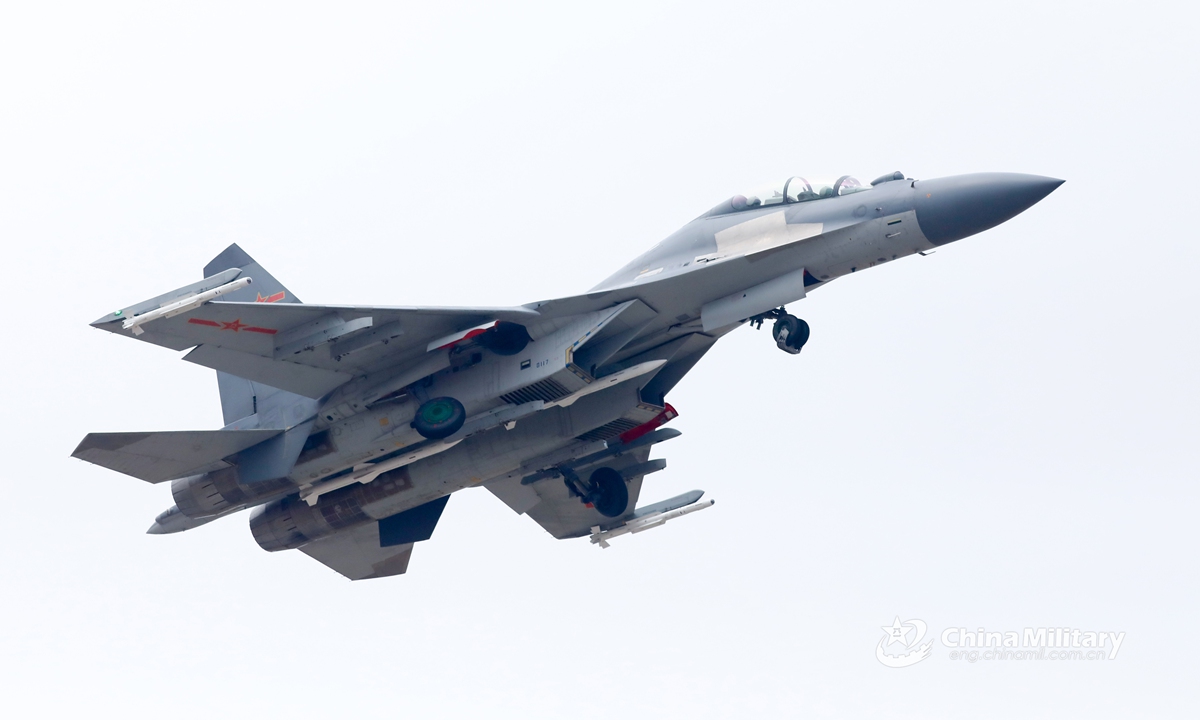
In a bold demonstration of its growing carrier aviation capabilities, China is set to publicly unveil the J-15DT, its first carrier-based electronic warfare (EW) fighter jet, during the upcoming 80th Victory Day Parade. The twin-seat aircraft, specifically designed for electromagnetic catapult operations, signals the People’s Liberation Army Navy’s (PLAN) intent to field a dedicated EW platform comparable in function to the U.S. Navy’s EA-18G Growler.
A New EW Era for PLAN’s Carrier Air Wing
The J-15DT is a significant leap in China’s naval modernization strategy. A catapult-capable evolution of the J-15 multirole fighter, the DT variant has undergone successful trials aboard China’s Type 003 aircraft carrier, Fujian. Recent satellite imagery and deck operations footage suggest that aircraft number 1523, the J-15DT prototype, was launched using the ship’s electromagnetic aircraft launch system (EMALS) — a critical capability that enables high-tempo operations similar to U.S. supercarriers.
Unlike its ski-jump-launched predecessors, the J-15DT features a launch bar on the nose gear and redesigned undercarriage systems to withstand catapult launches. Structural modifications, including a prominent dorsal spine for electronic systems, a slanted radome, and light gray tail tips, mark it visually distinct from earlier models. Its lack of internal cannon and IRST sensor confirms its non-kinetic, support-centric mission.
China’s Answer to the EA-18G Growler
The J-15DT is optimized for escort jamming, radar suppression, and electromagnetic support missions — critical roles in contested maritime airspace. It is equipped with external electronic support measure (ESM) pods, conformal antennas, and potentially signal intelligence gear along its fuselage. Onboard systems are believed to be derived from the J-15D and J-16D platforms, integrating a domestic AESA radar, wide-area HUD, and advanced communications systems.
The rear seat, operated by an electronic warfare officer, allows the J-15DT to coordinate jamming signals, relay targeting data, and manage sensor fusion across platforms. The jet’s compatibility with PLAN tactical datalinks enables seamless integration with the KJ-600 AEW aircraft, Type 055 destroyers, and stealth fighters like the J-35, forming a comprehensive naval strike network.
A Crucial Asset for EMALS-Capable Carriers
The timing of the J-15DT’s debut is no coincidence. Its development is tied directly to the operationalization of the Fujian, China’s first EMALS-equipped aircraft carrier. The vessel recently completed its eighth sea trial, where the J-15DT participated in catapult launch drills, evidenced by tire skid marks on Catapult No. 2. Reports suggest a future Fujian air wing may include 24 J-35 stealth fighters, 12 J-15T strike variants, four KJ-600 AEWs, and four J-15DTs — a composition modeled after U.S. carrier air wing doctrine.
While China is rumored to be developing a next-generation stealth EW jet for its future Type 004 nuclear carrier, the J-15DT will likely remain the PLAN’s primary CATOBAR-compatible EW aircraft for at least the next two decades.
From Soviet Roots to Indigenous Innovation
The J-15 lineage traces back to the Soviet T-10K-3 prototype, purchased from Ukraine. Since its first flight in 2009, the airframe has evolved into multiple roles: the J-15S for training, J-15D for early EW missions from ski-jump decks, and the J-15T/DT variants designed for EMALS systems.
The DT variant is the first to fully realize the PLAN’s vision for high-end electronic warfare operations from aircraft carriers capable of power projection far from Chinese shores. Its integration into active service illustrates a clear pivot in China’s naval strategy: from regional defense to blue-water electronic dominance.
Strategic Implications
With its official debut, the J-15DT shifts from a developmental prototype to a frontline support aircraft, expanding the PLAN’s operational envelope in multi-domain maritime conflict scenarios. Its role in electronic suppression, non-kinetic escort missions, and signal warfare will be critical in enabling strike packages and shielding stealth fighters during offensive operations.
While lacking stealth characteristics itself, the J-15DT’s presence fills a vital capability gap until a true fifth-generation EW jet arrives. In the meantime, its introduction marks China’s growing parity with Western carrier air wings, particularly the U.S. Navy’s Growler-led strike formations.
A New Vector in Naval Power Projection
As China prepares to showcase the J-15DT to the world, it sends a clear signal: the era of modern carrier-based electronic warfare in the PLAN has begun. The aircraft’s appearance at the Victory Day Parade not only affirms its readiness but also reflects a strategic doctrine shift toward integrated, information-dominant warfare at sea.
With the Fujian nearing combat readiness and the J-15DT taking flight, China’s ambitions to rival U.S. naval aviation in electronic warfare are no longer theoretical — they are unfolding in real time, on deck, and under radar silence.
