

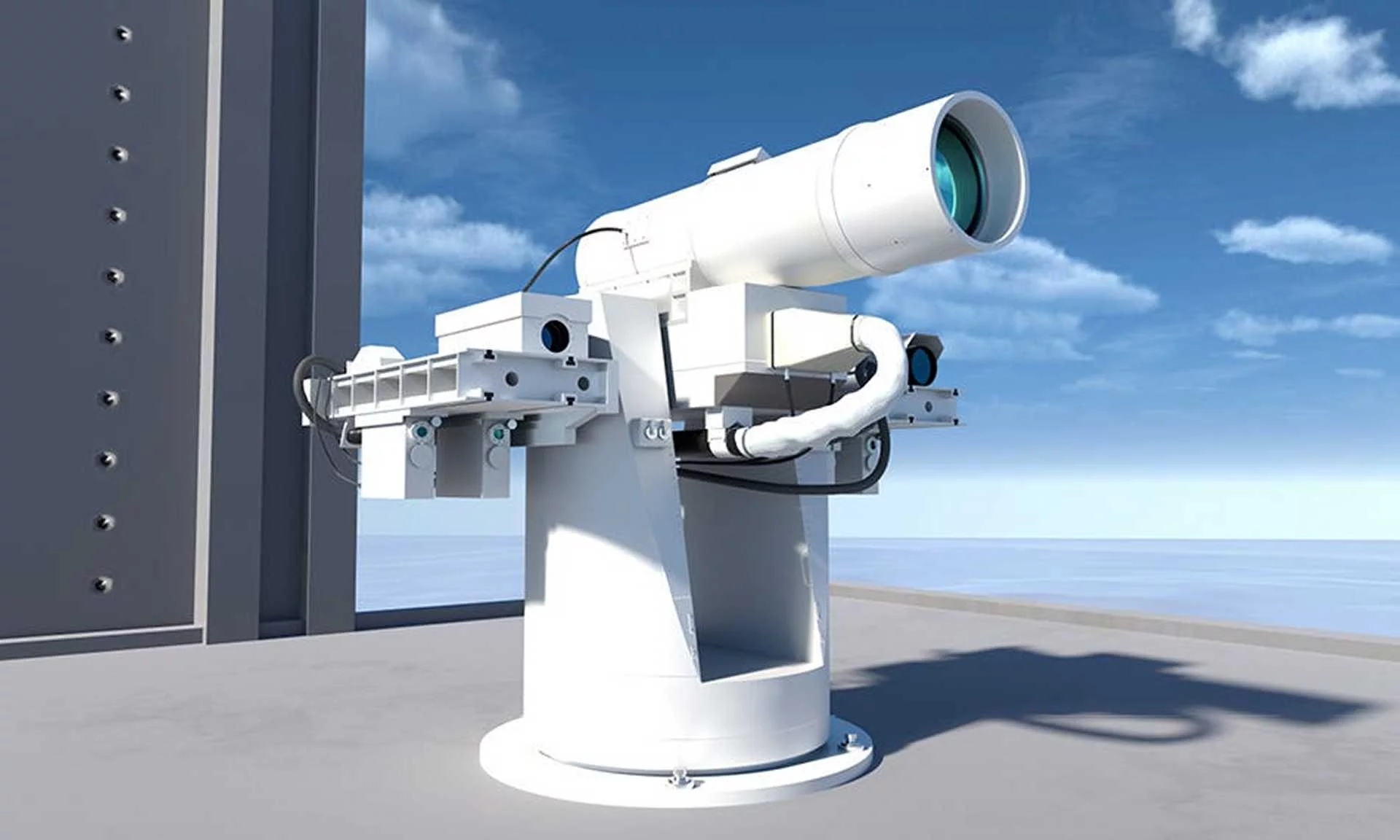
On June 10, 2025, the Navy awarded a $29.98 million cost-plus-fixed-fee contract to Coherent Aerospace & Defense in Murrieta, California. The project centers on developing pulsed fiber lasers and directed energy systems with advanced wavefront control. Key goals include creating pulsed fiber lasers for illumination and sensing, as well as assembling a 400-kilowatt laser by combining multiple 50-kilowatt modules into a single, precisely controlled beam.
The project timeline extends to January 2027, covering a 20-month base phase plus two optional phases of 11 and 18 months that could overlap. For Fiscal Year 2024, about $12.9 million in research and development funds have been allocated and will expire at the year’s end. Songbow fits within the Navy’s broader efforts to enhance its directed-energy arsenal as a cost-effective alternative to traditional missile interceptors.
Recent operations, such as those in the Red Sea and Gulf of Aden from October 2023 onward, exposed the Navy to the challenge of intercepting over 91 incoming threats—including drones, cruise missiles, and anti-ship ballistic missiles. These defensive actions required over 100 Standard Missiles, each potentially costing up to $4 million, leading to nearly $1 billion in munition expenditures by April 2024. Navy Secretary Carlos Del Toro and senior military officials, including Vice Chairman of the Joint Chiefs Admiral Christopher Grady and Rear Admiral Fred Pyle, have expressed concern that relying on expensive kinetic interceptors is unsustainable. Directed-energy weapons like Songbow offer a dramatically lower cost per shot—estimated between $1 and $10—and can operate as long as the ship’s power supply remains active.
Coherent Aerospace & Defense is tasked with developing the 400-kilowatt laser by integrating at least four 50-kilowatt modules. The deliverable includes complete directed-energy subsystems featuring beam directors and precision optics optimized for naval use. This output level marks a considerable upgrade from existing Navy lasers, such as the 30-kilowatt LaWS and the 60-kilowatt Helios system aboard USS Preble, which integrates with the Aegis Combat System. Besides defending against drones and missiles, Songbow is expected to support functions like remote sensing and target illumination. Though its deployment platform hasn’t been officially disclosed, the system is designed for both maritime and land applications. Coherent’s expertise spans vertically integrated production of lasers, amplifiers, optical fibers, and optomechanical components, supporting the technical demands of this contract.
Songbow complements ongoing Navy directed-energy initiatives like Odin, Helios, and Helcap. Odin is a dazzler system installed on eight Arleigh Burke-class destroyers to disrupt ISR drones by blinding their optical sensors. Helios operates at around 60 kilowatts and can scale up to 150 kilowatts, combining reconnaissance and destructive power with planned integration into Aegis. Helcap aims to field a 300-kilowatt-class system to counter anti-ship cruise missiles and is part of the larger High Energy Laser Scaling Initiative (HELSI), involving industry leaders such as Lockheed Martin and General Atomics. Additionally, the Layered Laser Defense (LLD) program, funded by the Office of Naval Research, successfully destroyed drones and simulated cruise missiles during 2022 testing but is not yet scheduled for deployment. Together, these efforts form the Navy Laser Family of Systems (NFLoS), a coordinated framework for integrating various laser weapons.
Deploying high-energy laser weapons like Songbow faces challenges including atmospheric distortion, refraction, thermal blooming, and beam jitter—especially near the sea surface where temperature gradients affect beam quality. To maintain precision, beam control assemblies and computational correction are essential. Previous systems like the chemically powered MIRACL, which achieved megawatt outputs, were impractical due to toxic emissions and safety risks. Modern designs, such as Helios, utilize solid-state fiber lasers that combine multiple wavelengths into a coherent beam, enabling continuous and adjustable operation without bulky capacitors. Integration with current platforms like Flight III Arleigh Burke destroyers is limited by power and cooling capacities, as these ships prioritize electrical supply for their AN/SPY-6 radars. Future surface combatants are being engineered with enhanced power generation to support directed-energy weapons.
The push for Songbow and similar systems is driven by the growing threat from unmanned aerial vehicles and low-cost missiles. Directed-energy weapons provide sustained multi-target engagement without the logistical complexities of missile replenishment. Media reports from February 2024 confirmed extensive use of Standard Missiles in the Red Sea region, with some targets requiring multiple interceptors per threat. This pattern reinforces the Navy’s aim to deploy scalable, cost-effective defensive technologies.
Other nations are pursuing parallel developments: Israel’s Iron Beam for short-range rocket and drone defense is expected by late 2025; South Korea’s Cheongwang Block I and Japan’s 10-kilowatt High-Power Laser Electronic Warfare Vehicle entered service in 2024. India is testing laser systems with outputs up to 30 kilowatts and aims for 300 kilowatts with the Surya program. Ukraine employs mobile lasers like Tryzub and SlimBean in ongoing conflict zones, while Russia and China continue experimental work on systems such as Peresvet and Silent Hunter.
Laser weapons extend beyond destructive roles. Non-lethal dazzlers like Odin and Light Blade impair enemy sensors and targeting systems, and are not prohibited by international law if their effects are temporary. The PHASR rifle and similar devices use dual-wavelength lasers to cause temporary blindness without violating protocols against blinding weapons. Despite numerous attempts since the 1980s, most high-power laser systems have remained experimental or were canceled due to cost, toxicity, or battlefield limitations. Projects like the Strategic Defense Initiative’s space-based X-ray lasers faced atmospheric scattering challenges, and programs such as the YAL-1 Airborne Laser and Tactical High Energy Laser were discontinued after limited success and high costs.
Songbow continues the Navy’s longstanding effort to transition directed-energy technology from experimental phases into practical, deployable systems, emphasizing scalability, integration, and reduced cost per engagement.
