

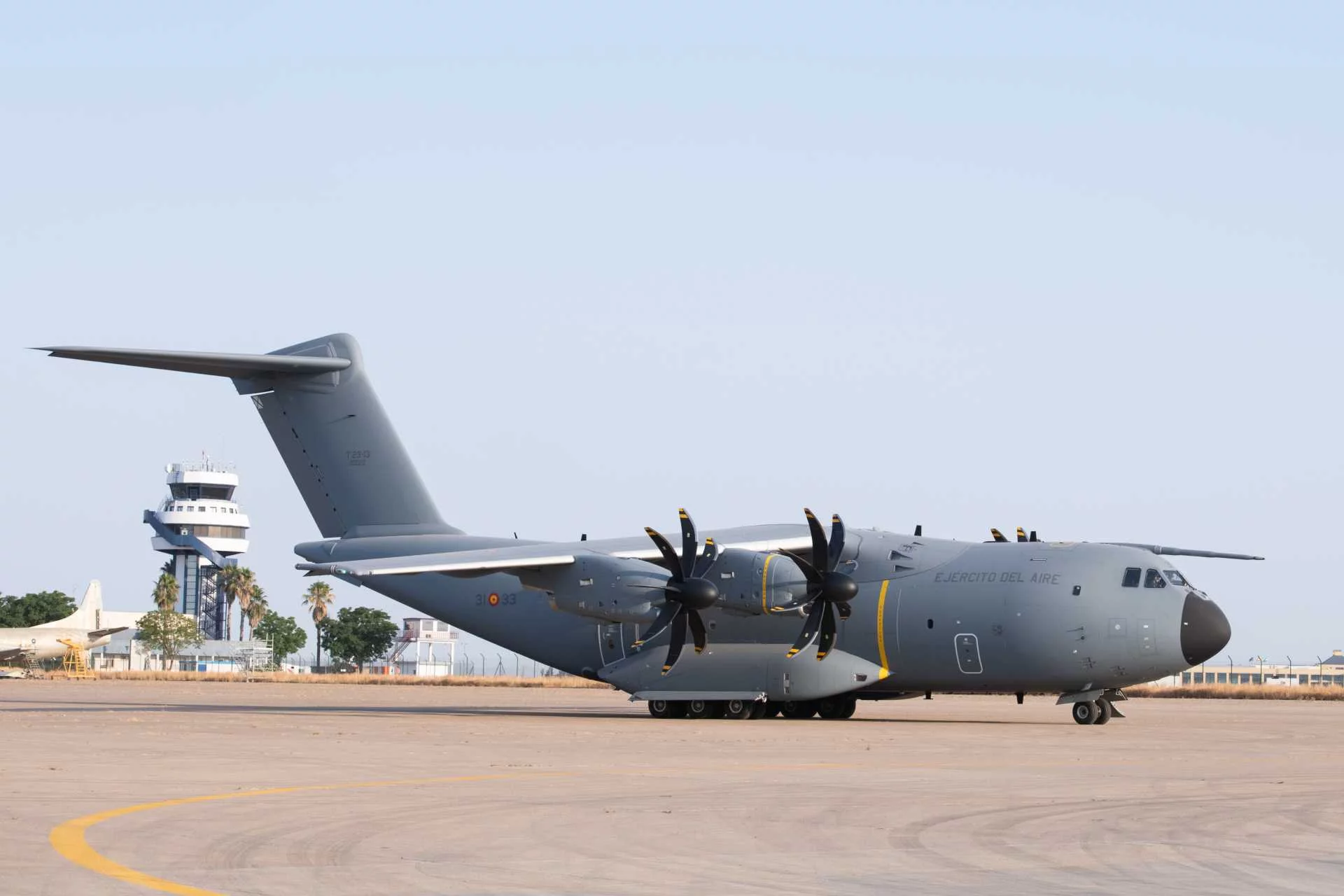
At the 2025 Paris Air Show, Airbus Defence and Space unveiled plans to increase the A400M Atlas military transport aircraft’s certified payload from 37 tonnes to 40 tonnes. This incremental 3-tonne boost aims to enable new mission variants currently in development without requiring a major structural redesign, allowing Airbus to implement the upgrade through existing production and certification processes.
The payload increase is designed to expand the aircraft’s operational versatility and maintain its competitive edge among medium-lift airlifters in the 30–50 tonne class. Airbus highlighted six variants that would directly benefit from the enhanced capacity: an electronic warfare platform with standoff jamming capabilities, a UAV mothership enabling airborne drone launch and recovery, an aerial firefighting version, an upgraded aerial refueling tanker with expanded fuel storage options, a broadband SATCOM communications relay, and a missile-capable strike model under consideration by the French Army.
Each variant incorporates mission-specific equipment that adds substantial weight—such as electronic jamming gear, drone control consoles, retardant tanks, additional fuel systems, and advanced communication arrays—making the extra payload critical to fulfilling operational requirements.
The A400M’s cargo hold spans approximately 340 cubic meters with a 4×4 meter cross-section. Currently certified to carry 37 tonnes with a 3,300 km range at max load, the aircraft’s operational flexibility includes short, unprepared runway capability thanks to its four powerful Europrop TP400-D6 turboprop engines. While the aircraft’s rear ramp can handle about 32 tonnes for outsized single loads, Airbus has not confirmed whether ramp reinforcement will accompany the payload upgrade, suggesting the new limit may primarily apply to distributed payloads.
Compared to other airlifters, the upgraded A400M surpasses the payload of the C-130J (~20 tonnes), Embraer C-390 (~26 tonnes), and Kawasaki C-2 (~37.6 tonnes), while narrowing the gap with heavier transports like the Antonov An-70 (~47 tonnes) and Il-76 (~48–60 tonnes). Though smaller than the C-17 Globemaster III’s 77.5 tonnes, the A400M retains an advantage in operating from austere airfields.
The enhanced payload will allow the standoff-jamming variant to carry heavier electronic warfare systems without sacrificing fuel or crew capacity. The UAV mothership can support more drones and in-flight recovery operations. The firefighting model will carry additional retardant for improved coverage. The refueling tanker can deploy extra cargo hold tanks, increasing the number of receiver aircraft serviced. The SATCOM platform gains capacity for larger communication suites, critical for contested environments. The missile-strike version will be capable of deploying guided munitions directly from the aircraft.
Strategically, the upgrade supports evolving global markets and military demands. India’s Medium Transport Aircraft program, which requires payloads between 25 and 40 tonnes, aligns well with the A400M’s profile. Existing operators like Indonesia and Kazakhstan stand to benefit, while Airbus seeks to attract customers in regions with challenging terrain or limited infrastructure. Certification efforts are ongoing with EASA and OCCAR to apply the payload increase to both current and future aircraft, with France and Spain anticipated to adopt the variant in upcoming production batches.
Airbus plans to sustain an output of about eight aircraft annually, having delivered 131 units by the end of 2024. The program’s established customer base includes Germany, France, the UK, Turkey, Spain, Belgium, and Luxembourg, alongside export clients such as Malaysia, Indonesia, and Kazakhstan. Born from NATO’s need for a medium-lift platform bridging tactical and strategic airlift, the A400M has matured despite initial delays and budget challenges. The new 40-tonne payload upgrade fits seamlessly into this mature framework, offering improved utility with manageable investment and technical risk.
