

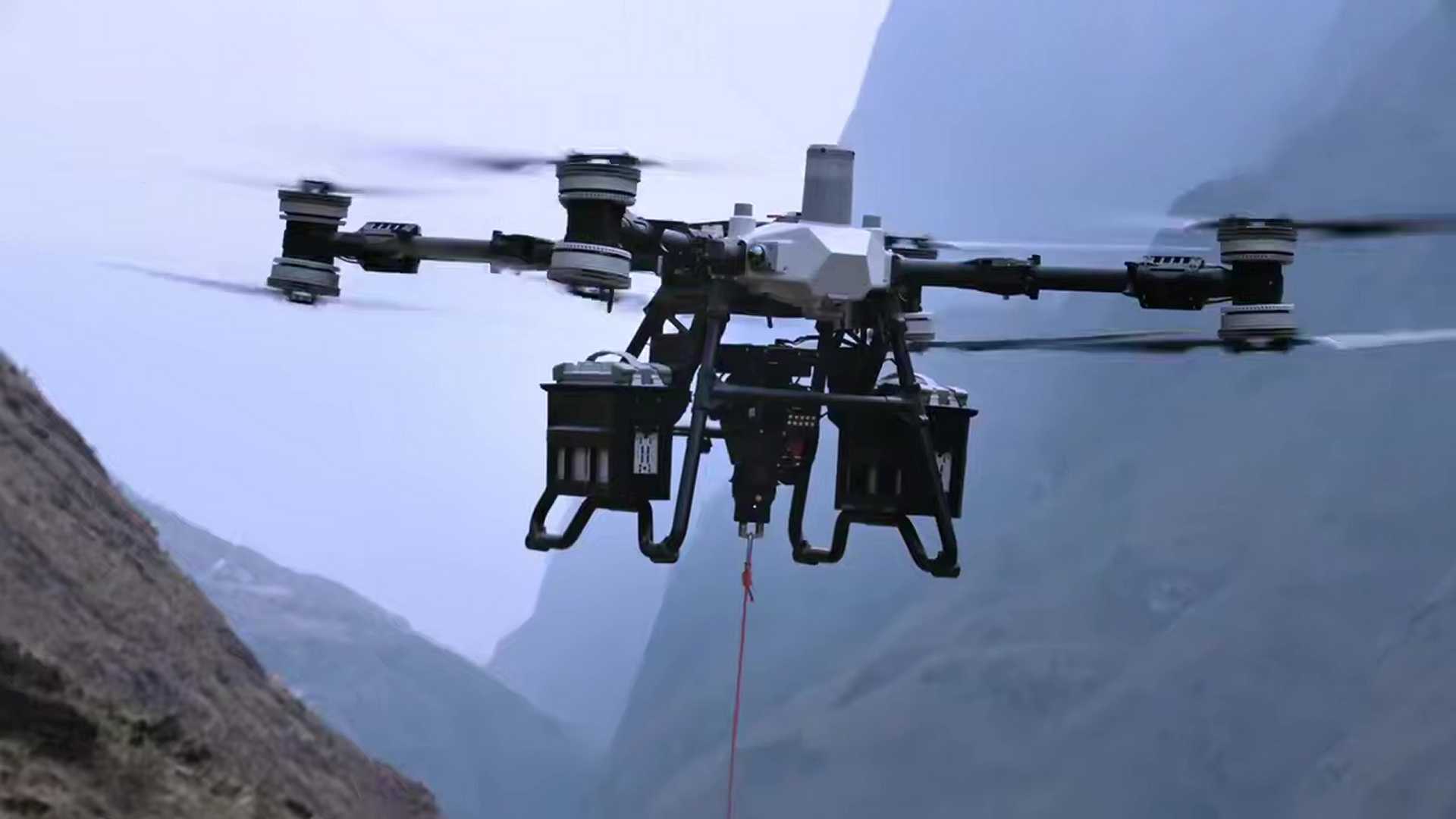
DJI, China’s leading drone manufacturer, introduced its latest industrial platform, the FlyCart 100 (FC100), during a showcase event in Shenzhen. Designed to meet the logistical demands of challenging terrains, the FC100 is set to replace the earlier FlyCart 30 model and marks a significant advancement in DJI’s cargo drone capabilities.
Positioned as a flagship civilian solution, the FC100 is engineered for use in emergency relief, infrastructure supply, maritime transport, and mountain operations—where access by traditional vehicles is limited or impossible.
Performance and Technical Profile
The FC100 is a high-performance multirotor drone that can carry up to 80 kg using a single battery or 65 kg with dual-battery operation. With a maximum takeoff weight of 149.9 kg, it’s built for demanding lift-and-haul operations in rugged environments.
Its coaxial rotor system features four arms and eight 62-inch carbon fiber propellers, each powered by advanced motors and a 420A ESC. Each rotor delivers a thrust of up to 82 kg. The FC100 can fly as far as 26 km unloaded and operates at altitudes up to 6,000 meters, with a service ceiling of 1,500 meters. At 3,000 meters elevation, it can transport 70 kg on a single battery and 50 kg with two.
The drone is powered by DJI’s DB2160 battery system, which supports hot-swapping, intelligent thermal regulation, and up to 1,500 charging cycles. Full recharging is achieved in under nine minutes, offering rapid turnaround for logistics operations.
Advanced Navigation and Safety Features
The FC100 is equipped with a robust triple-layered safety suite, including:
- 300,000-point/sec LiDAR sensor
- Millimeter-wave radar
- Five-camera fisheye system with 360° vision
These systems enable real-time obstacle detection, terrain following, and safe flight in low-visibility or complex environments. For emergency situations, the drone includes a parachute system capable of deploying above 80 meters, with full payload support and multiple fail-safe triggers. The system reduces descent speed to below 7 m/s and operates on an independent power source.
Control and Fleet Integration
Command is executed via the RC Plus 2 controller, featuring a 7-inch, 1400-nit display and DJI’s O4 transmission protocol—allowing control ranges up to 20 km. Additional connectivity options include 4G video uplinks and D-RTK3 relay stations, ensuring uninterrupted operation in signal-blocked areas.
Operators can manage missions through the DJI Delivery app, featuring AR overlays, live multi-angle feeds, and delivery guidance. The DeliveryHub platform supports central fleet coordination, route planning, and team communication across devices.
Civil Use, Military Applications
DJI insists the FC100 is intended solely for non-military use. However, its design echoes growing global interest in dual-use heavy-lift drones, as militaries worldwide integrate such platforms for autonomous resupply, equipment drops, and operations in inaccessible zones.
Countries like the U.S., U.K., and Russia are actively fielding or developing similar rotorcraft, capable of lifting 50–200 kg payloads over short distances. Some military systems mirror the FC100 in payload management, navigation autonomy, and ruggedized build—features easily transferable to battlefield environments.
DJI Drones and the Ukraine Conflict
The ongoing war in Ukraine has underscored the military relevance of commercial drones. Despite halting sales to both sides in April 2022, DJI platforms—especially the Mavic series—have become staples for reconnaissance, targeting, and video documentation by both Ukrainian and Russian forces.
The AeroScope system, previously used to locate drone operators, sparked controversy after Ukraine claimed it enabled Russian forces to pinpoint Ukrainian pilots. Though DJI discontinued the product and denied any misuse, concerns over its dual-use potential have persisted.
In 2023–24, Ukrainian leaders, including President Volodymyr Zelenskyy, criticized the uneven availability of DJI drones, citing Chinese export restrictions that disproportionately affected Ukrainian access.
Rise of Domestic Drone Production
As access to DJI’s platforms narrowed, both Russia and Ukraine accelerated domestic drone production and alternate sourcing. Ukraine’s government launched funding programs to support local drone startups, with 96% of drone procurement funds in 2025 allocated to Ukrainian manufacturers.
At least ten local companies had released DJI-style quadcopters by mid-2025, though duplicating DJI’s advanced features has proven challenging. On the Russian side, procurement through third-party channels in Kazakhstan, China, and the UAE continues, alongside ramped-up production of alternatives like the Shahed UAVs.
As DJI rolls out the FC100 into the commercial logistics market, its design, capabilities, and potential use in dual-purpose scenarios will likely keep it in the global spotlight. Whether ferrying relief supplies or enabling frontline operations, the FC100 reflects a broader trend—civilian drone technology is now inseparable from modern strategic infrastructure.
