

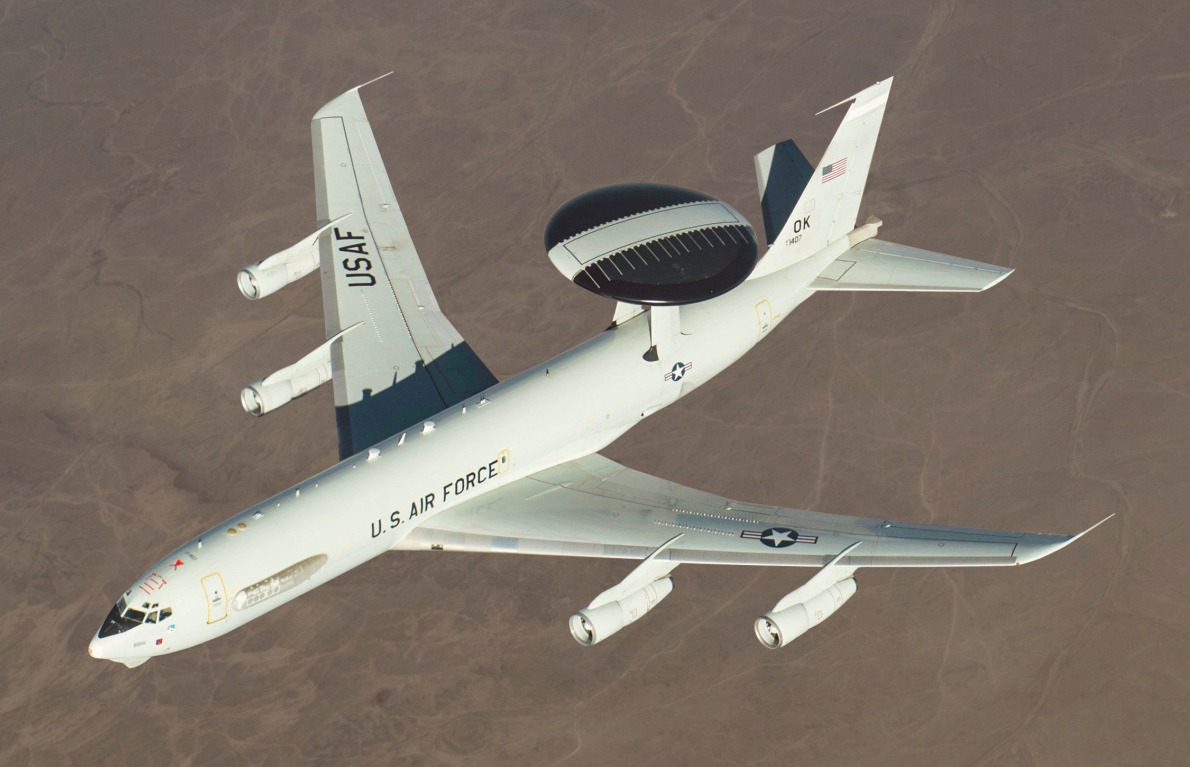
The Boeing E-3 Sentry is an advanced Airborne Early Warning and Control (AEW&C) system developed by U.S.-based Boeing, built on the Boeing 707 aircraft platform. Since the 1970s, it has played an active role in missions such as airspace control and threat detection, used by the United States, NATO, the United Kingdom, France, and Saudi Arabia.
Project Development: From EC-121 to Sentry
In 1965, the U.S. Air Force began developing a new aircraft equipped with a more advanced radar system to replace the aging EC-121 Warning Star fleet. There was a growing need for a modern radar aircraft capable of detecting low-flying and ground targets.
Initially, discussions were held with Boeing, Lockheed, and Douglas, while Westinghouse and Hughes competed to develop the radar system. In 1970, Boeing’s design—based on the Boeing 707 with General Electric TF34 engines and a rotating radar dome—was selected over McDonnell Douglas’s DC-8 proposal.
Flight testing began in 1972. Westinghouse’s radar technology was then chosen, marking a revolution in frequency analysis with its Digital Doppler Radar technology and Fast Fourier Transform processing.
Serial Production and Equipment
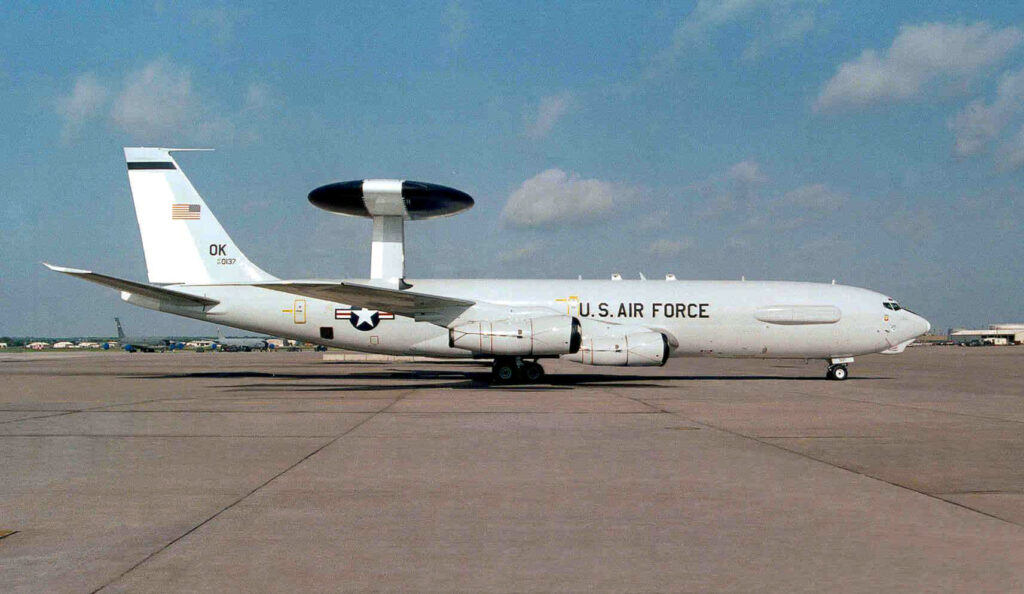
The first fully equipped production model flew in 1975. These versions featured a 30-foot rotating radar dome mounted on the fuselage, advanced communication and mission computers, and in-flight refueling capability. The aircraft was developed to handle a wide range of operational missions such as air surveillance, command and control, and mission coordination.
The crew typically includes a four-person flight team and a mission crew of 13 to 19. The radar can detect low-altitude targets at a range of 400 km and high-altitude objects at 650 km. Mission data can be shared simultaneously with ground bases and ships.
Modernization and RSIP Program
As of 2001, the E-3 Sentry fleet received significant upgrades under the Block 30/35 modernization, which added:
- Electronic Support Measures (ESM)
- Link-16 (JTIDS) tactical data link
- GPS integration
- Larger onboard computer memory
Additionally, radar performance was greatly enhanced under the Radar System Improvement Program (RSIP). The aircraft’s electronic counter-countermeasures (ECCM) capabilities were improved, hardware was upgraded, and radar range was increased. New radar algorithms enabled earlier detection of targets with small radar cross-sections.
Next-Generation Solutions and Future Plans
Since production of the Boeing 707 platform ended, alternatives like the E-767 model developed for Japan have been explored. Under the Block 40/45 and Airframe Modernization Program (AMP), there are plans to fully digitize the cockpit, integrate new-generation engines, and increase mission range and endurance.
The AMP is expected to reduce fuel consumption by nearly 20% and shorten the required takeoff distance. Although not among the top defense spending priorities, these investments are of strategic importance for extending the operational life of the E-3 platform.
Operational History
The E-3 Sentry played a key role in 24-hour air surveillance missions during the Gulf War, completing over 5,000 operational flight hours and tracking enemy movements. Thanks to these aircraft, for the first time in history, an aerial battle was recorded from beginning to end.
The U.S. Air Force still operates more than 30 E-3 aircraft. NATO, France, the United Kingdom, and Saudi Arabia also maintain E-3 Sentry fleets. NATO’s aircraft are registered in Luxembourg and based at Geilenkirchen Air Base in Germany.
Operators and Variants
The E-3 Sentry platform is currently operated by the following countries:
- United States – 33 aircraft (E-3B/C/G)
- NATO – 17 aircraft (E-3A)
- United Kingdom – 7 aircraft (E-3D/Sentry AEW.1)
- France – 4 aircraft (E-3F)
- Saudi Arabia – 5 aircraft (E-3A)
- Japan – 4 aircraft (E-767) with similar systems
Variants of the E-3 include test aircraft (EC-137D), tanker aircraft (KE-3A), and advanced radar models (E-3C/D/F/G).
Technical Specifications (USAF Version)
| Specification | Value |
|---|---|
| Length | 46.61 m |
| Wingspan | 44.42 m |
| Height | 12.60 m |
| Engines | 4 × Pratt & Whitney TF33 |
| Maximum Speed | 854 km/h |
| Range | 7,400 km |
| Mission Duration | 8+ hours (without refueling) |
| Radar | AN/APY-1 or AN/APY-2 |
