

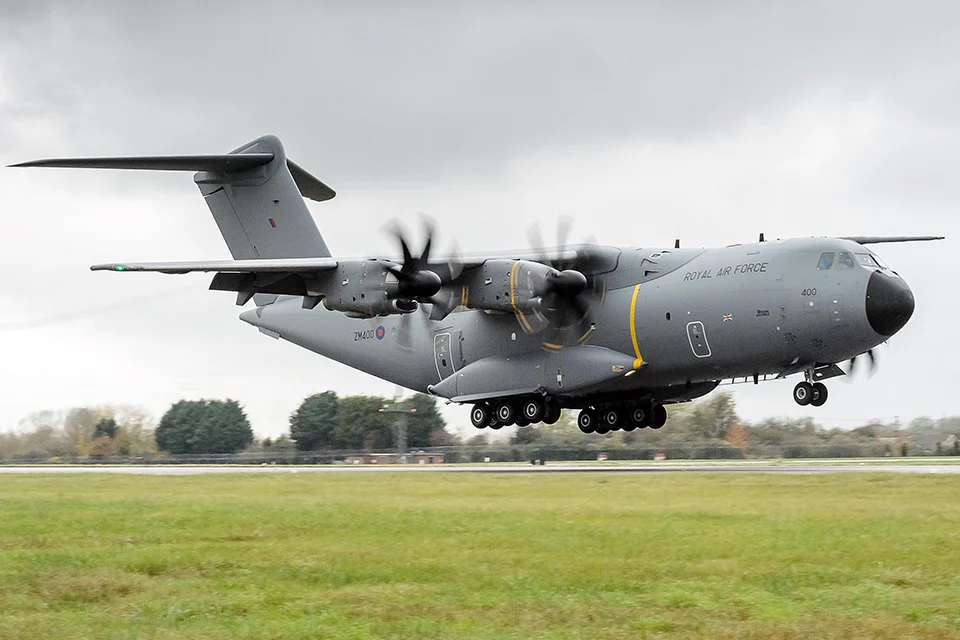
At the 2025 Paris Air Show, Airbus Defence and Space detailed plans to adapt the A400M transport aircraft for stand-off electronic warfare (EW) missions. Alongside this development, Airbus also announced intentions to expand the A400M’s mission range to include new roles such as drone carrier, providing satellite and cloud-based battlefield connectivity within the Future Combat Air System (FCAS) program, and equipping the aircraft with firefighting kits capable of dropping 20,000 liters of water. Furthermore, discussions are ongoing with the French Air and Space Force about a potential strike variant capable of deploying short-range missiles or guided bombs.
The A400M electronic warfare variant is expected to not only support NATO’s spectrum dominance efforts but also enable smaller air forces to acquire effective jamming capabilities without the need to invest in costly dedicated EW fleets.
While the aircraft is already equipped with radar warning receivers, infrared countermeasure systems, flare and chaff dispensers, and structural design features that enhance survivability, a significant upgrade is underway involving the integration of Directed Infrared Counter Measures (DIRCM) systems. Airbus has secured a contract from the German procurement agency BAAINBw to install DIRCM systems supplied by Elbit Systems on 23 Luftwaffe A400M aircraft. These systems protect the aircraft by detecting and neutralizing incoming infrared-guided missiles using directed laser beams. Testing is currently underway in Seville, Spain, with certification expected by summer 2025. Installation will take place at Airbus facilities in Manching (Germany), Getafe and Seville (Spain), and continue until 2032 in coordination with scheduled aircraft maintenance. These modernized aircraft will support tactical operations and medical evacuations in high-threat environments, complementing the strategic logistics version of the A400M that transports armored vehicles, helicopters, and engineering equipment.
Airbus states that the A400M is technically suitable to operate as a stand-off jammer performing electronic jamming from outside contested airspace. This role requires the integration of multiple antennas, which the A400M’s internal volume can accommodate. Its four TP400-D6 engines provide the necessary electrical power for the jamming systems. Unlike traditional EW platforms converted from smaller jets or reconnaissance aircraft, the A400M’s large fuel capacity allows it to operate for extended durations at safe distances from the front line. Airbus is currently studying both podded jamming systems and integrated antennas with roll-on/roll-off EW mission packages. These improvements are seen as part of a broader vision to expand the A400M’s multi-role mission portfolio.
What is the Airbus A400M?
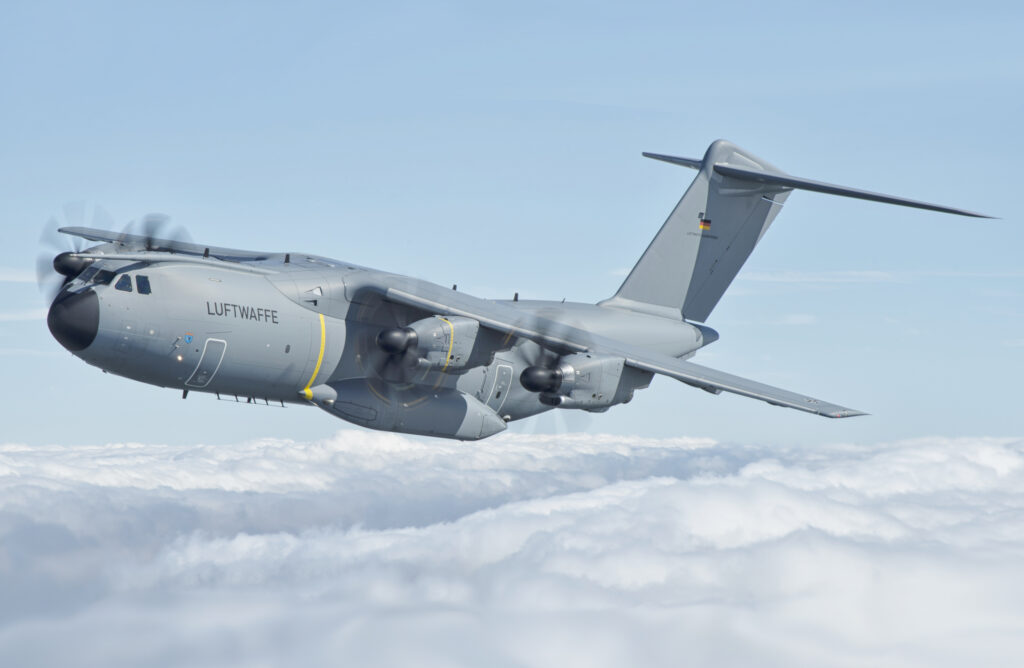
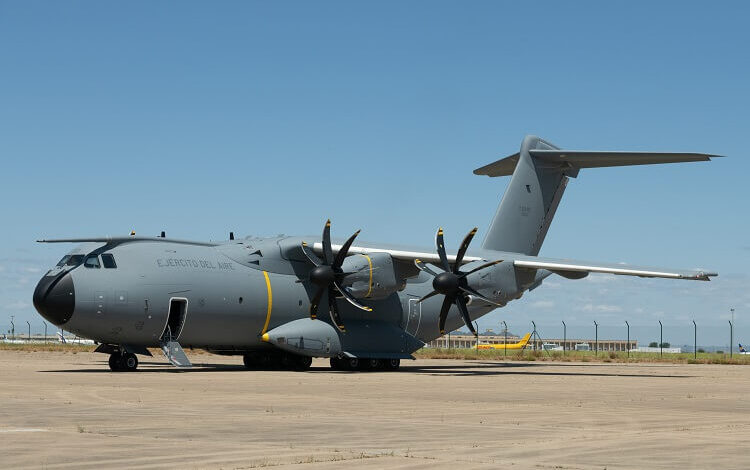
The A400M Atlas is a four-engine turboprop military transport aircraft developed by Airbus Defence and Space. It is positioned between the Lockheed C-130 and Boeing C-17 in terms of capability. Designed to perform both tactical and strategic transport missions, it can carry up to 37 tons of heavy vehicles, helicopters, and humanitarian supplies. The A400M can take off from short or semi-prepared runways, has a maximum speed close to Mach 0.72, and an unrefueled range exceeding 3,300 kilometers when fully loaded. It first flew in December 2009 and entered service in 2013. As of January 2025, 130 aircraft have been delivered. Its main operators include the German, French, British, and Spanish Air Forces. It is certified for aerial refueling missions and can also serve as a medical evacuation platform. Initially intended to replace the C-130 Hercules and C-160 Transall, ongoing upgrades aim to enable multiple new roles such as drone carriage, firefighting, and precision strike.
Transport Aircraft Used for Electronic Warfare Worldwide
The use of military transport aircraft for electronic warfare dates back to the Cold War, when large airframes’ endurance, payload, and electrical generation capabilities were leveraged for electromagnetic operations. In the US, the EC-130H Compass Call entered service in 1983, converted from the C-130 and equipped with jamming systems to disrupt enemy communications and command-and-control networks. In the Soviet Union, the Yakovlev Yak-28PP Brewer-E of the 1970s was converted from a bomber to an ECM platform, carrying large internal jammers instead of bombs, with external antenna arrays and chaff dispensers. Japan converted its Kawasaki C-1 transport to the EC-1 for EW training and signals intelligence. These conversions aimed to provide persistent jamming, radar deception, and electromagnetic support, especially in coordinated operations with strike aircraft and SEAD missions. Europe has researched equipping tactical transports like the C-27J with EW modules, but none have yet entered service.
Adapting transport aircraft for EW missions involves integrating various antennas on the fuselage, tail, or wingtips; converting cargo bays into workstations for EW operators; and upgrading electrical systems to support high-power electronic equipment. External pods, fairings, or radomes house jamming or ELINT components. Power systems may be supplemented with additional generators or backup batteries. Defensive systems such as radar warning receivers, flare and chaff dispensers, and directional infrared countermeasures can also be integrated. The aircraft’s endurance and air-to-air refueling capability allow long-duration missions. These features enable transport-based EW aircraft to conduct stand-off radar jamming, communication disruption, electronic support, and command relay roles. The A400M’s size, power generation, and modular mission architecture are well suited to these requirements, allowing EW package integration without structural modifications.
Worldwide, several transport-derived EW aircraft have been operational or proposed. The US EC-130H Compass Call remains active with 7 of 14 built aircraft in service. Its successor, the EA-37B Compass Call, based on the Gulfstream G550, features new SABER mission systems and modular jamming suites. Italy plans to integrate two mission systems on its G550 platforms. Russia operated the Yak-28PP until the early 1990s before replacing it with EW-capable fighter variants. China operates multiple Y-9DZ and Y-9G variants derived from the Shaanxi Y-9, featuring dorsal radomes, side antenna arrays, and jamming or ELINT systems. Japan continues to operate the EC-1 and plans to modify its modern C-2 for stand-off jamming. The Ukraine-Saudi AN-132ISR program, which included an EW variant, was canceled in 2019. Europe is conducting studies within PESCO and FCAS frameworks but has yet to deploy a dedicated EW transport aircraft. If Airbus proceeds with the A400M EW conversion, it would mark Europe’s first large-scale adaptation of an active NATO platform for electronic warfare missions.
