

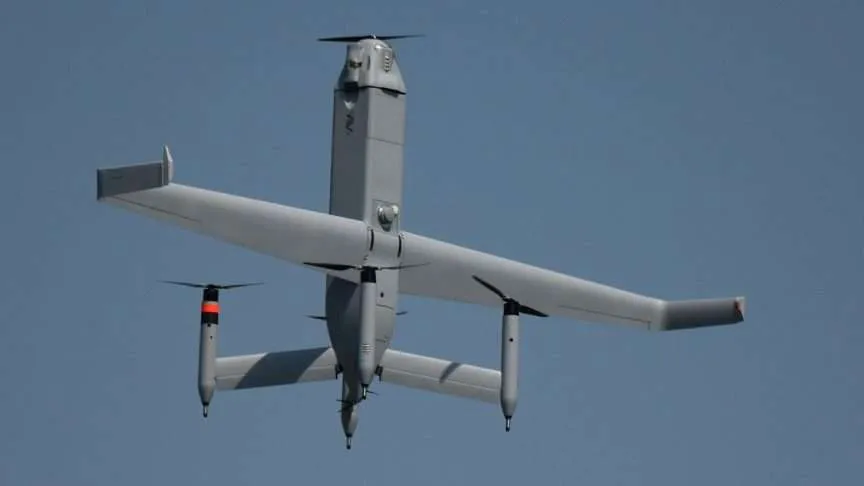
AeroVironment’s Wildcat Unmanned Aerial System (UAS) has achieved significant milestones in the Defense Advanced Research Projects Agency’s (DARPA) Early Vertical Take-off and Landing (EVADE) initiative. Both AeroVironment and DARPA, U.S.-based leaders in defense technology innovation, are driving advancements in unmanned systems through this program. The Wildcat platform has successfully demonstrated seamless transitions from vertical take-off to forward flight, while rigorously validating its propulsion and flight control systems.
Wildcat’s Core Capabilities
Designed as a tail-sitting Vertical Take-off and Landing (VTOL) UAS, Wildcat is engineered for deployment from naval vessels in challenging maritime environments. Its compact design and robust flight stability enable autonomous launch and recovery, making it well-suited for operations in coastal regions with minimal infrastructure.
Chris Fisher, Vice President of Novel Systems at AeroVironment’s MacCready Works, stated, “In just weeks, we’ve advanced from system integration to executing full flight transitions, all while confirming the reliability of critical subsystems. This pace reflects true innovation in action.”
Technical Upgrades for Enhanced Performance
To meet the stringent requirements of DARPA’s EVADE program, AeroVironment upgraded the Wildcat UAS with cutting-edge features:
- Advanced Visual Precision Landing System (VPLS): Ensures accurate and safe landings in dynamic conditions.
- Government-Supplied Software Integration: Enhances compatibility with operational frameworks.
- Modular Autopilot and AI Processing Unit: Supports autonomous operations and flexible mission planning.
Currently, Wildcat is being outfitted with modular payloads to enable a range of missions, including intelligence, surveillance, reconnaissance (ISR), communications relay, and other tactical applications. These enhancements position Wildcat as a versatile asset for modern warfare.
Upcoming Maritime Trials
Future tests will simulate naval operations, with Wildcat transitioning between hover and forward flight modes while performing payload-specific tasks across diverse scenarios. These trials will further validate the UAS’s ability to operate effectively in contested environments, showcasing its operational flexibility and autonomy.
DARPA’s ANCILLARY Vision
The EVADE program is a key component of DARPA’s AdvaNced airCraft Infrastructure-Less Launch And RecoverY (ANCILLARY) initiative. This ambitious effort aims to develop lightweight VTOL drones capable of large-scale deployment from ships or remote locations, transforming a single platform into a hub for unmanned systems. Phase 2 of ANCILLARY, scheduled for 2026, will prioritize early integration of autonomous systems and mission-specific payloads.
