

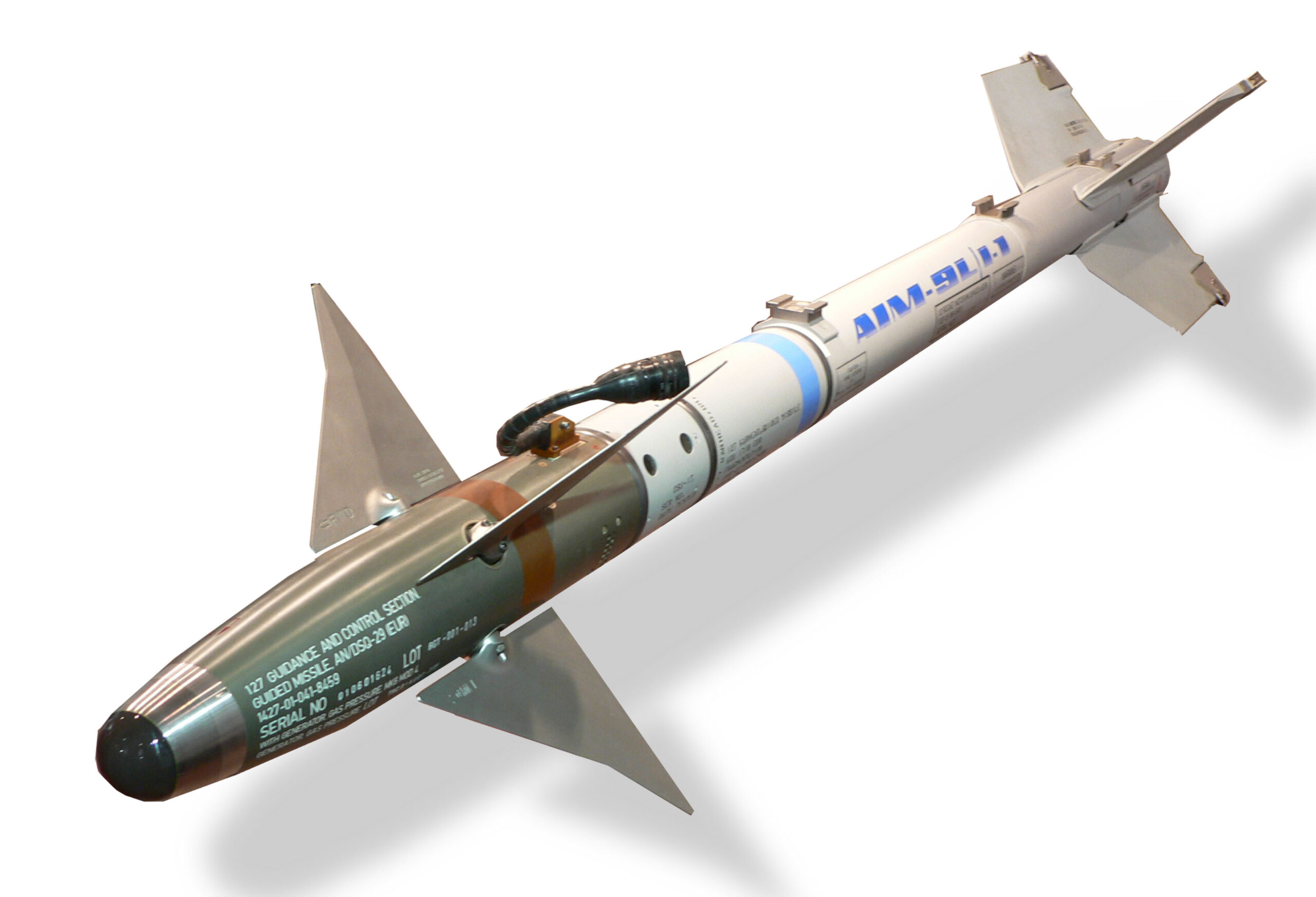
The AIM-9 Sidewinder is a supersonic, heat-seeking air-to-air missile equipped with a high-explosive warhead. Originally developed by the U.S. Navy for fleet air defense, it was later adapted by the U.S. Air Force for use on fighter jets. The missile proved its battlefield effectiveness early on, particularly during the conflicts in Southeast Asia.
Design Features and Operational Principle
The AIM-9 features a cylindrical body, roll-stabilizing rear fins (rollerons), and double-delta control surfaces positioned just behind the nose—granting it exceptional maneuverability. These components are arranged in a cross-shaped configuration to maintain aerodynamic stability during flight.
The missile is composed of four primary components:
- Infrared (IR) homing guidance unit
- Optical target detection sensor
- High-explosive warhead
- Solid-propellant rocket motor
The infrared guidance head allows the missile to lock onto the heat emitted by an enemy aircraft’s engines. This guidance system is both cost-effective and capable of functioning day or night—even in environments with electronic countermeasures. Once launched, the missile can autonomously track its target, enabling the pilot to break away or take evasive action.
Development History and Variants
- AIM-9A: The first prototype, successfully test-fired in 1953.
- AIM-9B: The first production version, entered service in 1956. Effective only at short range and lacked night, low-altitude, and head-on engagement capability.
- AIM-9J: Improved maneuverability, speed, and range for better dogfighting performance. Introduced in 1977 on F-15s and other platforms.
- AIM-9L: Enhanced with a more powerful solid motor, all-aspect targeting capability, improved seeker, and resistance to electronic countermeasures. Production began in 1976.
- AIM-9P Series: Upgraded versions of the J model.
- P-1: Added an optical proximity fuse.
- P-2: Introduced a reduced-smoke rocket motor.
- P-3: Combined both upgrades, with a stronger warhead and improved electronics for better durability and temperature resistance.
- AIM-9M: Retained the all-aspect engagement of the L model while improving resistance to infrared countermeasures. Deliveries began in 1983.
- AIM-9M-9: Featured enhanced IR counter-countermeasure circuitry.
- AIM-9X: The most advanced variant to date. Physically equipped with fixed forward canards and smaller, high-performance fins. Incorporates an imaging IR seeker and jet vane steering for superior post-launch agility. Fully compatible with the Joint Helmet-Mounted Cueing System (JHMCS), allowing pilots to designate targets simply by looking at them.
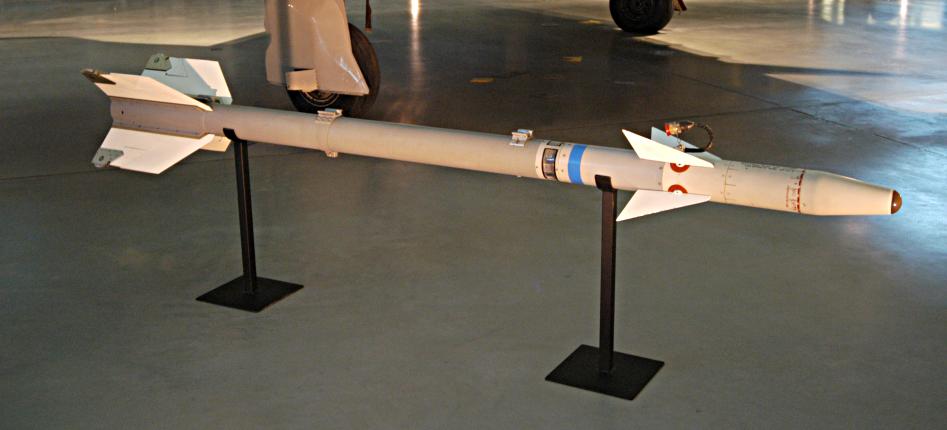
General Technical Specifications
| Feature | Value |
|---|---|
| Primary Function | Air-to-air missile |
| Manufacturers | Raytheon, Loral Martin |
| Motor Type | Hercules & Bermite Mk 36 Mod 11 |
| Length | 2.87 m (9 ft 5 in) |
| Diameter | 13 cm (5 in) |
| Finspan | 0.63 m (2 ft ¾ in) |
| Warhead | Annular blast-fragmentation |
| Launch Weight | 85.5 kg (190 lb) |
| Guidance System | Solid-state infrared homing |
| Service Entry Year | 1956 |
| Unit Cost | Variable; depends on lot and block |
| Inventory Status | Classified |
Continuously refined over more than half a century, the AIM-9 Sidewinder remains a cornerstone of modern air forces around the world. Its technological evolution and combat-proven performance have made it one of the most enduring and indispensable weapons in air-to-air warfare.
