

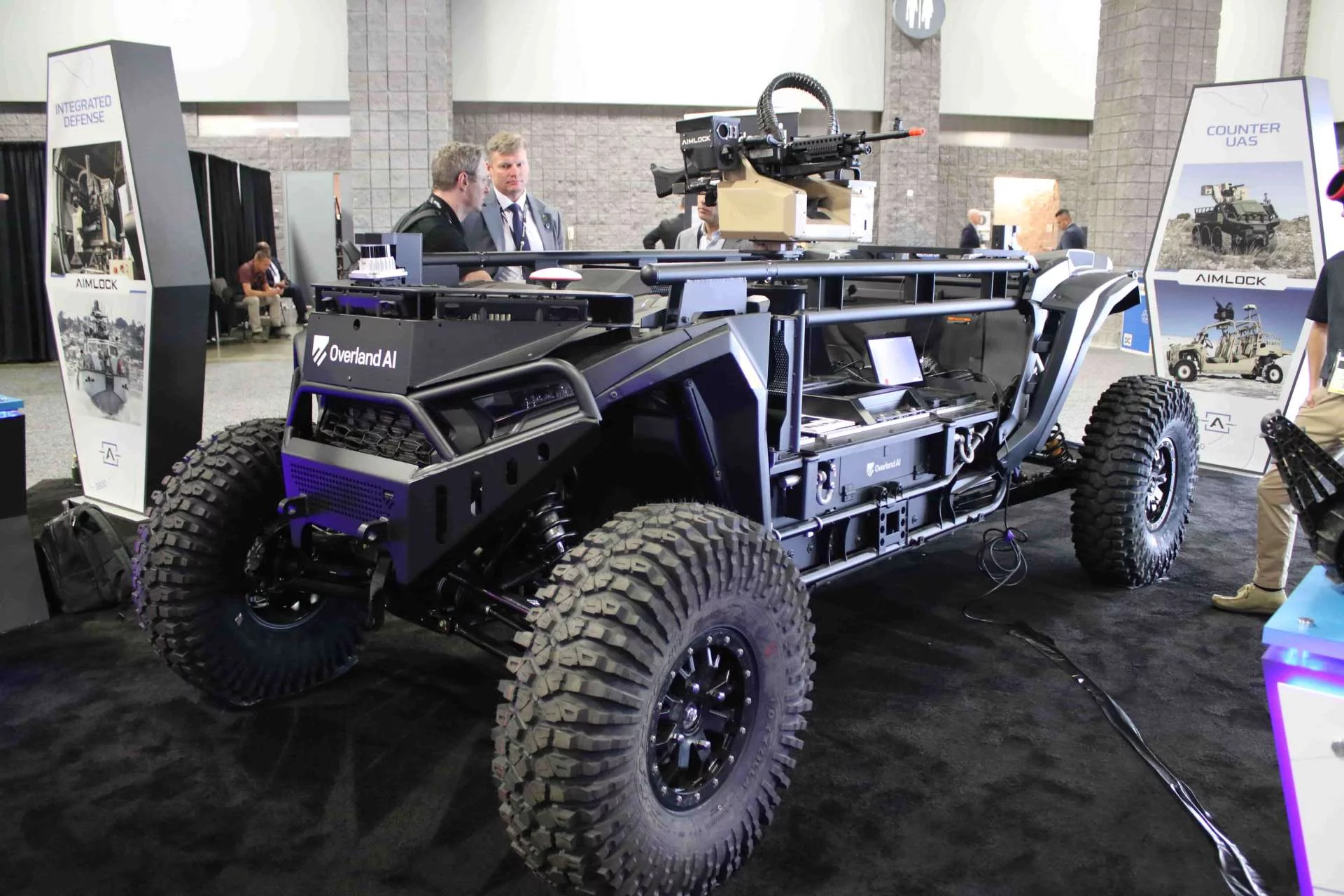
AimLock and Overland AI announced at AUSA 2025 a partnership that pairs AimLock’s autonomous targeting stack with Overland AI’s mission-ready unmanned ground vehicle. The effort focuses on delivering precision effects in GPS- and communications-denied environments while keeping humans firmly in control.
Platform Design And Hardware
The exhibited system appears as a rugged UGV built for broken ground: long-travel suspension, high ground clearance and oversized all-terrain tires. A stabilized weapon and sensor pod sits atop the chassis and contains optics, fire-control electronics and an autonomous slewing unit. Exposed interface rails, power distribution points and accessible payload bays underline a plug-and-play modular approach.
Software, Sensors And Effectors
AimLock supplies the Keystone Core Targeting Module (CTM) and a family of effectors (Spur, Rampart, Summit, Switchback, ROLS). CTM automates sensing, cueing and ballistic solutions while remaining compatible with multiple weapon classes. Overland AI contributes beyond-line-of-sight autonomy, mature mobility and perception stacks hardened against GPS denial and EW interference.
Human Oversight And Safety
The architecture retains a human-in-the-loop fire authority: the UGV can autonomously detect, track and prepare engagement solutions, but the final firing decision stays with an operator. This preserves accountability and adherence to rules of engagement while reducing operator workload.
Tactical And Operational Benefits
Deploying UGVs forward improves force survivability and allows rapid threat prosecution without exposing dismounted troops. A single chassis can assume counter-UAS, perimeter security, direct-fire, anti-armor strike or support-by-fire roles simply by swapping payloads — streamlining logistics, training and sustainment.
Technical Flexibility And Future-Proofing
Open interfaces and modular payload bays shorten integration timelines for new sensors or non-kinetic packages, making the platform adaptable to emerging threats. Both kinetic and non-kinetic payload options extend operational utility across mission sets.
Development Path And Testing
Development has advanced through iterative trials with U.S. stakeholders, validating autonomous mobility, perception and engagement flows in GPS-denied, EW-contested and complex-terrain scenarios. Parallel validation of target handoff, shot execution and recovery procedures has improved overall system reliability.
