

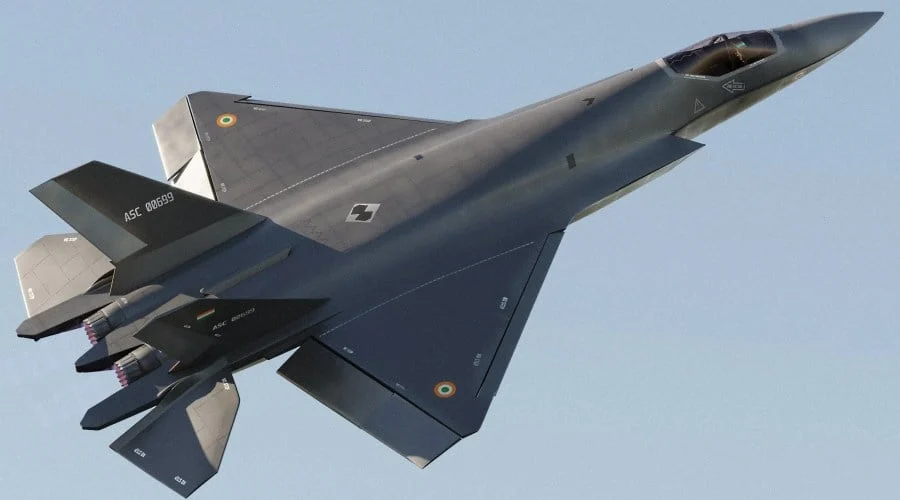
India’s Advanced Medium Combat Aircraft (AMCA) is not just another fighter jet project—it’s a defining leap toward reshaping the region’s aerial warfare landscape. Designed as a fifth-generation stealth platform with sixth-generation innovations, the AMCA embodies India’s ambitions to become a key player in cutting-edge military aviation by the mid-2030s.
Strategic Context: A Timely Response to Regional Power Shifts
The AMCA emerges amid growing military posturing in South Asia. With China deploying its J-20 stealth fighters near the Indian border and Pakistan reportedly on track to receive China’s J-35As by 2026, India faces a widening air power disparity. Compounding this is the IAF’s dwindling squadron strength—down to around 30 from the authorized 42.5.
The AMCA, developed in tandem with the Tejas Mk2, is India’s answer to this capability gap. It’s designed not only to restore balance but to tilt it in India’s favor through indigenous design, stealth, and intelligent systems integration.
Engineering Excellence: Design Built for Dominance
Weighing approximately 25 tons and powered by twin engines, the AMCA is a multirole stealth fighter tailored for air dominance, precision strike, SEAD missions, and electronic warfare. Its futuristic shape incorporates:
- Stealth Geometry: Diverterless supersonic inlets, twin-tail configuration, and extensive use of composite materials (up to 40%) contribute to reduced radar visibility.
- Radar Absorption: An internal weapons bay and radar-absorbent skin reduce cross-section from all angles.
- Spectral Camouflage: A standout feature is its planned use of IIT-Kanpur’s Anālakṣhya Meta-material Surface Cloaking System (MSCS), capable of masking the aircraft from synthetic aperture radar imaging.
Smarter Skies: The Role of Artificial Intelligence
What truly separates the AMCA is its next-level AI. The onboard “Electronic Pilot” system goes beyond automation—it offers tactical support, real-time decision-making, and multi-sensor fusion to enhance pilot situational awareness. Capable of autonomous flight functions such as takeoff, landing, and navigation, it also enables seamless manned-unmanned teaming (MUM-T) with drone swarms or loyal wingmen.
Armed and Indigenous: India’s Homegrown Arsenal
The AMCA will wield a suite of domestically developed weaponry, underlining the country’s drive for defence autonomy:
- Strike Capabilities: The aircraft will carry the BrahMos-NG—a compact, supersonic cruise missile reaching speeds over Mach 3.5 with a range of 290 km.
- Air Superiority: Astra Mk1, Mk2, and Mk3 beyond-visual-range missiles will provide engagement distances from 80 to 350 km.
- Suppression and Precision: Rudram anti-radiation missiles and precision-guided bombs support SEAD and ground operations.
- Future Enhancements: The AMCA is designed to integrate laser-based directed energy weapons in later variants, ensuring it evolves with future combat trends.
Phased Evolution and Indigenous Engine Dreams
The AMCA will be developed in two phases:
- MK-1 (2025–2035): Initial units will be powered by GE F414 engines, offering speeds beyond Mach 2 and limited supercruise. The first flight is slated for 2028–2029 with operational service expected by 2034–2035.
- MK-2 (2035–2040): The advanced variant will feature Indian-made engines (potentially co-developed with Safran or Rolls-Royce), pushing thrust to 110–130 kN, full supercruise, and advanced stealth.
Production and Industry Partnership Model
Marking a shift in procurement philosophy, the Indian Defence Ministry’s 2025 approval outlines an open industrial competition between public and private entities. HAL, TATA, L&T, and Adani Defence are expected to bid, bringing private sector agility into national defence manufacturing.
The selected partner must be capable of setting up end-to-end production lines, not just for domestic needs but also for export markets.
Investment Blueprint and Economic Impact
The AMCA is India’s most ambitious air combat project to date, with ₹15,000 crore ($1.8 billion) earmarked for initial development. Full-scale implementation is estimated to cost around $15 billion. Beyond its defence value, the program is expected to catalyze high-tech manufacturing, jobs, and innovation across India’s industrial ecosystem.
Where AMCA Stands Globally
Globally, the AMCA enters a battlefield dominated by platforms like the F-35 and Su-57. While the F-35 leads in network-centric warfare, AMCA prioritizes agility and indigenous weaponry. Compared to the Su-57, AMCA focuses more on stealth refinement and AI integration. China’s fighters remain largely unverifiable due to lack of public data.
Thanks to features like AI-assisted flight and MUM-T, the AMCA earns a “5.5-generation” label—bridging today’s fifth-gen standards with emerging sixth-gen tech.
A Vision Beyond the Horizon
More than a combat jet, the AMCA is a symbol of India’s technological rise and strategic independence. Once operational, it will place India in an elite circle alongside the U.S., Russia, and China—nations capable of designing and fielding fifth-generation fighters.
Its success could fundamentally shift the air power dynamic in South Asia, marking India’s transition from a buyer of defence systems to a creator of future warfare platforms.
