

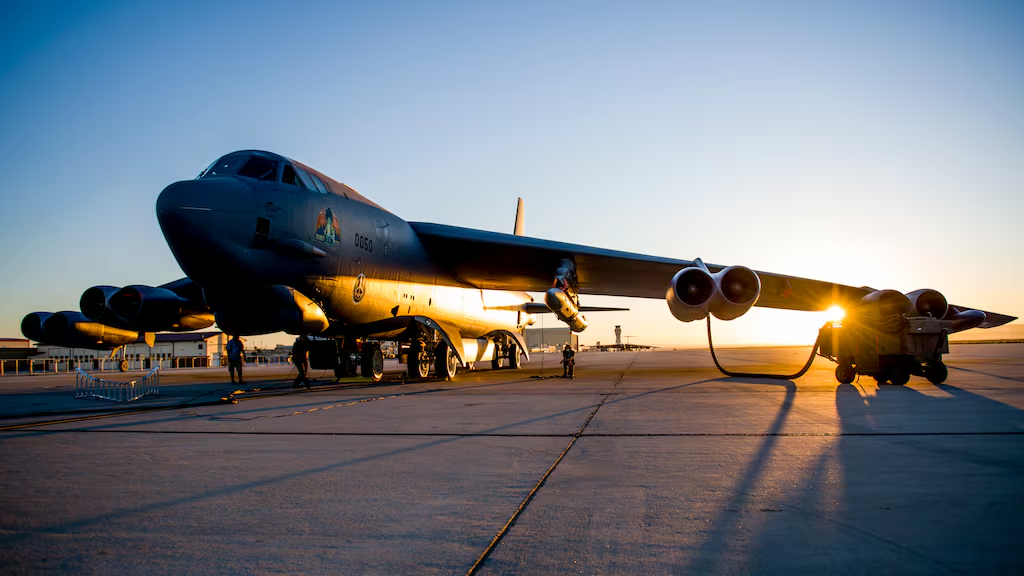
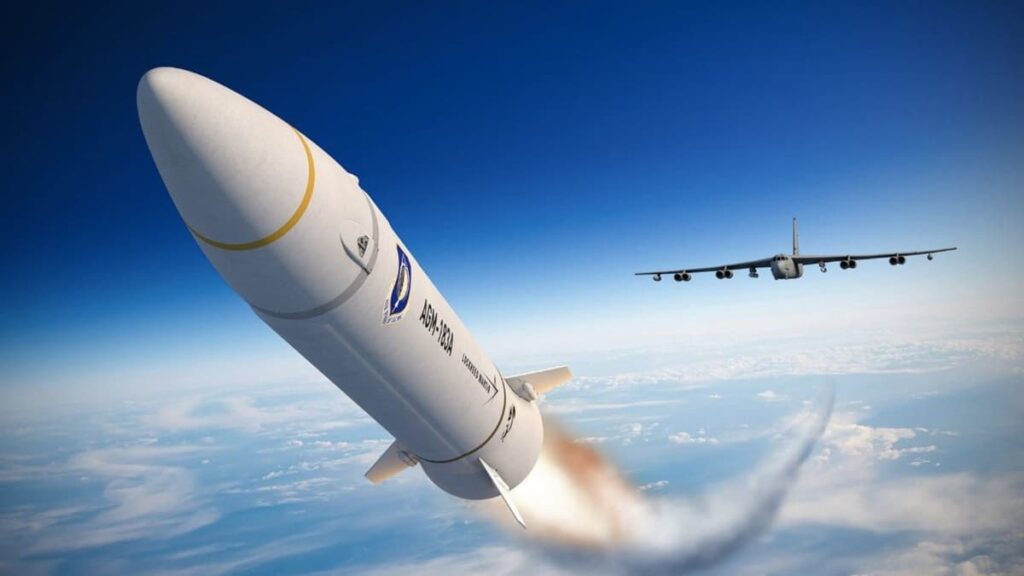
The U.S. Air Force is signaling renewed interest in its previously shelved hypersonic missile initiative—the AGM-183A Air-launched Rapid Response Weapon (ARRW)—with plans to potentially move it toward procurement.
During a House Armed Services Committee hearing last week, Air Force Chief of Staff Gen. David Allvin said the service’s fiscal year 2026 budget proposal includes funding for both ARRW and the Hypersonic Attack Cruise Missile (HACM).
“We are looking at — and have included in the budget submission, assuming it remains intact — two distinct hypersonic programs,” Allvin said. “One is a larger, strategic-range platform we’ve tested multiple times, known as ARRW. The other is HACM.”
Hypersonic weapons can fly at speeds exceeding Mach 5 and possess maneuverability during flight, making them significantly more difficult to intercept than traditional ballistic missiles. Their ability to evade missile defense systems has made them a strategic priority for global powers.
China and Russia have both heavily invested in hypersonic capabilities, with Moscow even employing such weapons in its war against Ukraine. These advancements have raised concerns among U.S. defense officials and lawmakers, prompting a push to accelerate domestic hypersonic development.
ARRW, developed by Lockheed Martin, was once a leading candidate to close the capability gap with adversaries. However, a series of failed flight tests in late 2022 and early 2023 cast doubt on the program’s future. In March 2023, then-assistant secretary of the Air Force for acquisition, Andrew Hunter, told Congress there were no plans to procure ARRW beyond its prototyping phase.
The Air Force’s fiscal 2025 budget request, released in March 2024, included no funding for ARRW’s procurement or continued development. The prototype phase concluded in 2024.
However, Gen. Allvin suggested last week that both ARRW and HACM are now being eyed for progression beyond research and development.
“We are accelerating not only the development of the technology but also the transition into procurement,” he said.
Echoing that sentiment, Assistant Secretary of the Air Force for Acquisition, Technology and Logistics, Troy Meink, emphasized the importance of affordability and scalability.
“It has to be cost-effective,” Meink said. “We need to be able to procure more than just a handful. The current priority is ramping up production while driving down unit cost to enable meaningful operational impact.”
