

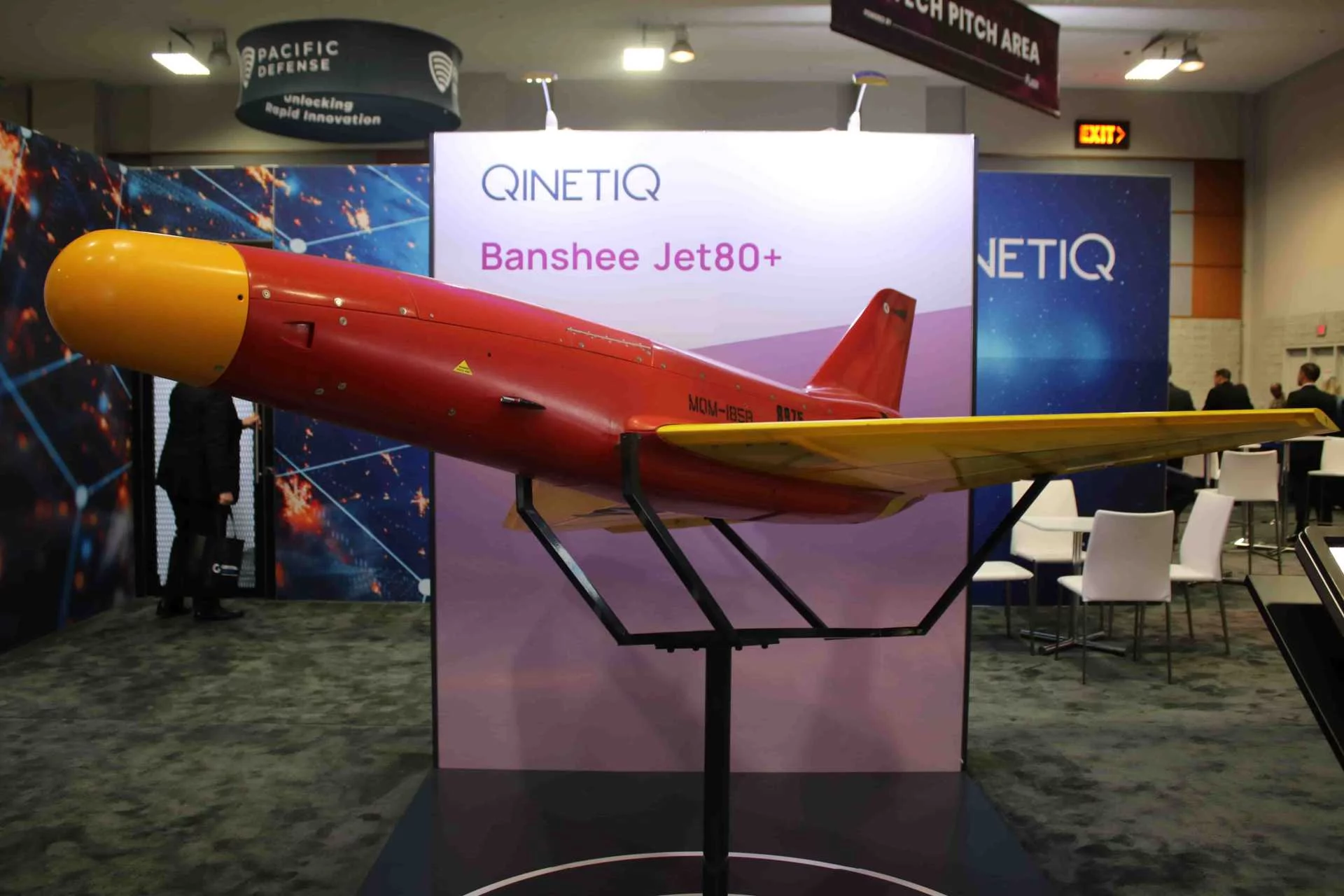
At the 2025 AUSA Defense Expo, QinetiQ unveiled the Banshee Jet 80+, a jet-powered target drone designed for surface and air defense training. The platform simulates cruise missiles and fast-jet threats while offering modular payloads and autonomous flight capabilities for versatile training scenarios.
Modular Design and Multi-Environment Operations
The Banshee Jet 80+ features a twin-turbine configuration with CASPA digital avionics. Its modular payload system allows rapid reconfiguration, and it can be launched from land or sea. This makes it suitable for a wide range of live-fire exercises and testing operations. The drone continues to support the U.S. Army and allied forces in system calibration and operational evaluation.
Performance and Technical Specifications
Powered by twin gas turbines generating approximately 45 kg of static thrust each, the Jet 80+ can reach speeds of up to 720 km/h in level flight. The platform measures 2.85–2.95 meters in length, 2.49 meters in wingspan, about 0.78 meters in height, and has a wing area of 2.42 m². Its operational range exceeds 100 km, and it can fly from 5 meters above sea level up to 9,144 meters. The drone is recoverable via parachute for repeated use.
Avionics and Payload Capacity
The CASPA avionics suite provides three-axis stabilization, an inertial measurement unit, and a digital autopilot. The drone supports autonomous waypoint navigation through GPS and digital telemetry. Payload options include smoke and infrared flares, radar augmentation modules, IFF transponders, and other mission-specific modules.
International Training and Usage
The Banshee series is integrated into NATO and allied training architectures. Special variants, like the MQM-185B, are used by the U.S. Army to evaluate short and medium-range MANPADs, long-range interceptors, and naval gun systems. The platform provides realistic threat emulation for training and system assessment.
Operational Applications and History
The Banshee family has been operated in over 40 countries, supporting tests with a wide range of air-to-air and surface-to-air weapons including Meteor, AMRAAM, AIM-9 Sidewinder, IRIS-T, MICA, Stinger, Mistral, ESSM, NASAMS, and Patriot systems. Some variants were reportedly supplied to Ukraine between 2023–2025 and adapted for offensive applications in real-world operations.
