

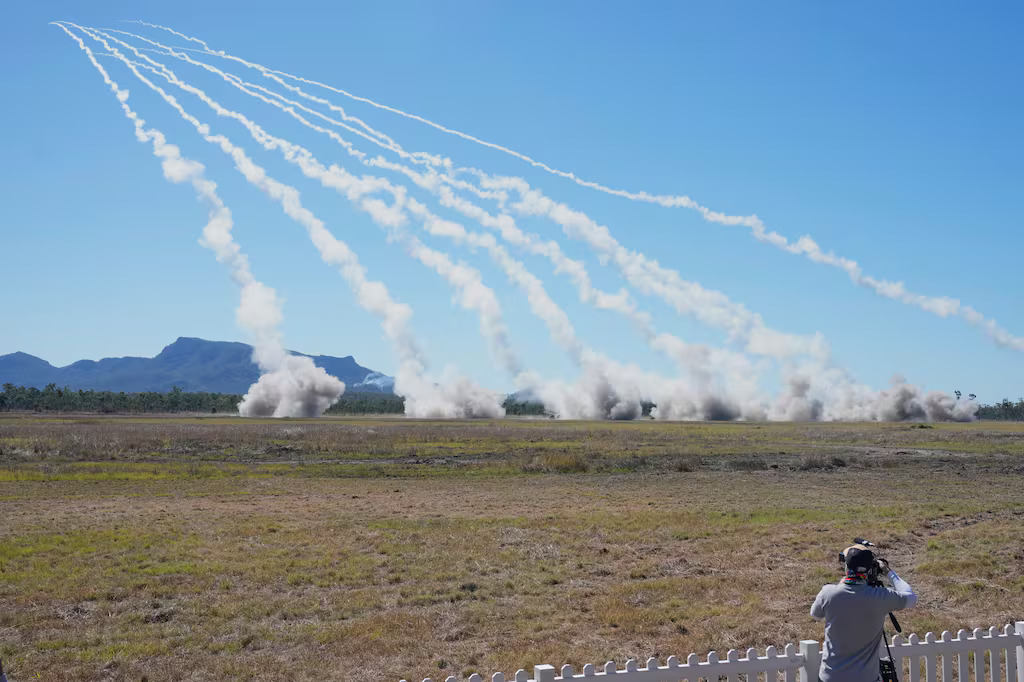
Australia has launched its most extensive military exercise to date — the 2025 iteration of Exercise Talisman Sabre, a major war simulation drawing attention both locally and abroad, including likely surveillance from Chinese naval intelligence vessels.
The live-fire drills began with a historic milestone: Australia’s first-ever launch of missiles from the M142 HIMARS (High Mobility Artillery Rocket System), newly acquired from the United States. The launch took place at the vast Shoalwater Bay Training Area in Queensland, a rugged expanse covering 1,700 square miles. Brigadier Nick Wilson described the moment as a “remarkable day” for the Australian Army, marking the operational debut of its long-range, multi-domain strike capabilities.
Since its inception in 2005 as a bilateral endeavor between the United States and Australia, Talisman Sabre has evolved into a vast multinational undertaking. This year’s edition includes over 35,000 troops from 19 countries, ranging from regional allies like Japan and South Korea to European partners such as France, the UK, and Germany. Observers from Malaysia and Vietnam are also in attendance, reflecting the growing strategic relevance of the Indo-Pacific.
Notably, this is the first time the exercise is being partially held outside Australia, with some activities taking place in Papua New Guinea, reinforcing Australia’s defense outreach in the Pacific.
Chinese intelligence ships have consistently monitored previous Talisman Sabre exercises, and Australian officials anticipate similar surveillance this year. “The Chinese military have observed these drills since 2017. It would be unusual if they didn’t,” said Defense Industry Minister Pat Conroy. While no Chinese vessels had been spotted shadowing operations as of Sunday, Conroy confirmed Australia would adapt accordingly, both in monitoring Chinese presence and adjusting its own exercise conduct.
The drills officially commenced on Sunday with a formal ceremony in Sydney, attended by U.S. Army Pacific’s Deputy Commanding General Lt. Gen. J.B. Vowell and Australia’s Vice Admiral Justin Jones, Chief of Joint Operations. The timing coincided with Prime Minister Anthony Albanese’s six-day diplomatic visit to China, including an expected meeting with President Xi Jinping in Beijing — their fourth face-to-face encounter.
Asked whether he would raise concerns about Chinese surveillance during his trip, Albanese downplayed the matter, calling it routine. “That would be nothing unusual… I’ll continue to assert Australia’s national interest, as I do,” he said while speaking in Shanghai.
Albanese also addressed domestic criticism regarding his limited in-person engagement with U.S. leadership, noting he had visited the U.S. five times but only traveled to China twice. Despite lacking a meeting with former President Donald Trump, he emphasized ongoing communication: “We’ve had three constructive phone conversations, and I look forward to a productive relationship.”
With live-fire capability demonstrations, growing multinational cooperation, and geopolitical undercurrents in the background, Talisman Sabre 2025 is shaping up to be not just a military milestone, but a focal point of Indo-Pacific strategy.
