

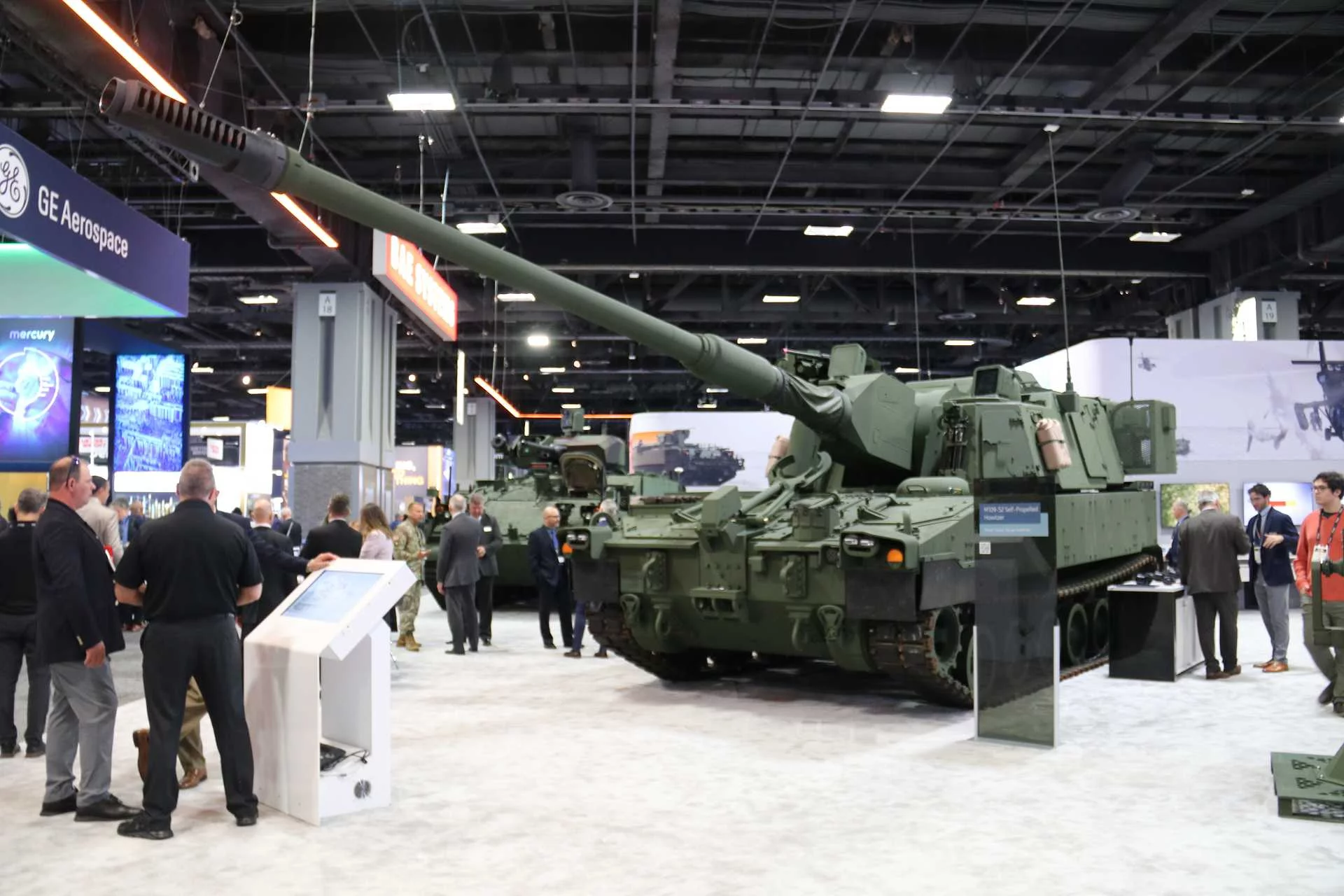
At AUSA 2025, BAE Systems introduced the M109A7 52-caliber self-propelled howitzer, a next-generation upgrade designed to extend the U.S. Army’s long-range artillery capabilities. The system integrates the Rheinmetall 155mm L52 cannon onto the proven M109A7 Paladin tracked chassis, offering a significant boost in range and rate of fire without compromising fleet compatibility.
Developed as a rapid-response solution following the halt of the ERCA program, the M109A7 52-caliber aims to close the Army’s long-range fires gap through practical innovation rather than experimental risk. It maintains the Paladin’s advanced digital fire control, electric gun drive, and power systems, while introducing a barrel that nearly doubles effective range — over 30 km with standard rounds and up to 60 km with rocket-assisted projectiles.
The project is being conducted under a Cooperative Research and Development Agreement (CRADA) with the U.S. Army Combat Capabilities Development Command Armaments Center (DEVCOM-AC). Successful live-fire tests at Camp Ripley, Minnesota, confirmed seamless integration between the Rheinmetall L52 gun and the M109A7’s existing turret and recoil systems.
By pairing battle-proven U.S. hardware with a NATO-standard cannon, BAE Systems takes a low-risk, high-return approach that aligns with the Army’s new modernization philosophy: focusing on incremental, achievable advancements rather than high-risk revolutionary programs. The adoption of the L52, already in frontline service with systems like the PzH 2000 and Archer, underscores growing interoperability across allied forces.
Still, questions remain about sustainability and automation. The prototype currently relies on manual loading, and long-term barrel wear under sustained fire is yet to be evaluated. Integration with the Army’s networked targeting and sensor systems will be key to achieving full operational potential.
In essence, the M109A7 52-caliber is not a revolution but a strategic bridge — enhancing range, reliability, and coalition interoperability while setting the stage for future precision systems. It may well be the pragmatic modernization step the U.S. Army needs right now: more range, more readiness, and less risk.
